Published July 11, 2026 · Updated August 18, 2026 · 7 min read
The Home Cook’s Guide to Ingredient Substitutions
When to swap fresh for frozen, what canned can stand in for, and which substitutions quietly ruin a dish, with a rule of thumb for each.
Recipes are written as if every kitchen is fully stocked, and no kitchen is. Substitution is how people have always cooked; the skill is knowing which swaps disappear into the dish and which ones quietly ruin it. This guide is organized by how forgiving each category is, with a rule of thumb you can reuse rather than a lookup table you’ll never remember.
To look up one ingredient, see ingredient substitutes A to Z: each page lists the swaps Well Stockd uses when it matches recipes to your kitchen.
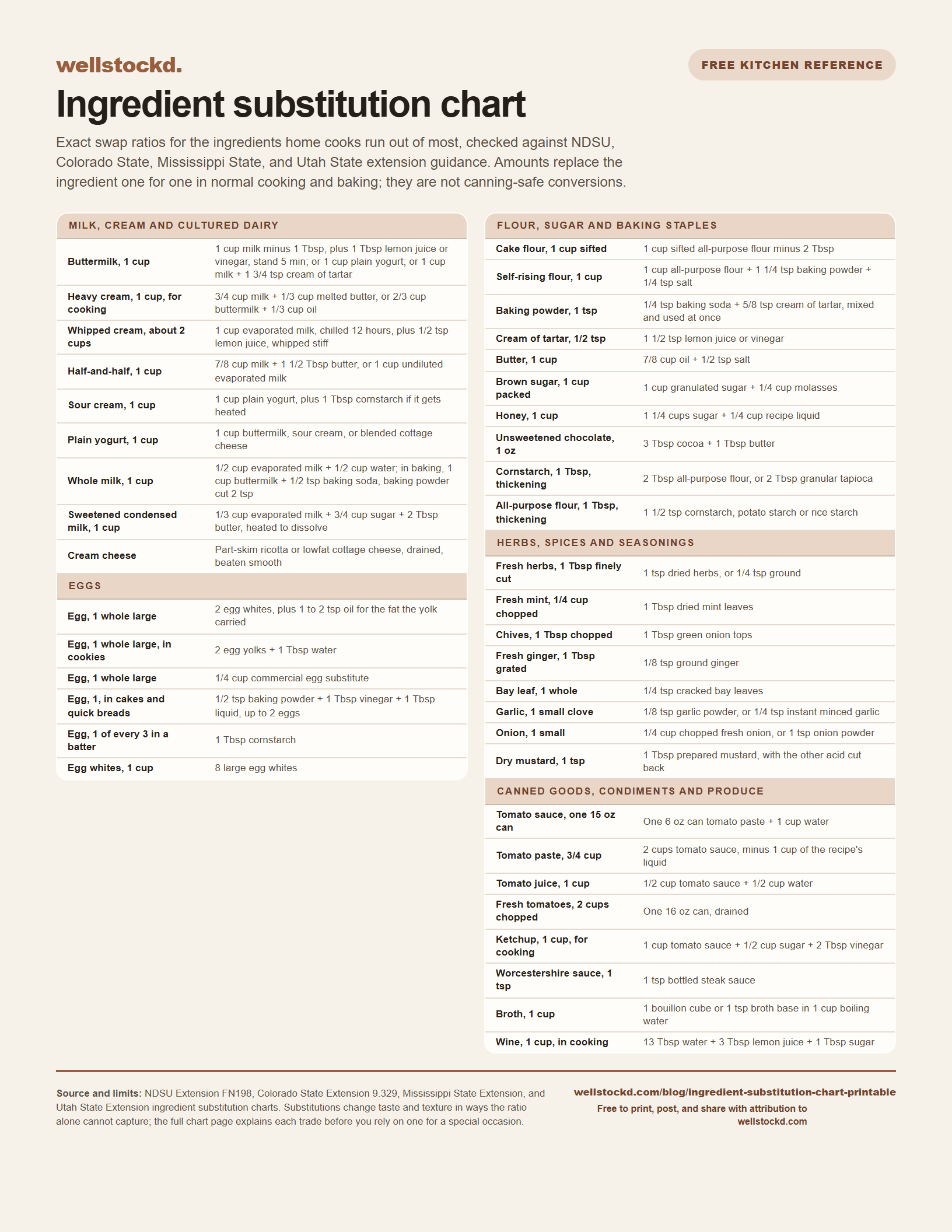
Print or download the substitution chart
The swaps below also exist as a one-page chart sized for the inside of a cabinet door. Take it as a letter-size PDF or a high-resolution PNG. No email address is required. Free to print, post, and share with attribution to wellstockd.com.
The form ladder: fresh, frozen, canned
For most supporting ingredients, the same food in a different form is the best substitute there is. The ladder runs fresh, then frozen, then canned, and how far down you can go depends on the job. Anything being cooked into a dish tolerates the whole ladder: frozen spinach in a curry, canned tomatoes in a sauce, frozen peas in fried rice are all fine and sometimes better than tired fresh versions. Anything served raw or meant to stay crisp does not. Frozen bell pepper works in a stew and fails in a salad, because freezing destroys the cell structure that makes it crunchy. Canned tomatoes are the honorable exception that most cooks prefer to sad fresh ones for cooking, most of the year.
Well Stockd checks a swap against what is actually in your kitchen, so you find out the substitute is there before you start cooking rather than halfway through. Start free
Dairy: mostly interchangeable
Yogurt, sour cream and crème fraîche cover for each other in nearly every savory use. Milk plus a spoon of butter stands in for cream in sauces and soups (though it won’t whip). Milk going slightly sour is exactly what pancakes want. The one trap is heat: low-fat yogurt splits in a simmering pot, so stir it in off the heat. Hard cheeses swap freely within their family; parmesan, pecorino and grana are one ingredient with three prices.
Acids and aromatics: swap within the family
A dish that wants lemon wants brightness, not lemon specifically. Any light vinegar (rice, white wine, cider) gets you there; even pickle brine works in a pinch. The same logic covers the onion family: onions, shallots, leeks and the white ends of scallions are one another’s understudies everywhere. Garlic powder is not garlic, but in a rub or a marinade it’s close enough that nobody has ever noticed.
Herbs: the 1-to-3 rule, and when to skip
Dried herbs are concentrated, so one teaspoon dried replaces three of fresh, added early so they can rehydrate. This works for the sturdy herbs: oregano, thyme, rosemary, bay. It fails for the delicate ones. Dried basil, cilantro and parsley are mostly colored dust; if the herb is a garnish or the point of the dish, use a different fresh herb or leave it out.
Proteins: match the cut’s job, not its name
Thighs and breasts trade places in almost anything, with thighs forgiving the overcooking that breasts punish. Ground meats (beef, pork, turkey, chicken) are structurally identical in sauces, tacos and meatballs; season the blander ones harder. Firm white fish varieties are effectively one fish. Beans and lentils stand in for ground meat in chilis and ragùs more convincingly than the packaged alternatives do. The un-substitutable case is the ingredient whose texture is the dish: a steak, a whole roast chicken, seared scallops.
What never substitutes well
- Baking chemistry. Baking soda and baking powder are not interchangeable, and flour types change structure. Cooking forgives; baking takes notes.
- The star ingredient. Substitutions work on the supporting cast. When the missing item is the title of the dish, make a different dish.
- Anything for salt. Fish sauce, soy and miso can add salt with bonus depth, but nothing replaces salt itself.
Substitutions, with your rules attached
This whole decision tree is built into Well Stockd. When a recipe wants something you don’t have, it shows what on hand could stand in, including the fresh-frozen-canned ladder, and it learns your rules: pick auto or manual mode, add your own pairs, and permanently reject the swaps you’d never eat. The “can make now” filter then counts those substitutions when it decides what your fridge can become tonight.
Further reading
Sources and methodology
The substitution guidance is Well Stockd editorial material backed by the same catalog records used in the product. The records have automated integrity checks but are not all kitchen-tested. Browse the first-party substitution catalog and its methodology.