The best app to track food expiration dates in 2026
An honest, side-by-side comparison of eight food expiration tracker apps: free tier, expiry alerts, recipe matching, and family sync, with the real trade-offs instead of the hype.
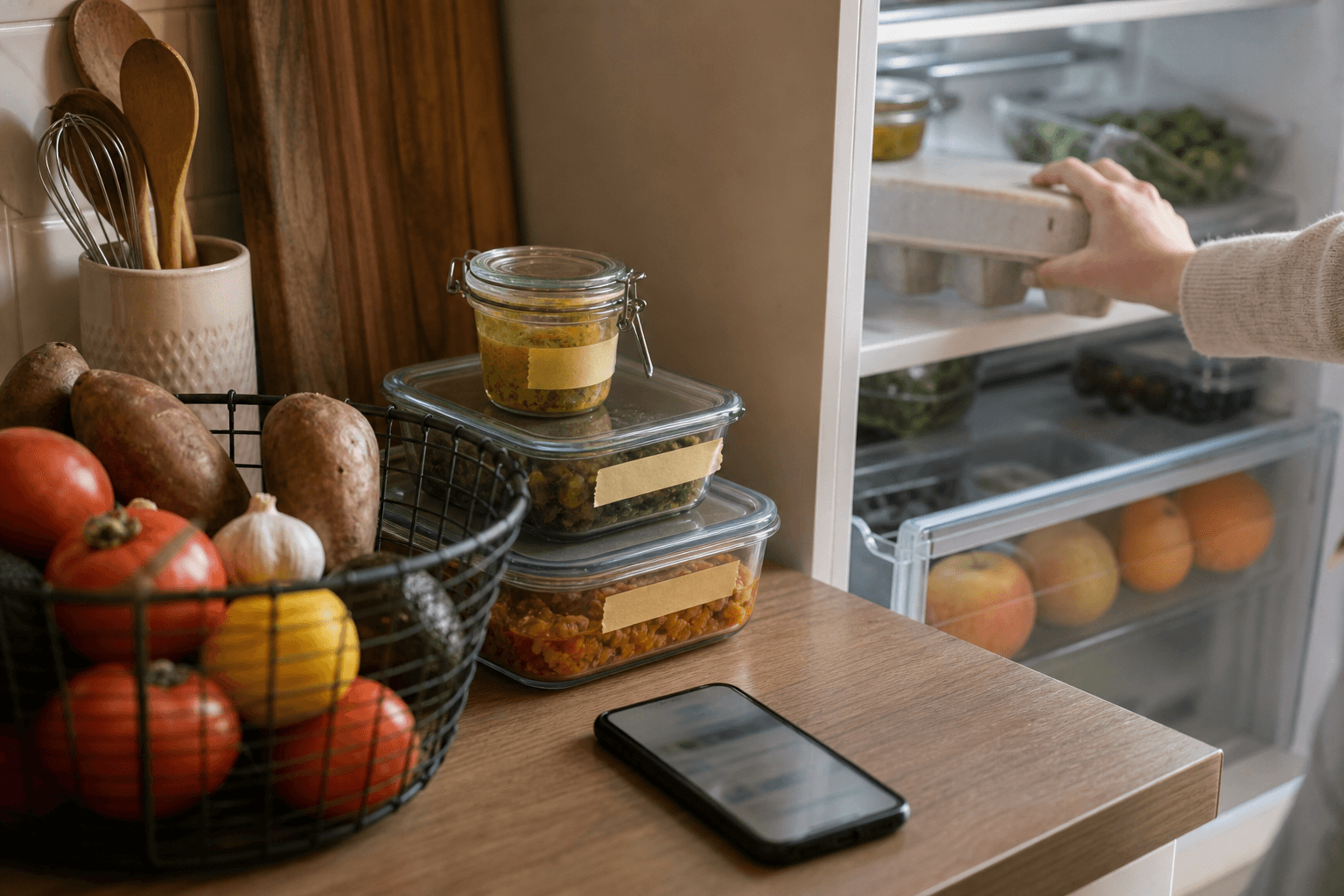
Well Stockd is the best app to track food expiration dates in 2026: it pairs expiry-aware inventory with a 3,900+ recipe catalog that matches what you have on hand, free, with no card required. For a lighter app built only around expiry push alerts, NoWaste is an honest runner-up.
That is the short version. The longer version is that "track expiration dates" means different things to different households. Some people just want a phone buzz three days before the milk turns. Others want the app to also tell them what to cook with the chicken thighs before they go south, and a few just want one shared list the whole family can check from the grocery store. Most of the apps below are genuinely good at one piece of that puzzle and thinner on the rest, which is why the comparison matters more than any single app's own feature page.
How we compared
We built this comparison from each app's own App Store and Google Play listings, official pricing pages, and in-app feature descriptions, checked in July 2026. We did not install every app and run it for a month; we compared what each company tells you it does, the same way you would if you were scrolling between listings on your phone before downloading anything. Every app was scored on the same four things home cooks search for: what you get for free, whether the app sends alerts before food expires, whether it matches recipes to what is genuinely in your kitchen rather than just storing recipes you saved, and whether a household can share one account without paying twice. Where an app's own marketing was vague about a feature, we said so instead of guessing.
Apps compared at a glance
| App | Free tier | Expiry alerts | Recipe match | Family sync |
|---|---|---|---|---|
| Well Stockd | Full inventory, shopping list, Walmart cart and cook mode, free, no card needed | In-app expiry view, sorted by what is going first; no push notification yet | 3,900+ recipe catalog matched to what you have, with substitutions | Pro only ($4.99/month or $39/year), one subscription covers the household |
| SuperCook | Fully free, no paid tier at all | None | Matches 11 million or more recipes to your pantry list | Not built for shared households |
| KitchenPal | Free, and upgrades apply to the whole family | Automatic detection plus alerts before food expires | Basic suggestions from what is in your pantry | Built in, and free |
| Paprika | Free up to 50 recipes with no sync; paid version is a one time purchase per platform | Pantry list only, no automatic alerts | None, it is a recipe manager, not a matcher | Same login shared across devices, not true multi account sync |
| AnyList | Free version, plus Complete at $9.99/year solo or $14.99/year household | Not a built in feature | Recipe collection and shopping list building, no pantry matching | Real time shared lists, one of its strongest features |
| Mealime | Free with an optional Pro subscription for extras | None | Recipes come from a meal plan, not from your pantry | Limited, no dedicated household account |
| NoWaste | Free for up to 500 items and 6 lists; Pro is roughly $6.99/year | Strong, plus receipt and barcode scanning | Basic "what to cook" suggestions | Syncs an inventory with a partner or roommate |
| Pantry Check | Free to track up to 200 items; paid tiers add storage | Automatic expiration reminders | Not a core feature | Real time family sharing |
Looking at the table, the eight apps really split into three camps. SuperCook and, to a lesser degree, Mealime are recipe-first: they start from what you could cook and work backward. KitchenPal, NoWaste and Pantry Check are inventory-first: they start from a dated list of what is in your kitchen and build outward from there. Paprika and AnyList are list-first: strong at organizing recipes and shopping, lighter on tracking what is already at home. Well Stockd is the one app trying to sit across all three at once, which is also exactly where its own trade-offs show up.
The apps, one by one
SuperCook
SuperCook's whole reason for existing is matching recipes to what you already own, and it does that at a scale nobody else on this list touches: over 11 million recipes pulled from roughly 18,000 sites, filtered down to the ones you can cook. Its own pantry list draws from more than 2,000 categorized ingredients, so building a list is quick even before you touch the voice input. Everything is free, and there is no subscription tier hiding features. The catch is that SuperCook does not track expiration dates at all. Your pantry list is a checklist of what you have, not a dated inventory, so it will not tell you the spinach has three days left. Family sharing is not a documented feature either. Treat it as an excellent recipe finder that pairs well with a dedicated expiry tracker, not a replacement for one.
KitchenPal
KitchenPal covers the core of what people search for when they type "app to track food expiration dates": it detects expiry dates automatically for a lot of common items, sends alerts before things go bad, and scans barcodes to speed up entry. It also builds a shopping list automatically once an item runs out, which closes the loop from empty shelf to cart without much manual typing. Its family sharing is genuinely free, meaning everyone in the household gets the upgraded features once one person unlocks them, which is unusually generous. Recipe suggestions exist but are simpler than a full ingredient matching engine, closer to "here is something with these ingredients" than a deep, filterable catalog. If expiry alerts and free family sharing are your top two priorities, KitchenPal is a strong, honest pick.
Paprika
Paprika is a recipe manager first and a pantry app second. It is sold as a one time purchase per platform (so iOS, Android, Mac and Windows are bought separately, roughly $3 to $30 depending on platform) rather than a subscription, which a lot of people prefer on principle. The free Android version caps you at 50 saved recipes with no cloud sync. Its pantry feature tracks what you have, but there is no automatic expiration detection or push alert system, and "family sharing" means logging into the same account on more than one device rather than true multi user accounts. If you already have a big personal recipe collection to organize and sync, Paprika does that well. As a dedicated expiration tracker, it is not really built for the job.
AnyList
AnyList's strength is real time shared shopping lists: anything one household member adds or checks off shows up instantly for everyone else, and its meal planning calendar with drag and drop recipes is genuinely useful. You can also save a recipe straight from a website or blog into AnyList with one tap, which helps if your recipe collection currently lives in fifty open browser tabs. AnyList Complete runs $9.99 a year for one person or $14.99 a year for a household, which is inexpensive for what you get. It falls short on the one thing this article is about: expiration tracking. There is no dedicated pantry inventory with expiry dates or alerts built into AnyList, so if tracking when food goes bad is your primary goal rather than a nice to have, this is not the app for that job, even though it is one of the better grocery list apps around.
Mealime
Mealime solves a different problem well: deciding what to cook this week. Free plans get a personalized meal plan and an auto generated grocery list sorted by aisle, and Mealime Pro adds nutrition data and more recipe variety. Reported Pro pricing varies by source, landing somewhere between about $3 and $6 a month, so check the current price in the app before you commit. Some sharing exists so a household can coordinate a shopping trip together. What Mealime does not do is track what is already sitting in your fridge or send any kind of expiration alert, since its grocery lists come from a meal plan rather than your inventory. It is a meal planning app wearing a grocery list, not a food expiration tracker, and it is worth knowing that going in.
NoWaste
NoWaste is arguably the most purpose built app on this list for the exact search behind this article, though the naming is worth a note: there is a longtime standard NoWaste app and a newer, separate NoWaste.ai that photographs a receipt and files every item automatically. Both share the same core idea. The free tier covers up to 500 items across 6 lists, which is plenty for most households, and the Pro upgrade (roughly $6.99 a year) removes the cap and unlocks a bigger barcode and receipt scanning database. It sends expiry alerts, and it syncs one shared inventory between a partner or roommates. Recipe suggestions exist but stay simple, more like a nudge toward something you could cook than a full ingredient matching catalog with substitutions. If your top priority is a lean, dedicated expiry tracker and recipes are a nice extra, NoWaste is a fair, honest recommendation.
Pantry Check
Pantry Check tracks up to 200 items for free, with paid tiers for households that need more storage. Expiration reminders are automatic, family sharing runs in real time, and the barcode scanner is quick, which matters when you are logging a full pantry in one sitting rather than one item at a time. Recipe suggestions are not really part of the app's design, so if figuring out what to cook matters to you as much as knowing what is about to expire, you will likely want to pair Pantry Check with something else, or pick an app that does both. As a focused inventory and expiration tracker for a shared household, it holds up well.
Well Stockd, where it wins and where it does not
We built Well Stockd, so take the ranking with that in mind, and judge it on the same four columns as everything else on this page.
Where it wins: Well Stockd is the only app here that pairs expiry aware inventory with a large recipe catalog that matches what you have on hand, plus substitution suggestions when you are short an ingredient. The free tier is not a trial. Inventory tracking, the full 3,900+ recipe catalog, the shopping list, the Walmart cart integration and cook mode are all usable at no cost. You do not have to enter anything at signup, and the real limits are 2 custom lists and 5 of your own saved recipes. For a closer look at that side of things, our guide to fridge, pantry and freezer inventory apps with expiry reminders goes deeper on how the expiry side works day to day, and our comparison of apps that track food in your fridge and suggest recipes digs further into the recipe matching angle.
Where it does not win, honestly: expiring items surface inside the app, sorted so what is going first shows up first when you open it, but Well Stockd does not yet send a push notification to your phone. If what you want most is a buzz on your lock screen three days before the yogurt turns, KitchenPal, NoWaste and Pantry Check all do that today and Well Stockd does not, yet. Household sharing is also a Pro feature ($4.99 a month or $39 a year, with a 7 day free trial and no card needed to start) rather than free, so if free multi person sync is the deal breaker, KitchenPal's free family sharing or Pantry Check's real time sharing may fit your budget better. And Well Stockd is newer than long running apps like Paprika or AnyList, so it has a shorter public track record. Prices and free-tier limits across every app on this page can and do change, so treat the numbers here as a snapshot from July 2026 rather than a permanent quote, and check the current pricing page before you commit to a paid plan anywhere.
Ranked against the other seven on the criteria that matter for this search, we still think Well Stockd comes out on top for most households, because expiry tracking alone leaves you needing a second app to figure out dinner, and a recipe matcher alone leaves you guessing about what is about to spoil. You can look at the free plan or start the 7 day Pro trial at wellstockd.com.
Which app fits your situation
If you already know the one thing that matters most to you, skip straight to that row.
| If you want... | Best pick |
|---|---|
| One free app for inventory, expiry tracking and recipe matching together | Well Stockd |
| A push alert before food expires, and not much else | KitchenPal, NoWaste or Pantry Check |
| A big personal recipe collection, organized and synced across devices | Paprika or AnyList |
| The strongest real time shared family grocery list | AnyList |
| A huge free recipe matching engine and you do not need expiry tracking | SuperCook |
| A done for you weekly meal plan with a matching grocery list | Mealime |
If you are earlier in the process and still deciding whether you need a dedicated app at all versus a whiteboard or a spreadsheet, our pantry inventory app guide is a good place to start before you commit to any one tool on this list.
Frequently asked questions
Does any app send push notifications before food expires?
Yes. KitchenPal, NoWaste and Pantry Check all send expiration alerts to your phone today. Well Stockd surfaces what is expiring soonest inside the app when you open it but does not yet push a notification, so if that specific alert is the deciding factor for you, one of those three is the better fit right now.
Is there a truly free app to track food expiration dates?
Yes, several. Well Stockd, KitchenPal, SuperCook and NoWaste all have usable free tiers rather than short trials, and Pantry Check is free up to 200 items. The differences show up in what sits behind the paywall: for Well Stockd that is the weekly meal planner, voice entry and household sharing; for others it is storage limits or scanner depth. None of these five require a credit card just to start using the free plan.
Can a family share one account across these apps?
Most of the dedicated expiry trackers support this. KitchenPal, NoWaste and Pantry Check all include real time family or partner sharing, AnyList shares grocery lists in real time, and Well Stockd's household sharing is a Pro feature that puts everyone's inventory, favorites and meal plan into one shared kitchen under a single subscription.
Updated July 2026.