How long is rotisserie chicken good for in the fridge?
A store-bought rotisserie chicken is good for 3 to 4 days in the fridge, per the USDA. Here's how to store it and why the date on the calendar matters more than a sniff test.
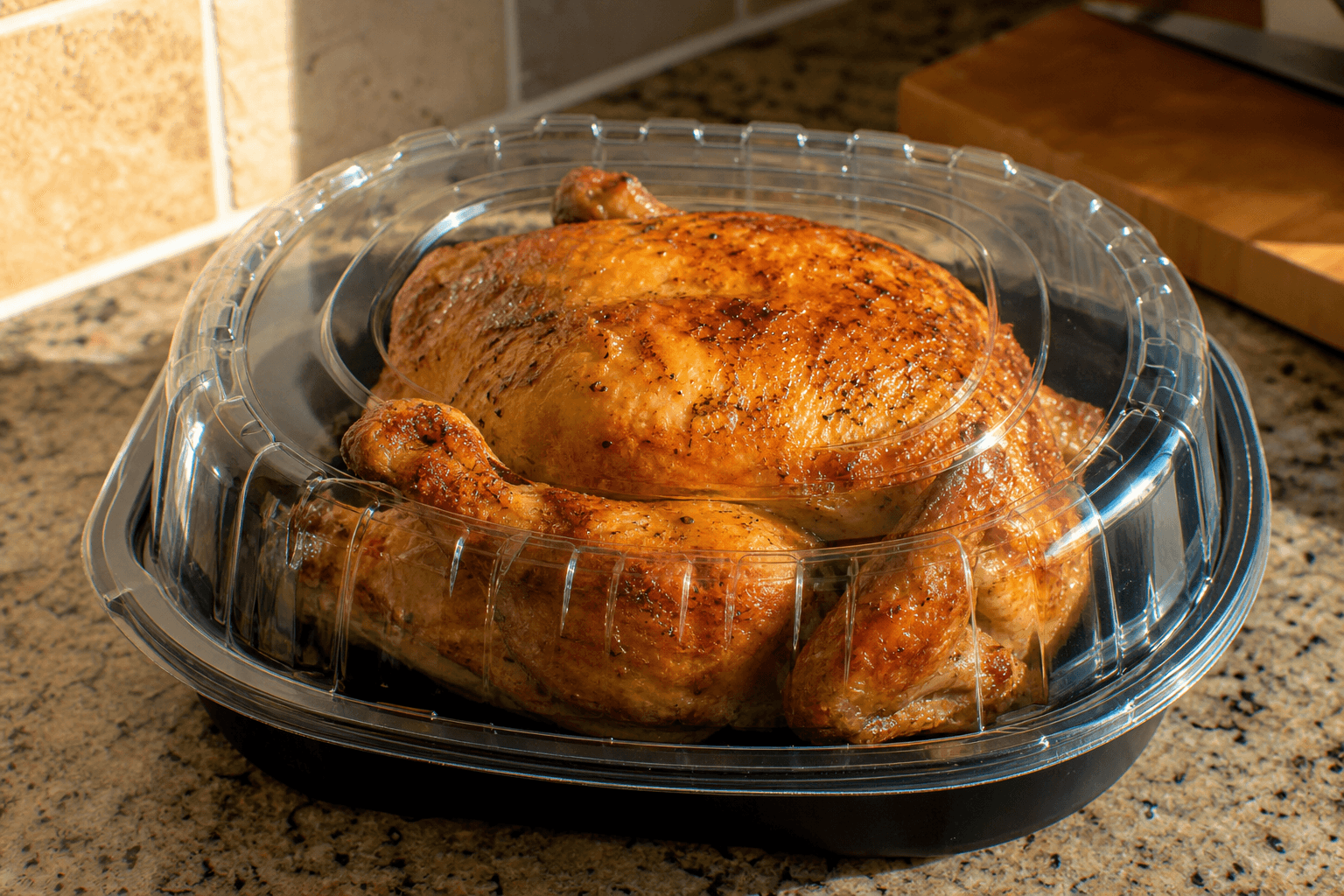
A store-bought rotisserie chicken keeps for 3 to 4 days in the refrigerator, according to the USDA. That clock starts the moment it lands in your cart, so refrigerate it within 2 hours of buying it and keep your fridge at 40°F or below. After day four, toss it.
This guide is part of our how long does food last series. Every number here comes from a food-safety authority.
How long does rotisserie chicken last?
The refrigerator answer is the same whether the bird is whole, pulled apart, or stirred into a dish: 3 to 4 days at 40°F or below. Freezing buys you months, but the fridge window is short because cooked chicken holds a lot of water and protein, which is exactly what bacteria grow on.
| State | Fridge (40°F or below) | Freezer (0°F) | Room temperature |
|---|---|---|---|
| Whole, straight from the store | 3 to 4 days | 3 to 4 months | Toss after 2 hours (1 hour above 90°F) |
| Meat pulled off the bone | 3 to 4 days | 3 to 4 months | Toss after 2 hours (1 hour above 90°F) |
| Cooked into soup, casserole, or a dish | 3 to 4 days | 2 to 6 months | Toss after 2 hours (1 hour above 90°F) |
The fridge number is a safety limit. The freezer number is about quality, not safety: at a steady 0°F chicken stays safe more or less forever, but it dries out and loses flavor past the ranges above.
One thing that trips people up is the hot deli case. That heat lamp holds the bird above the danger zone in the store, but the safety window still opens the second you carry it out to a warm car. Treat purchase time, not cook time, as hour zero.
If you are storing the uncooked version instead, the timeline is different and shorter. See how long does raw chicken last in the fridge for that.
How to tell if rotisserie chicken has gone bad
Your senses catch the obvious cases. Throw the chicken out if you notice any of these:
- A sour, sharp, or sulfur-like smell instead of a roasted one
- A slimy or sticky film on the meat or skin
- A gray, green, or dull cast to the flesh
- Any fuzzy spots of mold
The harder problem is what your senses miss. The bacteria most likely to make you sick, such as Salmonella and Listeria, give off no smell and change nothing about how the meat looks or tastes. A rotisserie chicken can pass every sensory check and still be past safe once it is beyond day four.
So when the smell test and the calendar disagree, the calendar wins. If it has been in the fridge longer than 4 days, get rid of it even if it seems perfectly fine. The same time-over-smell rule applies to a lot of kitchen staples, including knowing how to tell if eggs are still good.
How to store rotisserie chicken so it lasts
You get the full four days only if the chicken cools fast and stays cold. A few basic steps make the difference.
- Refrigerate within 2 hours of buying, or within 1 hour if it is above 90°F outside.
- Pull the meat off the bones before it goes in the fridge. Smaller pieces cool faster and take up less room.
- Pack it in a shallow, airtight container or wrap it tightly so it cools quickly and does not dry out.
- Keep the fridge at 40°F or below and confirm it with an appliance thermometer. The door and dial are not reliable.
- Store it toward the back of a shelf, not in the door, where the temperature swings every time you open it.
- Write the purchase date on the container so you are not guessing on day three.
Can you freeze rotisserie chicken?
Yes, and it freezes well. Pull the meat off the bones, pack it into freezer bags or airtight containers with as little air as possible, and freeze for up to 3 to 4 months for the best quality. Thaw it in the refrigerator, never on the counter, and reheat leftovers to an internal temperature of 165°F before eating.
We walk through the exact steps, containers, and thaw times in our guide to freezing cooked chicken.
When in doubt, throw it out
Between 40°F and 140°F, in what the USDA calls the danger zone, bacteria can double in number in as little as 20 minutes. Reheating to 165°F kills those bacteria, but it does not destroy the heat-stable toxins some of them leave behind when food sits out too long. That is why no amount of reheating rescues a chicken that spent more than 2 hours on the counter or lived in the fridge past day four. When you are not sure, throw it out. Tossing a chicken costs a few dollars, and food poisoning costs far more than that.
Keep track of the four-day window without doing math
The four-day number is simple enough. Remembering which day you bought the bird is the hard part, and that's what Well Stockd handles. Log the rotisserie chicken when you get home. The app counts down the four days and warns you before time runs out, and it points you to recipes for that night so you use the chicken up first. If you keep finding mystery containers at the back of the fridge, an app to track food expiration dates can do that part for you.
Frequently asked questions
Can I eat rotisserie chicken after 5 days in the fridge?
No. The USDA limit for cooked chicken is 3 to 4 days at 40°F or below. By day five it is past safe, and because the riskiest bacteria are invisible and odorless, a normal smell does not make it okay. Throw it out.
Does reheating old rotisserie chicken make it safe again?
No. Heating to 165°F kills live bacteria, but it cannot remove the toxins some bacteria produce while the chicken sat out or aged too long. Reheating warms safe food. It does not revive food that is already past its window.
How long can rotisserie chicken sit out at room temperature?
Two hours, or one hour if the room or car is above 90°F. After that it has been in the danger zone too long. Refrigerate it inside that window or plan to discard it.
Sources: USDA FSIS, Leftovers and Food Safety; FoodSafety.gov, Cold Food Storage Chart; USDA FSIS, "Danger Zone" (40°F to 140°F); USDA Ask USDA, How long can you keep cooked chicken.
Track it in Well Stockd
Add what you have, see what you can cook tonight, and get a reminder before anything goes off.
