Chicken broth left out overnight: is it safe to eat?
Chicken broth left out overnight is not safe to eat, according to USDA guidelines. Below is the two hour rule, a full storage chart, spoilage signs to check for, and tips for storing and freezing broth so it lasts longer.
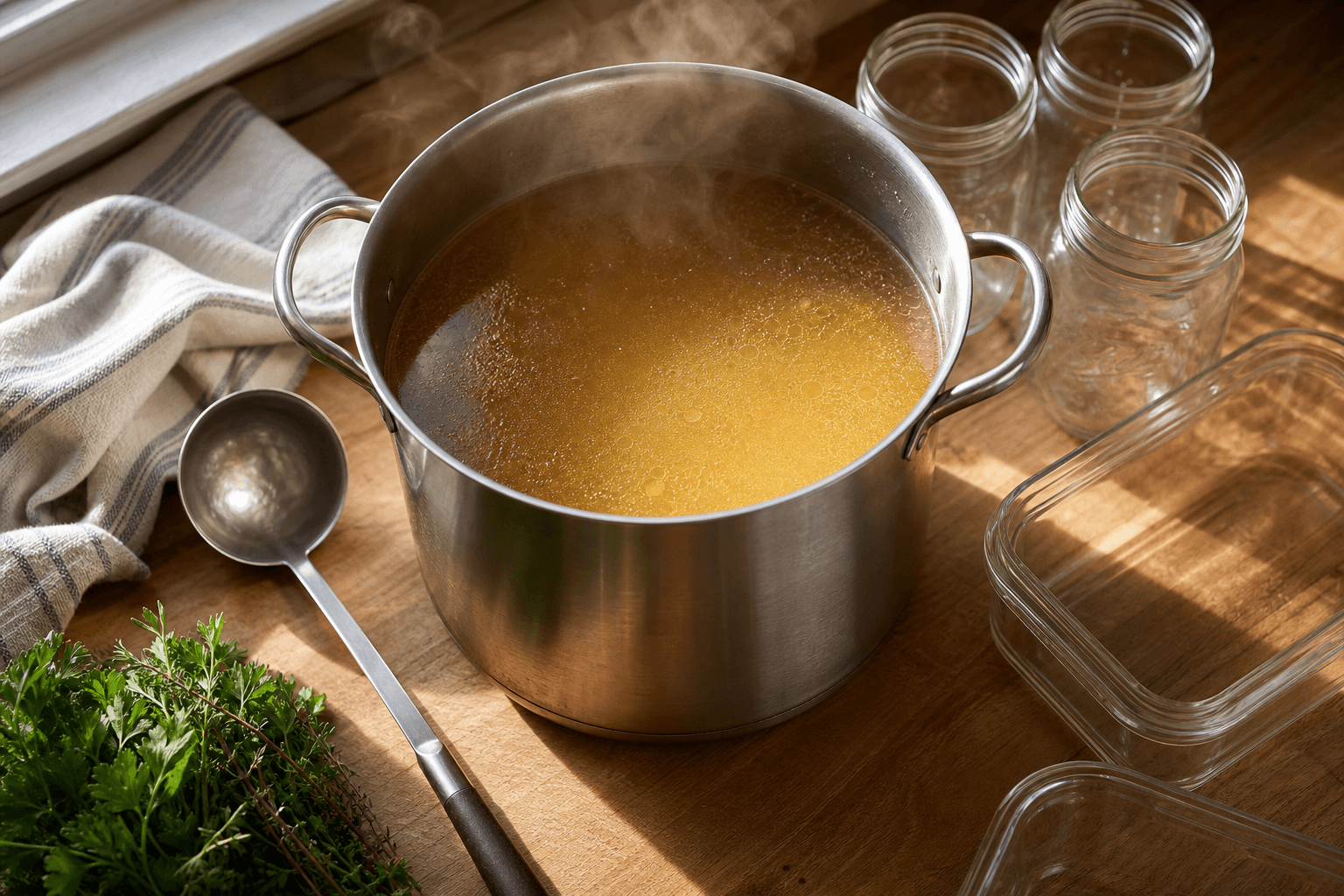
Chicken broth left out overnight is not safe to eat. USDA guidelines give perishable food a two hour window at room temperature, or just one hour above 90 degrees Fahrenheit, before bacteria can multiply to unsafe levels. Overnight is far longer than that, so the safest choice is to throw it out, no matter how good it looks or smells.
How long can chicken broth sit out?
Broth is a moist liquid that's high in protein, exactly the kind of food bacteria love. The USDA calls the range between 40 and 140 degrees Fahrenheit the danger zone, because bacteria can double in number in as little as 20 minutes at those temperatures. Once broth cools below 140 degrees on the counter, the clock starts running.
The rule is simple: perishable food can sit at room temperature for a maximum of two hours before it needs to go back in the fridge. If your kitchen is hotter than 90 degrees, that window shrinks to one hour. A full night on the stove or counter, usually eight hours or more, blows past either limit many times over.
| Storage method | Safe storage time |
|---|---|
| Room temperature, danger zone (40 to 140 degrees F) | Up to 2 hours total (1 hour if above 90 degrees F) |
| Refrigerator (40 degrees F or below) | 3 to 4 days |
| Freezer (0 degrees F) | 2 to 3 months for best quality, safe indefinitely if kept frozen |
| Unopened canned or boxed broth, pantry | Use by the date on the package |
| Opened canned or boxed broth, refrigerated | 3 to 4 days |
This same two hour window is what protects most cooked leftovers, including cooked rice left on the counter. For a broader rundown of how the rule applies across your fridge, check the full guide to how long food lasts.
How to tell if chicken broth has gone bad
If broth has been refrigerated within that two hour window and is still within its 3 to 4 day fridge life, check for the usual spoilage signs before using it:
- A sour, sulfurous, or off smell
- Cloudiness, foam, or bubbles that were not there before
- A slimy or stringy texture
- Any visible mold, even a small spot
Some of the bacteria that grow in broth left out too long, including Staphylococcus aureus, produce toxins that do not change the smell, taste, or appearance of the broth, and boiling does not destroy those toxins. That is why the time rule matters more than a sniff test for broth left out overnight. If you cannot say for certain it went back in the fridge within two hours, sensory checks cannot clear it, and the only safe move is to discard it.
If your broth started from raw chicken, the raw meat itself has an even tighter window: typically 1 to 2 days in the fridge before it needs to be cooked or frozen.
How to store chicken broth so it lasts
- Cool a full pot faster by ladling hot broth into shallow containers, no more than two inches deep, or setting the pot in an ice bath before it goes in the fridge. A large stockpot left whole can take hours to drop out of the danger zone even inside the refrigerator.
- Refrigerate at 40 degrees F or below within two hours of cooking or opening.
- Use airtight containers to keep the broth from picking up other fridge odors.
- Label containers with the date, since it's easy to lose track after a few days in the fridge. If keeping track of open dates is the part that trips you up, a food tracking app like Well Stockd can log when broth goes into the fridge and remind you before it hits day four.
Can you freeze chicken broth?
Yes, and freezing is the best way to stretch a big batch. Chicken broth keeps its quality for 2 to 3 months in the freezer at 0 degrees F, and stays safe to eat indefinitely as long as it stays frozen solid, though flavor and texture fade over longer stretches. Freeze in the portions you actually use, such as ice cube trays for a splash in a pan sauce or quart containers for soup night, and leave an inch of headspace since liquid expands as it freezes. Thaw it in the refrigerator or reheat straight from frozen on the stove.
When in doubt, throw it out
This is the USDA's own guidance, and it applies here. You cannot see, smell, or taste the bacteria and toxins that make food unsafe, so when the timeline is uncertain, the safest call is to skip the taste test and toss the broth. A pot of broth costs you almost nothing to remake, and that's a far better trade than a case of food poisoning.
Frequently asked questions
Can you get sick from chicken broth left out overnight? Yes. Bacteria that grow in the danger zone over many hours can cause food poisoning, and reheating or boiling the broth afterward will not undo the risk.
Does boiling broth that sat out overnight make it safe again? No. Boiling kills many active bacteria, but some bacteria produce heat-stable toxins while the broth sits out, and those toxins survive cooking.
Is bone broth held to the same rule as regular chicken broth? Yes. Bone broth is still a perishable liquid that's high in protein, so the same two hour rule, danger zone range, and 3 to 4 day fridge window apply.
If you are trying to cut down on food waste from broth, soup, and other perishables going bad before you use them, the Well Stockd app to track food expiration dates can help you keep tabs on what is in the fridge and when it needs to be used.
Sources: USDA Food Safety and Inspection Service, "Danger Zone (40 F - 140 F)"; USDA Food Safety and Inspection Service, "Leftovers and Food Safety"; USDA FoodKeeper via FoodSafety.gov, Cold Food Storage Chart; USDA Ask USDA, "Is food safe if left out overnight?"
Quick answer: see the Chicken Broth storage reference.
Track it in Well Stockd
Add what you have, see what you can cook tonight, and get a reminder before anything goes off.
