Is cooked chicken still good after 5 days in the fridge?
USDA guidance caps cooked chicken at 3 to 4 days in the fridge, so day 5 is past the safe window. Here is how to tell if it has gone bad, how to store it right, and when to freeze it instead.
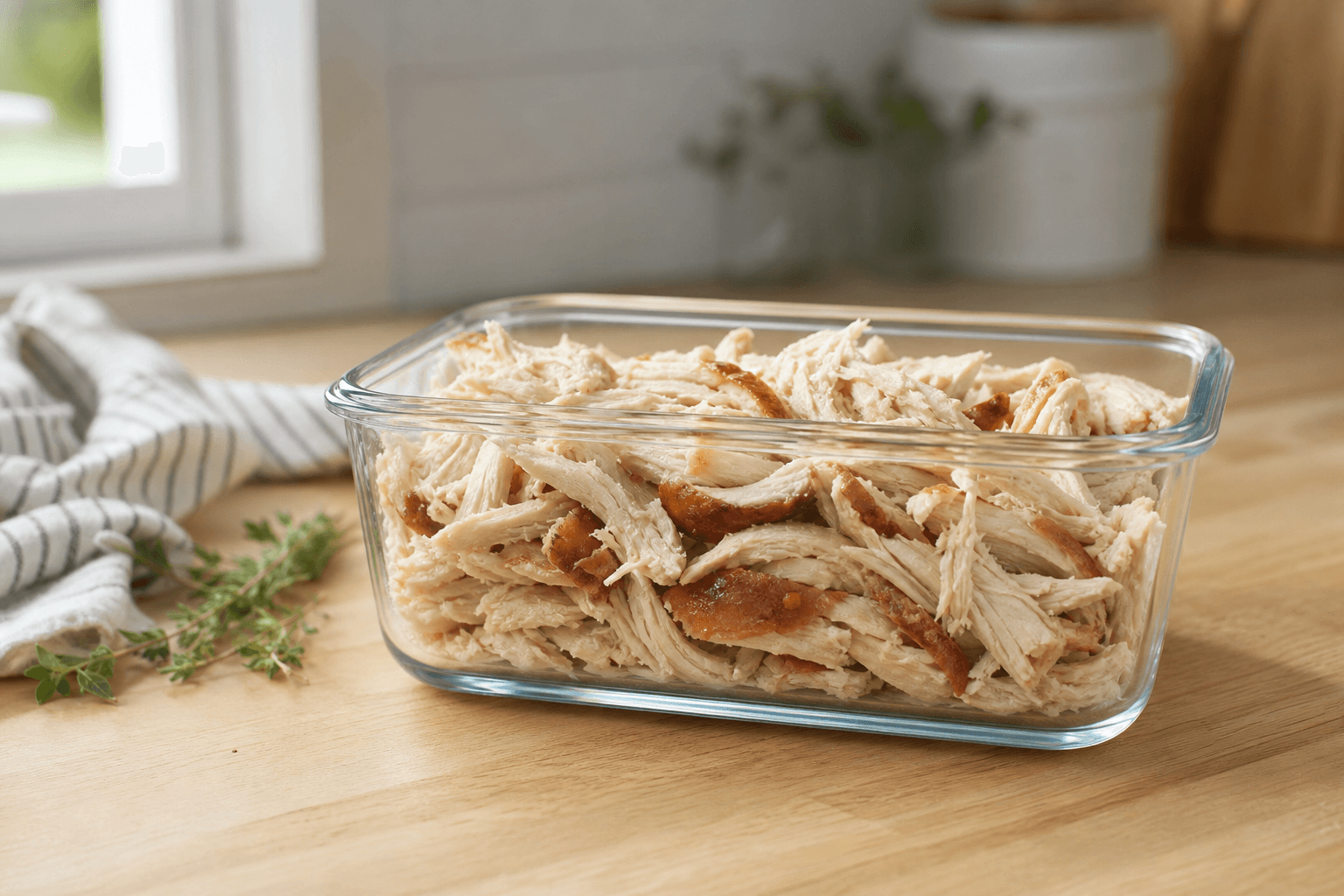
No. The USDA says cooked chicken is safe in the fridge for only 3 to 4 days at 40°F or below, so day 5 is past the safe window. Throw it out even if it still looks, smells, and tastes normal, since some spoilage bacteria leave no trace.
That 3 to 4 day rule comes straight from the USDA's Food Safety and Inspection Service, and it applies to cooked chicken breast, thighs, wings, rotisserie chicken, fried chicken, chicken soup, and chicken casseroles alike. There is no version of "cooked chicken" that gets a longer window in the refrigerator. If you are counting from the day you cooked it (or the day you brought home a rotisserie bird), day 5 means it is time to let it go.
How long does cooked chicken last in the fridge?
Refrigeration slows bacterial growth but does not stop it, which is why the clock keeps running even in a cold fridge. The table below covers the common ways cooked chicken shows up in a kitchen.
| Cooked chicken | Refrigerator (40°F or below) | Freezer (0°F) |
|---|---|---|
| Chicken breast, thighs, wings, or rotisserie chicken | 3 to 4 days | 3 to 4 months for best quality |
| Chicken soup, casserole, or dishes in sauce or broth | 3 to 4 days | 3 to 4 months for best quality |
| Fried chicken | 3 to 4 days | 3 to 4 months for best quality |
| Chicken salad or other mayonnaise-based dishes | 3 to 4 days | Not recommended, the texture breaks down |
| Cooked chicken left out at room temperature | Discard after 2 hours (1 hour if above 90°F) | Not applicable |
For the full picture on other foods, our guide to how long food lasts in the fridge and freezer rounds up storage times across many categories.
How to tell if cooked chicken has gone bad
Trust your senses for the obvious signs, but do not treat them as the final word. Cooked chicken that has gone bad usually shows one or more of these signs:
- A sour, sulfur-like, or ammonia smell
- A slimy, sticky, or tacky surface
- A dull gray, green, or otherwise off color
- Visible mold, which can look fuzzy or have colored spots
Some of the bacteria responsible for foodborne illness, including Listeria, can grow at refrigerator temperatures without changing how the chicken looks, smells, or tastes. That kind of spoilage is invisible. That is one reason the USDA relies on a time limit rather than a smell test, and why the 3 to 4 day rule still applies even when the chicken seems fine on day 5.
How to store cooked chicken so it lasts
A few habits stretch cooked chicken across its full safe window instead of cutting it short:
- Get it into the fridge within 2 hours of cooking, or within 1 hour if the room is hotter than 90°F
- Use shallow, airtight containers so the chicken cools quickly and evenly all the way through
- Keep your refrigerator at 40°F or below, and check it with an appliance thermometer if you are not sure
- Label the container with the date you cooked or stored it, so you are not guessing on day 4
- Reheat leftovers to 165°F before eating, checking the temperature with a food thermometer
That last point about labeling is where most people slip. It is easy to lose track of exactly when a rotisserie chicken went into the fridge once you split it into three different containers. If keeping the dates straight is the part that trips you up, an app like Well Stockd's food expiration tracker logs the day you stored the chicken and can remind you before the 3 to 4 day window closes.
If you are storing chicken that has not been cooked yet, the rules are different. See our guide to how long raw chicken lasts in the fridge for that timeline.
Each reheat matters as well: how many times can you reheat chicken safely.
Can you freeze cooked chicken?
Yes, and freezing is the right move if you know you will not finish the chicken within 3 to 4 days. Freeze it before that window closes, since freezing does not undo time that has already passed in the fridge.
Cooked chicken keeps its best quality in the freezer for about 3 to 4 months. Beyond that it is generally still safe if the freezer has held a steady 0°F, since food frozen continuously at that temperature stays safe indefinitely, but texture and flavor start to fade. Thaw it in the refrigerator, in cold water, or in the microwave. Do not thaw it on the counter. Reheat it to 165°F before serving.
Cooked rice follows a similarly short refrigerator clock. If you meal prep both, our guide to how long cooked rice lasts in the fridge is worth a look too.
We walk through the exact steps, containers, and thaw times in our guide to freezing cooked chicken.
When in doubt
The USDA's own advice for exactly this situation is "when in doubt, throw it out." You cannot see, smell, or taste the bacteria or toxins that cause foodborne illness, so a taste test is not a safety test. If cooked chicken has been in the fridge for 5 days, or you genuinely are not sure how long it has been there, the safest choice is to discard it rather than reheat and eat it.
Frequently asked questions
Is it safe to eat chicken that has been in the fridge for 5 days? No. USDA guidance limits cooked chicken and other cooked meat or poultry to 3 to 4 days in the refrigerator at 40°F or below. Five days is outside that window, regardless of how the chicken looks or smells.
Will reheating chicken make it safe again after 5 days? No. Reheating to 165°F kills many bacteria, but it does not destroy toxins that some bacteria have already produced, and heat does not reset the USDA's storage clock. Throw out chicken past day 4 rather than reheating and serving it.
Does the clock restart if the chicken was frozen and then thawed? Once cooked chicken is thawed in the refrigerator, treat it like any other refrigerated leftover and use it within 3 to 4 days of thawing. Thawing does not extend the original fridge window if the chicken had already been sitting out before it was frozen.
Sources: Leftovers and Food Safety, USDA Food Safety and Inspection Service, How long can you keep cooked chicken?, Ask USDA/FSIS, Cold Food Storage Chart, FoodSafety.gov.
Track it in Well Stockd
Add what you have, see what you can cook tonight, and get a reminder before anything goes off.
