Printable freezer storage chart: how long food lasts in the freezer
A free, USDA-based printable freezer storage chart for meat, seafood, dairy, produce, and leftovers, plus how to freeze, thaw, and refreeze safely.
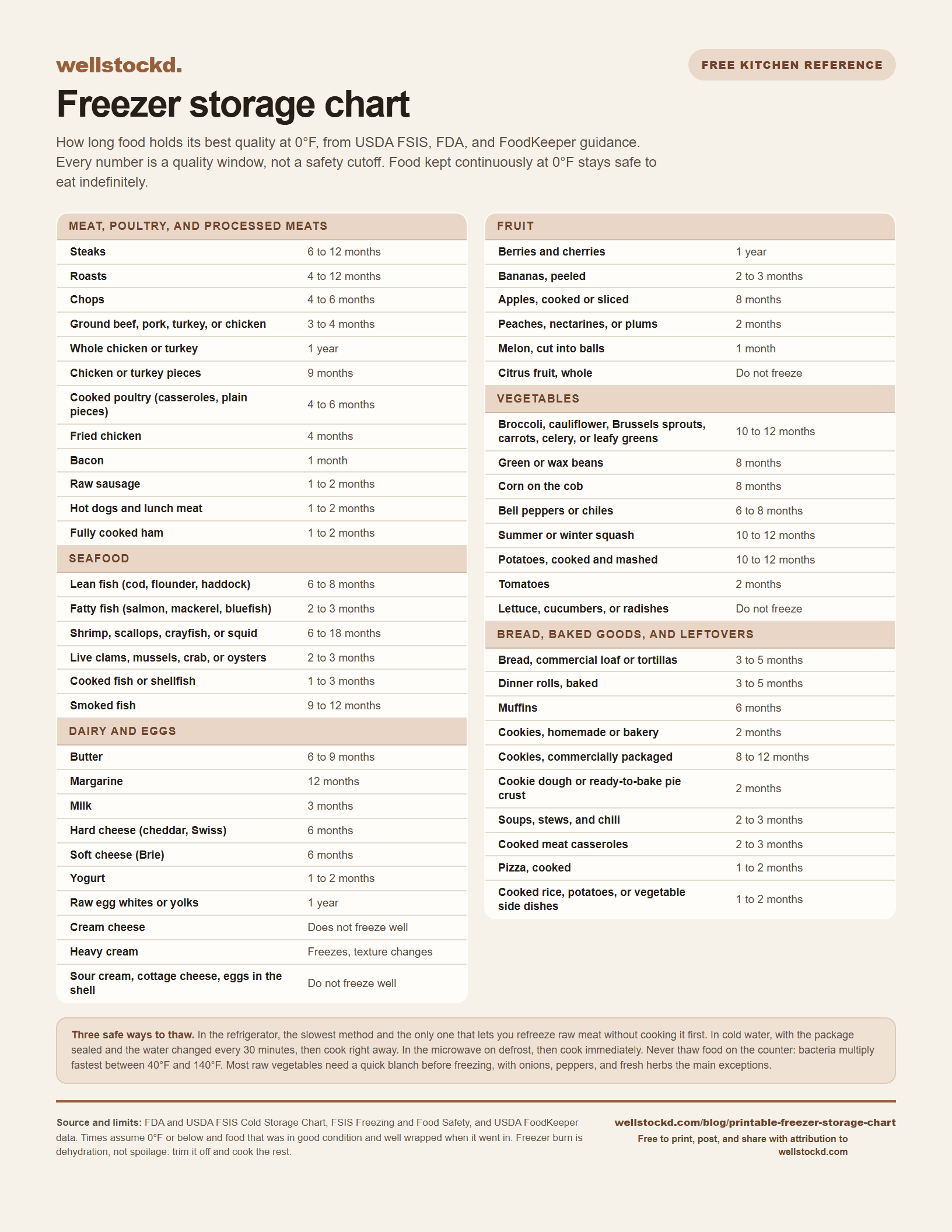
Print or download the freezer storage chart
Use the clean print layout below, or download the free letter-size PDF and high-resolution PNG. No email address is required.
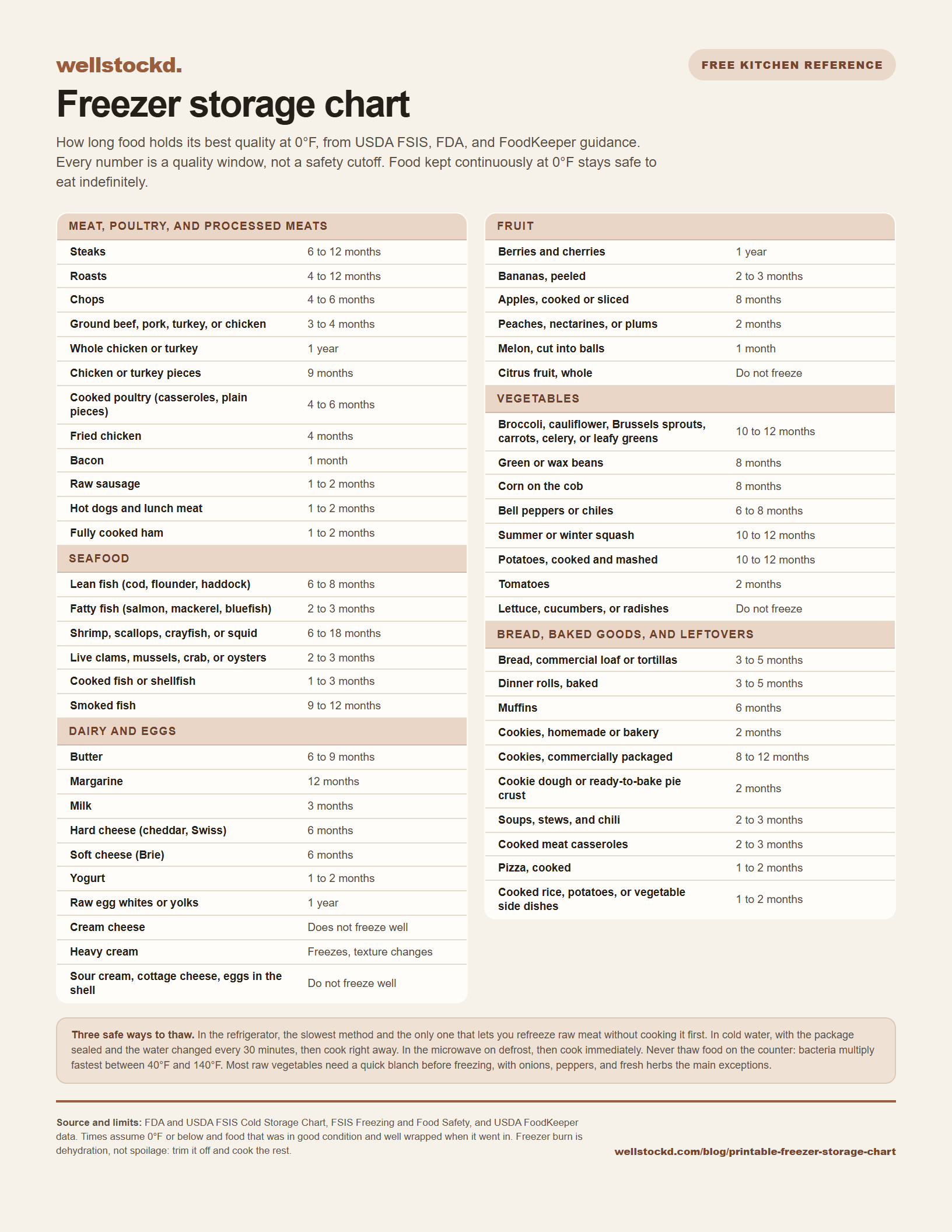
Primary references: FDA and USDA cold storage chart and USDA FSIS freezing guidance.
Free to print, post, and share with attribution to wellstockd.com.
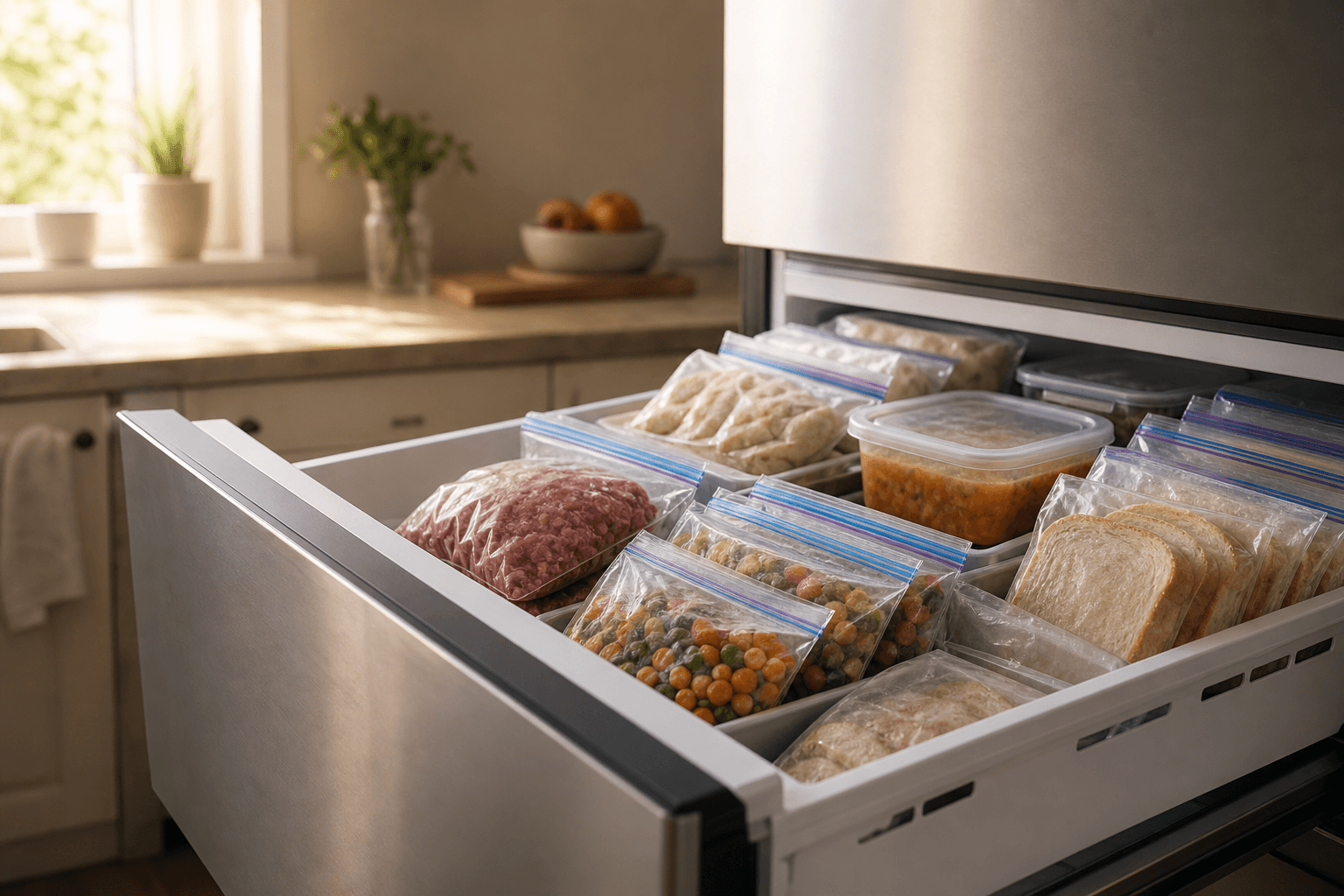
Yes, you can freeze almost everything in a normal kitchen, and a printable freezer storage chart is the fastest way to know how long each item holds its best quality at 0°F. Storage times on the chart below range from about one month for bacon to a full year for whole poultry and berries, based on USDA guidance.
What is a freezer storage chart?
A freezer storage chart is simply a reference list that pairs each food with two things: how long it stays safe (which, at 0°F, is indefinite for almost everything) and how long it stays at peak quality before texture or flavor starts to slip. The USDA Food Safety and Inspection Service (FSIS) and the Food and Drug Administration (FDA) publish the numbers behind most of these charts, and the same figures power the free USDA FoodKeeper app.
The short version: freezing at 0°F or below stops bacteria from growing, so frozen food never becomes unsafe just from sitting in the freezer. What changes is quality. A steak frozen for 14 months is still safe to eat; it just will not taste as good as one frozen for four. That is exactly what a printable freezer storage chart like the one below is for: matching realistic expectations to what is in your freezer drawer, so nothing goes to waste and nothing gets tossed too early. For the freezing basics that apply to every food category, see our full guide to freezing food safely.
How to freeze food
Whatever you are freezing, the same handful of steps keeps quality high and freezer burn away.
- Cool hot food first. Let leftovers, soups, and stews come down to room temperature in shallow containers in the fridge before they go into the freezer, so you are not raising the temperature of everything else in there.
- Portion before you freeze. Split meat, soup, and baked goods into meal-size amounts so you only thaw what you will actually use.
- Wrap it airtight. Use freezer bags, heavy freezer paper, or airtight containers, and press out as much air as you can. Air reaching the surface is what causes freezer burn, not the freezer itself.
- Label every package. Write the food and the date on it. That date is what you will check against the chart below.
- Confirm your freezer runs at 0°F or colder. An inexpensive freezer thermometer is the only reliable way to know, since dial settings can run warmer than they read.
- Flash-freeze loose pieces first. Spread berries, chopped vegetables, or meatballs on a tray until solid, then bag them, so they stay separate instead of freezing into one block. Berries you only need to hold a few more days are covered in how to make strawberries last longer.
- Do not overpack the freezer. Air needs room to circulate so food freezes quickly. Food that freezes slowly forms larger ice crystals and turns mushier once thawed.
How long food keeps frozen and how to thaw it
Here is the printable freezer storage chart itself, organized by category. Every number comes from USDA FSIS, FDA, and FoodKeeper guidance for quality at 0°F, not a safety cutoff, since properly frozen food stays safe to eat indefinitely.
Meat, poultry, and processed meats
| Food | Freezer time (0°F) |
|---|---|
| Steaks | 6 to 12 months |
| Roasts | 4 to 12 months |
| Chops | 4 to 6 months |
| Ground beef, pork, turkey, or chicken | 3 to 4 months |
| Whole chicken or turkey | 1 year |
| Chicken or turkey pieces | 9 months |
| Cooked poultry (casseroles, plain pieces) | 4 to 6 months |
| Fried chicken | 4 months |
| Bacon | 1 month |
| Raw sausage | 1 to 2 months |
| Hot dogs and lunch meat | 1 to 2 months |
| Fully cooked ham | 1 to 2 months |
Seafood
| Food | Freezer time (0°F) |
|---|---|
| Lean fish (cod, flounder, haddock) | 6 to 8 months |
| Fatty fish (salmon, mackerel, bluefish) | 2 to 3 months |
| Shrimp, scallops, crayfish, or squid | 6 to 18 months |
| Live clams, mussels, crab, or oysters | 2 to 3 months |
| Cooked fish or shellfish | 1 to 3 months |
| Smoked fish | 9 to 12 months |
Dairy and eggs
| Food | Freezer time (0°F) |
|---|---|
| Butter | 6 to 9 months |
| Margarine | 12 months |
| Milk | 3 months |
| Hard cheese (cheddar, Swiss) | 6 months |
| Soft cheese (Brie) | 6 months |
| Yogurt | 1 to 2 months |
| Raw egg whites or yolks | 1 year |
| Cream cheese | Does not freeze well; see our cream cheese freezing guide |
| Heavy cream | Freezes, but the texture changes; see our heavy cream freezing guide |
| Sour cream, cottage cheese, eggs in the shell | Do not freeze well |
Fruit
| Food | Freezer time (0°F) |
|---|---|
| Berries and cherries | 1 year |
| Bananas, peeled | 2 to 3 months |
| Apples, cooked or sliced | 8 months |
| Peaches, nectarines, or plums | 2 months |
| Melon, cut into balls | 1 month |
| Citrus fruit, whole | Do not freeze |
Vegetables
| Food | Freezer time (0°F) |
|---|---|
| Broccoli, cauliflower, Brussels sprouts, carrots, celery, or leafy greens | 10 to 12 months |
| Green or wax beans | 8 months |
| Corn on the cob | 8 months |
| Bell peppers or chiles | 6 to 8 months |
| Summer or winter squash | 10 to 12 months |
| Potatoes, cooked and mashed | 10 to 12 months |
| Tomatoes | 2 months |
| Lettuce, cucumbers, or radishes | Do not freeze |
Most raw vegetables need a quick blanch, a brief dunk in boiling water followed by an ice bath, before freezing so they hold their color, texture, and nutrients. Onions, peppers, and fresh herbs are the main exceptions and can go into the freezer raw.
Bread, baked goods, and leftovers
| Food | Freezer time (0°F) |
|---|---|
| Bread, commercial loaf or tortillas | 3 to 5 months |
| Dinner rolls, baked | 3 to 5 months |
| Muffins | 6 months |
| Cookies, homemade or bakery | 2 months |
| Cookies, commercially packaged | 8 to 12 months |
| Cookie dough or ready-to-bake pie crust | 2 months |
| Soups, stews, and chili | 2 to 3 months |
| Cooked meat casseroles | 2 to 3 months |
| Pizza, cooked | 1 to 2 months |
| Cooked rice, potatoes, or vegetable side dishes | 1 to 2 months |
USDA lists three safe ways to thaw anything on this chart.
- In the refrigerator. The slowest method, and the only one that lets you safely refreeze raw meat or poultry without cooking it first, as long as you use or refreeze it within one to two days of it fully thawing.
- In cold water. Submerge the sealed package and change the water every 30 minutes, then cook the food right away.
- In the microwave. Use the defrost setting and cook the food immediately afterward, since parts of it will start to warm above 40°F during the process.
Never thaw food on the counter at room temperature. Bacteria multiply fastest between 40°F and 140°F, and a roast can spend hours in that range before the center even softens.
If food thawed in the refrigerator, it is fine to refreeze without cooking, though you will lose some quality. If it thawed in cold water or the microwave, cook it before refreezing. And if raw meat, poultry, or leftovers sat out at room temperature for more than two hours, or one hour above 90°F, do not refreeze or eat them. When in doubt, throw it out.
What changes (texture and quality) and what to use food for after
Freezing is not a preservation trick that leaves food exactly as it was. Water inside every cell expands into ice crystals, and the bigger those crystals get, the more they rupture cell walls. That is why texture, not safety, is the tradeoff on this chart.
High-water vegetables and fruits, like lettuce, cucumbers, tomatoes, melon, and citrus, turn soft and watery once thawed, because there is little structure left to hold onto. They are still perfectly good, just not for a raw salad anymore. Use thawed vegetables in soups, stir-fries, casseroles, and sauces, where a little extra softness does not matter. Use thawed fruit in smoothies, baked goods, jam, or compote instead of eating it out of hand. Buying a fresh melon instead? See picking a ripe cantaloupe.
Dairy behaves differently. Milk, cream, and sour cream can separate or turn grainy as they freeze and thaw, which is why the chart above lists several as does not freeze well. If you already froze something like cream cheese or heavy cream, whisking or blending it back together usually rescues it for cooked or baked dishes, even if it will never be quite right spread on a bagel or whipped into peaks again. Our guides to freezing cream cheese and freezing heavy cream walk through exactly how each one changes and the best ways to use it afterward.
Freezer burn, the grayish white patches you sometimes see on frozen meat or bread, is dehydration from air reaching the food's surface, not spoilage. It is safe to eat; just trim off the affected part before cooking, since that spot will taste dry and stale.
A chart tells you the outer limit of quality, but the easiest way to use it is to know what is sitting in your freezer and when it went in. If you are already tracking a fridge, freezer, and pantry, an app that tracks food expiration dates can log the freeze date automatically and nudge you before quality, not safety, starts to slip, so this printable chart becomes something you check occasionally instead of something you have to memorize.
Frequently asked questions
Is frozen food still safe to eat after the times on this chart? Yes. Every number here is a quality recommendation, not a safety deadline. Food kept continuously at 0°F or below is safe to eat indefinitely; it just may lose flavor, texture, or color the longer it sits.
Can I print this freezer storage chart and keep it on the fridge? Yes. Use the Print button at the top of this page, or download the free letter-size PDF or PNG from the same box, no email required. Tape it inside a cabinet or the freezer door where you will see it while packing food away.
Do all vegetables need to be blanched before freezing? Most do. A quick dunk in boiling water followed by an ice bath stops the enzyme activity that causes mushiness, off flavors, and nutrient loss during freezer storage. Onions, peppers, and fresh herbs are the main exceptions and can be frozen raw.
Sources: USDA Food Safety and Inspection Service and FDA, Cold Storage Chart; FoodSafety.gov, Cold Food Storage Charts; FSIS, Freezing and Food Safety; USDA FoodKeeper App data; National Center for Home Food Preservation blanching guidance.
Track it in Well Stockd
Add what you have, see what you can cook tonight, and get a reminder before anything goes off.
