The printable food shelf life chart for your fridge, freezer, and pantry
A USDA backed, printable chart that shows how long eggs, dairy, meat, poultry, seafood, leftovers, and pantry staples last in the fridge, freezer, and cupboard.
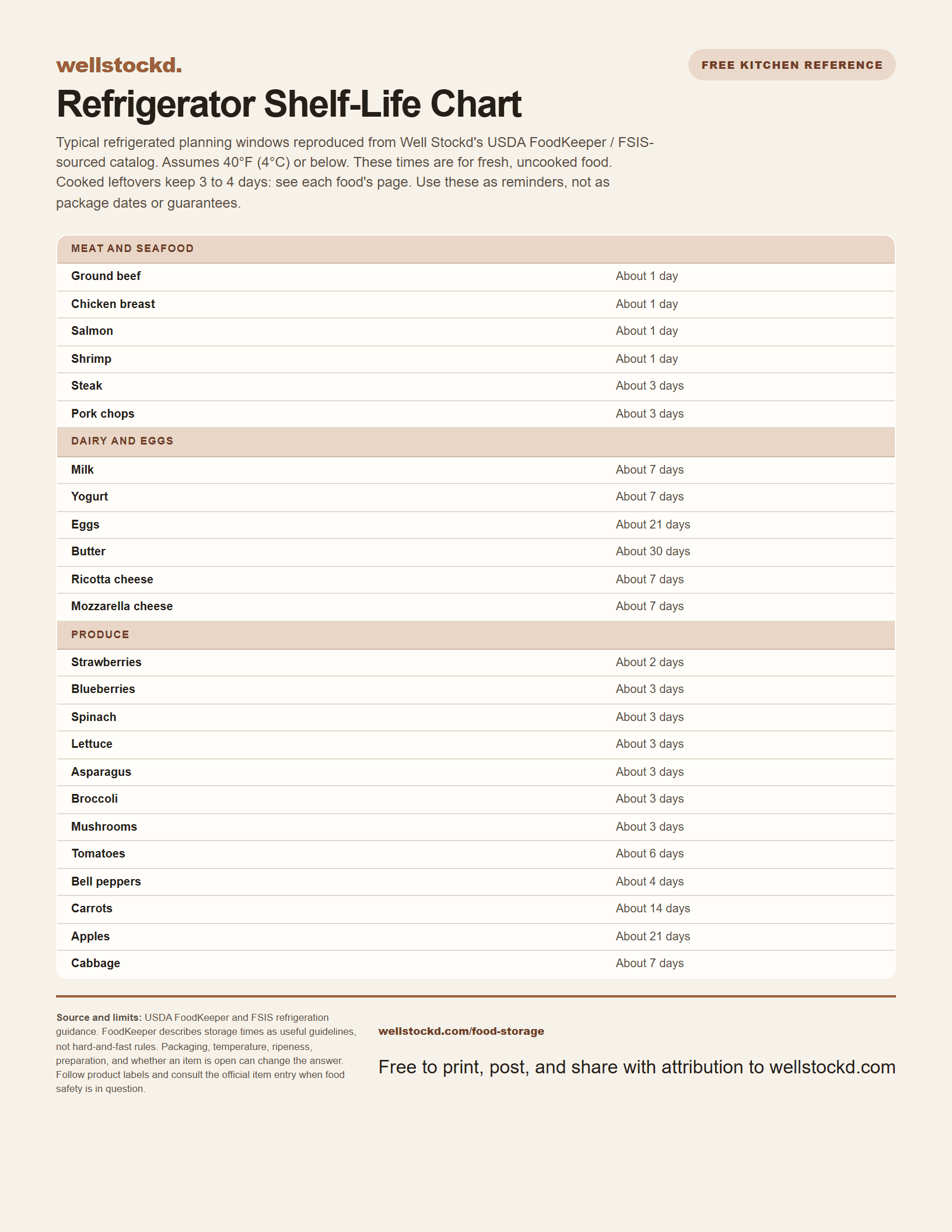
Print or download the fridge shelf-life chart
Use the clean print layout below, or download the free letter-size PDF and high-resolution PNG. No email address is required.
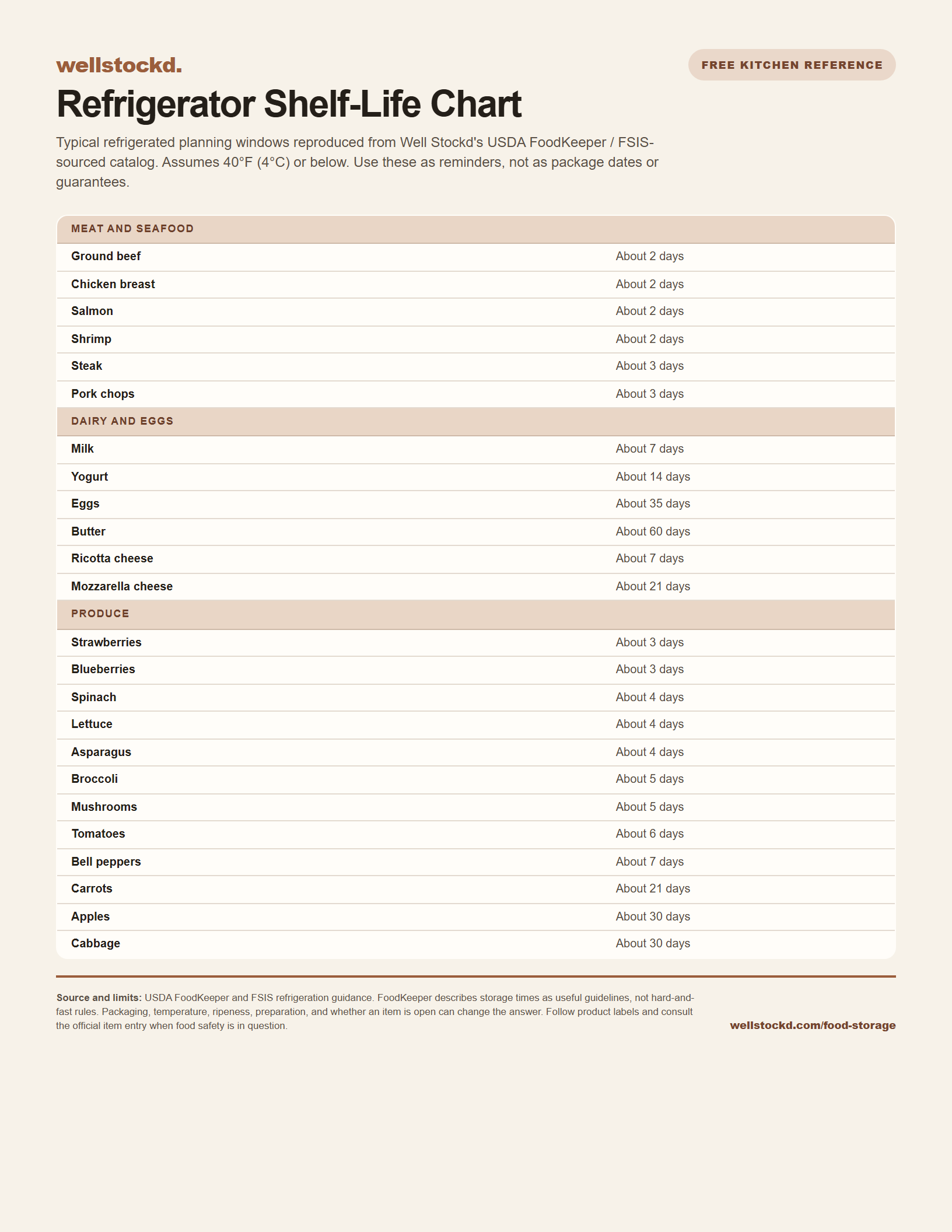
Primary references: FoodKeeper on FoodSafety.gov and USDA FSIS refrigeration guidance.
Free to print, post, and share with attribution to wellstockd.com.
Most cooked leftovers keep for 3 to 4 days in the refrigerator and 3 to 4 months in the freezer, according to the USDA. That safe window varies a lot by food, though: raw ground meat only holds for 1 to 2 days, while canned goods and dry pantry staples can last a year or more.
That range is why a single chart is worth keeping on hand. Print this page, or bookmark it on your phone, and you have USDA backed storage times for the foods that fill most kitchens: eggs and dairy, raw meat and poultry, seafood, cooked leftovers, and pantry staples. For a food by food breakdown of specific items, our full guide to how long food lasts covers more ground than any single chart can.
What this chart covers
All refrigerator times below assume a fridge at 40°F (4°C) or below, and all freezer times assume 0°F (-18°C) or below. Freezer times are for best quality, not safety, since food held continuously at 0°F stays safe to eat indefinitely.
Eggs and dairy
| Food | Refrigerator | Freezer |
|---|---|---|
| Fresh eggs, in shell | 3 to 5 weeks | Do not freeze in shell |
| Raw egg yolks or whites | 2 to 4 days | 1 year |
| Hard cooked eggs | 1 week | Does not freeze well |
| Milk | 7 days after opening | 3 months |
| Butter | 1 to 2 months | 6 to 9 months |
| Hard cheese, opened (cheddar, Swiss) | 3 to 4 weeks | 6 months |
| Soft cheese, opened (Brie, blue) | 1 week | 6 months |
| Cottage cheese or ricotta | 1 week | Does not freeze well |
| Cream cheese | 2 weeks | Does not freeze well |
| Yogurt | 1 to 2 weeks | 1 to 2 months |
| Sour cream | 1 to 3 weeks | Does not freeze well |
Raw meat and poultry
| Food | Refrigerator | Freezer |
|---|---|---|
| Ground meat (beef, turkey, pork, lamb) | 1 to 2 days | 3 to 4 months |
| Fresh chicken or turkey, whole or pieces | 1 to 2 days | 9 months to 1 year |
| Steaks | 3 to 5 days | 6 to 12 months |
| Chops | 3 to 5 days | 4 to 6 months |
| Roasts | 3 to 5 days | 4 to 12 months |
| Bacon | 7 days | 1 month |
| Raw sausage | 1 to 2 days | 1 to 2 months |
| Hot dogs, opened package | 1 week | 1 to 2 months |
| Deli or luncheon meat, opened | 3 to 5 days | 1 to 2 months |
Raw chicken has one of the shortest safe windows on this whole chart, which is why it trips people up so often. If that is the item on your mind, our guide to how long raw chicken lasts in the fridge walks through it in more detail.
Seafood
| Food | Refrigerator | Freezer |
|---|---|---|
| Lean fish (cod, flounder, haddock) | 1 to 2 days | 6 months |
| Fatty fish (salmon, mackerel, bluefish) | 1 to 2 days | 2 to 3 months |
| Shrimp, scallops, and shucked shellfish | 1 to 2 days | 3 to 4 months |
| Cooked fish | 3 to 4 days | 1 to 2 months |
| Cooked shellfish | 3 to 4 days | 3 months |
Cooked leftovers and deli
| Food | Refrigerator | Freezer |
|---|---|---|
| Cooked meat, poultry, or casseroles | 3 to 4 days | 2 to 3 months |
| Soups and stews | 3 to 4 days | 2 to 3 months |
| Cooked rice, pasta, or grains | 3 to 4 days | 1 to 2 months |
| Pizza | 3 to 4 days | 1 to 2 months |
| Gravy or meat broth | 1 to 2 days | 2 to 3 months |
Cooked rice deserves its own mention, since fried rice syndrome (from the bacterium Bacillus cereus) is a common source of confusion. See how long cooked rice lasts in the fridge for the full explanation, and the leftovers storage chart for cooked dishes this table leaves out, such as quiche and cooked vegetables.
Pantry staples (room temperature, about 70°F)
| Food | Pantry, unopened |
|---|---|
| White rice | 1 to 2 years |
| Dry pasta | 1 to 2 years |
| All purpose flour | 6 to 8 months |
| Canned vegetables, fruit, or meat | 12 months or longer for best quality |
| Peanut butter | 6 to 12 months (2 to 3 months once opened) |
| Cooking oil | 6 months (3 to 5 months once opened) |
| Dry cereal | 6 to 12 months (2 to 3 months once opened) |
How can you tell if food has gone bad?
Trust your senses first. Sour or ammonia like smells, slimy or sticky textures, visible mold, and dull or off color are all signs a food is done. If a can bulges or spurts liquid when you open it, or a jar's seal is broken, toss it without tasting.
Some of the bacteria that make people sick, including Salmonella, Listeria, and E. coli, do not change how food looks, smells, or tastes. A dish can be spoiled with pathogens and still seem completely normal. That is why the time limits in the chart above matter even when everything looks fine. If the storage window has passed, go by the date, not by how the food seems.
How should you store food so it lasts
- Keep your refrigerator at 40°F (4°C) or below and your freezer at 0°F (-18°C) or below. Check both with an appliance thermometer, since the dial setting is not always accurate.
- Refrigerate or freeze leftovers and groceries within 2 hours of cooking or purchase, or within 1 hour if the air temperature is above 90°F, such as a picnic or a hot car.
- Use airtight containers, or wrap food tightly in freezer paper or a freezer bag with the air pressed out, to slow freezer burn.
- Store raw meat, poultry, and seafood on the bottom shelf in a sealed container so juices cannot drip onto other food.
- Label leftovers and freezer items with the date, and use the oldest ones first.
- Do not pack the fridge too tightly. Cold air needs room to circulate, or things will not cool evenly.
How freezing extends these windows
In most cases, yes. Freezing at 0°F stops bacterial growth entirely, so food held continuously at that temperature stays safe to eat indefinitely, according to the USDA. The freezer times in the chart above are recommendations for best quality, meaning taste and texture, not a safety cutoff. Freezer burn (the dry, grayish patches that show up on food stored a long time) is a quality issue too. You can trim it away and eat the rest.
When in doubt
When you cannot confirm how a food was stored, whether it stayed cold the whole time, or how long it has been sitting there, USDA guidance is blunt: when in doubt, throw it out. No meal is worth a case of food poisoning, and reheating does not reliably undo unsafe storage.
Frequently asked questions
Is the date printed on a food package a safety deadline? No, except on infant formula. "Best if used by," "sell by," and "use by" dates are about peak quality, not a hard safety cutoff, and are not required by federal law. Once a package is opened, follow the fridge or freezer times in this chart instead.
How long can food sit out at room temperature before it becomes unsafe? No more than 2 hours in the 40°F to 140°F danger zone, or 1 hour if the temperature is above 90°F. Bacteria can double in as little as 20 minutes in that range, so refrigerate or freeze promptly rather than leaving food on the counter to cool.
Does food left in the freezer past the times on this chart become unsafe to eat? No. Freezing keeps food safe indefinitely as long as the freezer stays at 0°F or below. Quality declines over time. Safety does not, so freezer burned food is still fine to eat once you trim the affected parts.
If you would rather not keep a paper chart on the fridge door, an app that tracks food expiration dates can log what you bought and remind you before it turns, which is a lot more precise than a general chart once food is already open in your kitchen.
Sources: USDA Food Safety and Inspection Service, Cold Storage Chart (FSIS, FDA, and The FoodKeeper); FSIS, Food Product Dating; FSIS, "Danger Zone" (40°F - 140°F); FSIS, Leftovers and Food Safety; Kansas State University Extension, Safe Food Storage: The Cupboard (adapted from USDA FoodKeeper); FoodSafety.gov, Cold Food Storage Chart.
Track it in Well Stockd
Add what you have, see what you can cook tonight, and get a reminder before anything goes off.
