How to tell if salmon is bad
Raw salmon is only good for 1 to 2 days in the fridge. Spot spoiled salmon by smell, look, and feel, and check the USDA storage times for raw, cooked, and smoked salmon.
How to tell if salmon is bad
Raw salmon keeps for only 1 to 2 days in the refrigerator, per USDA guidance, whether it is fresh from the counter or thawed. After that window, trust your senses: a sour or ammonia smell, dull gray flesh, or a slimy surface all mean it belongs in the trash.
Salmon is one of the more delicate proteins in the fridge. It spoils faster than most cuts of meat, and because "fresh" fish already carries a mild sea smell, it is harder to tell when that smell has turned into spoilage.
The storage windows, briefly
The quick answer: raw salmon keeps 1 to 2 days in the fridge and cooked salmon 3 to 4 days. This page is about the sensory checks — for the full storage windows by cut and state, see how long raw salmon lasts in the fridge.
How to tell if salmon has gone bad
Smell. Fresh salmon should smell mild and faintly like the ocean, not "fishy." A strong fishy odor, a sour smell, or anything resembling ammonia is the clearest sign it has turned. If you catch that smell even briefly when you open the package, do not taste it to double check. Throw it out.
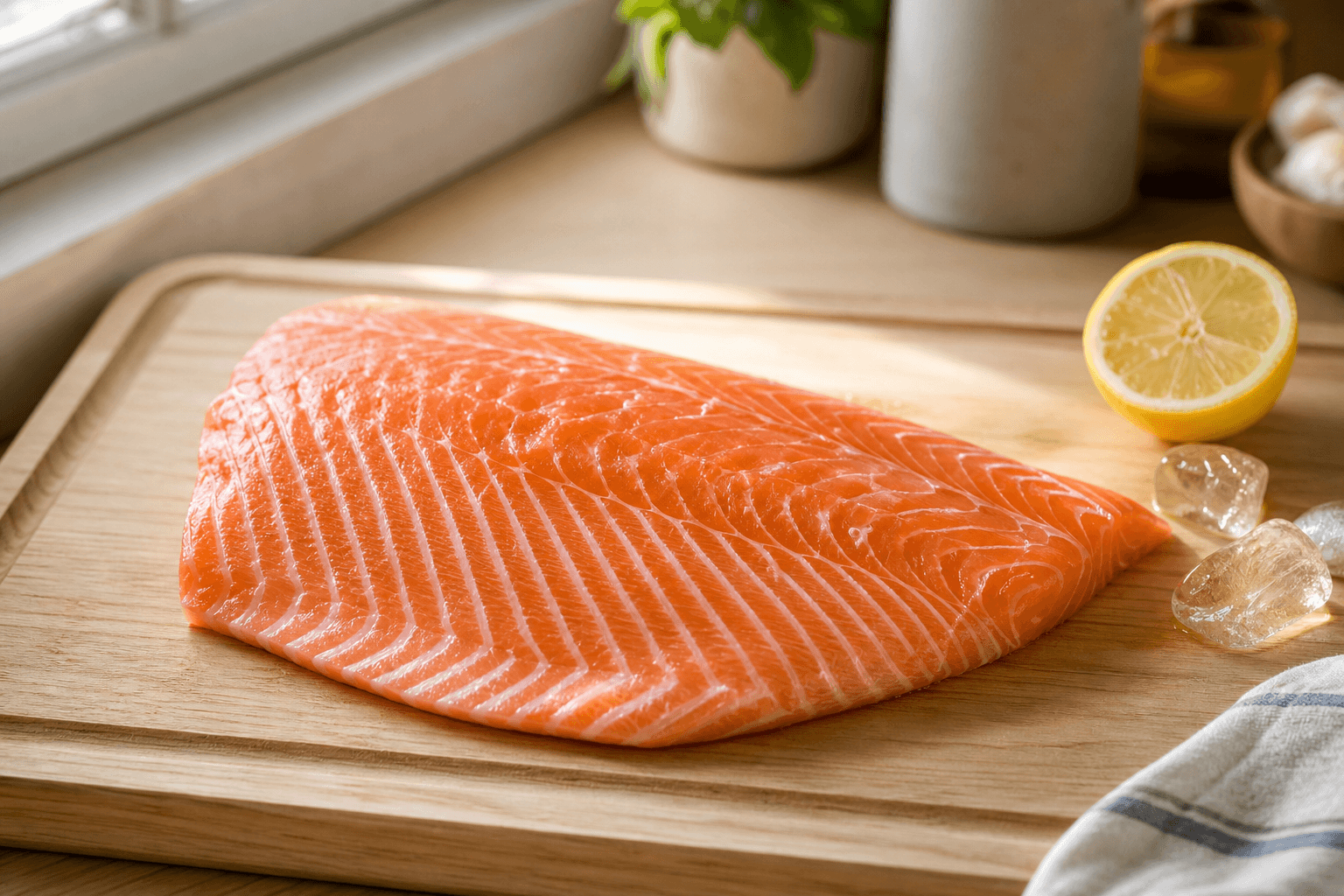
Appearance. Fresh salmon flesh is a vivid pink to orange with thin white lines of fat running through it, and the surface looks moist, not wet or filmy. Salmon that has gone bad looks dull or grayish, the edges may brown or yellow, and you may see a slimy film or a milky residue on the surface. If you bought a whole fish, the eyes should be clear and slightly bulging, not sunken or cloudy, and the gills should be red, not brown or gray.
Texture. Press the flesh gently. Fresh salmon is firm and springs back. If it feels mushy, sticky, or stays dented where you pressed it, it is past its prime.
Some of the bacteria responsible for foodborne illness do not change how food looks, smells, or tastes. Salmon can seem fine by every sensory check and still be unsafe to eat once it has sat too long. The storage times in the table matter more than your nose. If raw salmon has been in the fridge more than 2 days, or cooked salmon more than 4, throw it out even if it still looks fine.
How to store salmon so it lasts
- Buy salmon last on your shopping trip, and get it into the refrigerator within 2 hours of purchase (1 hour if it is a hot day above 90°F).
- Keep your refrigerator at 40°F or below, and store salmon on the coldest shelf, usually the bottom shelf toward the back, away from foods you will not cook.
- Keep it in its original wrapping, or rewrap it tightly, and set it in a shallow dish to catch any drips.
- If you know you will not cook it within a day or two, freeze it right away rather than waiting to see how it holds up.
A food expiration tracker can take some of the guesswork out of this. Well Stockd, our app to track food expiration dates, logs the day you bought your salmon and can nudge you before that 2-day window closes, so you use it or freeze it instead of finding out the hard way.
Can you freeze salmon?
Yes, and it is the easiest way to stretch its life well past the 2-day fridge window. Wrap raw salmon tightly in plastic wrap, then a layer of foil or a freezer bag, pressing out as much air as possible, and freeze it at 0°F. USDA guidance puts raw salmon at 2 to 3 months in the freezer for best quality, and cooked salmon at 1 to 2 months. Food held continuously at 0°F stays safe to eat indefinitely, but the texture and flavor start to fade the longer it sits, so those windows are about quality, not a safety cutoff. Thaw frozen salmon in the refrigerator overnight rather than on the counter.
When in doubt, throw it out
This is the USDA's own guidance, and it is worth taking literally. Because certain spoilage bacteria will not always produce an obvious smell, taste, or appearance change, tasting a small bite to check is not a reliable test and is not worth the risk. If salmon has passed its safe storage window, if you are unsure how long it has been in the fridge, or if anything about the smell or texture gives you pause, skip it. When you do cook salmon, cook it to an internal temperature of 145°F to kill any bacteria present.
Frequently asked questions
Is it safe to eat salmon that smells a little fishy? A faint, mild ocean smell is normal for fresh salmon. A strong fishy odor, a sour smell, or any hint of ammonia means it has spoiled. Do not taste it to check. Throw it out.
Can you eat salmon after the sell-by date? The sell-by date is meant for the store's inventory, not a safety deadline for you. What matters is how long the salmon has been in your refrigerator: 1 to 2 days raw or 3 to 4 days cooked, per USDA guidance, regardless of the printed date.
Does frozen salmon ever go bad? Salmon held continuously at 0°F stays safe to eat indefinitely, but USDA recommends using raw frozen salmon within 2 to 3 months for the best texture and flavor, since quality declines the longer it sits in the freezer.
If you are also keeping an eye on other foods in the fridge, the same logic applies. Check our guides to how long cooked rice lasts in the fridge and how long raw chicken lasts in the fridge for the same kind of time-and-senses approach.
Sources: USDA Food Safety and Inspection Service and FDA Cold Storage Chart (fsis.usda.gov); FDA, "Selecting and Serving Fresh and Frozen Seafood Safely" (fda.gov); FoodSafety.gov Cold Food Storage Chart (foodsafety.gov).
Quick planning number: see the Salmon fridge shelf-life reference.
Track it in Well Stockd
Add what you have, see what you can cook tonight, and get a reminder before anything goes off.
