Are frozen vegetables as healthy as fresh?
A UC Davis study of eight crops found vitamin C statistically the same in five and higher in frozen in three. Here is the nutrient-by-nutrient comparison of frozen and fresh vegetables, where beta-carotene loses out, how canned stacks up, and how to make the swap in real cooking.
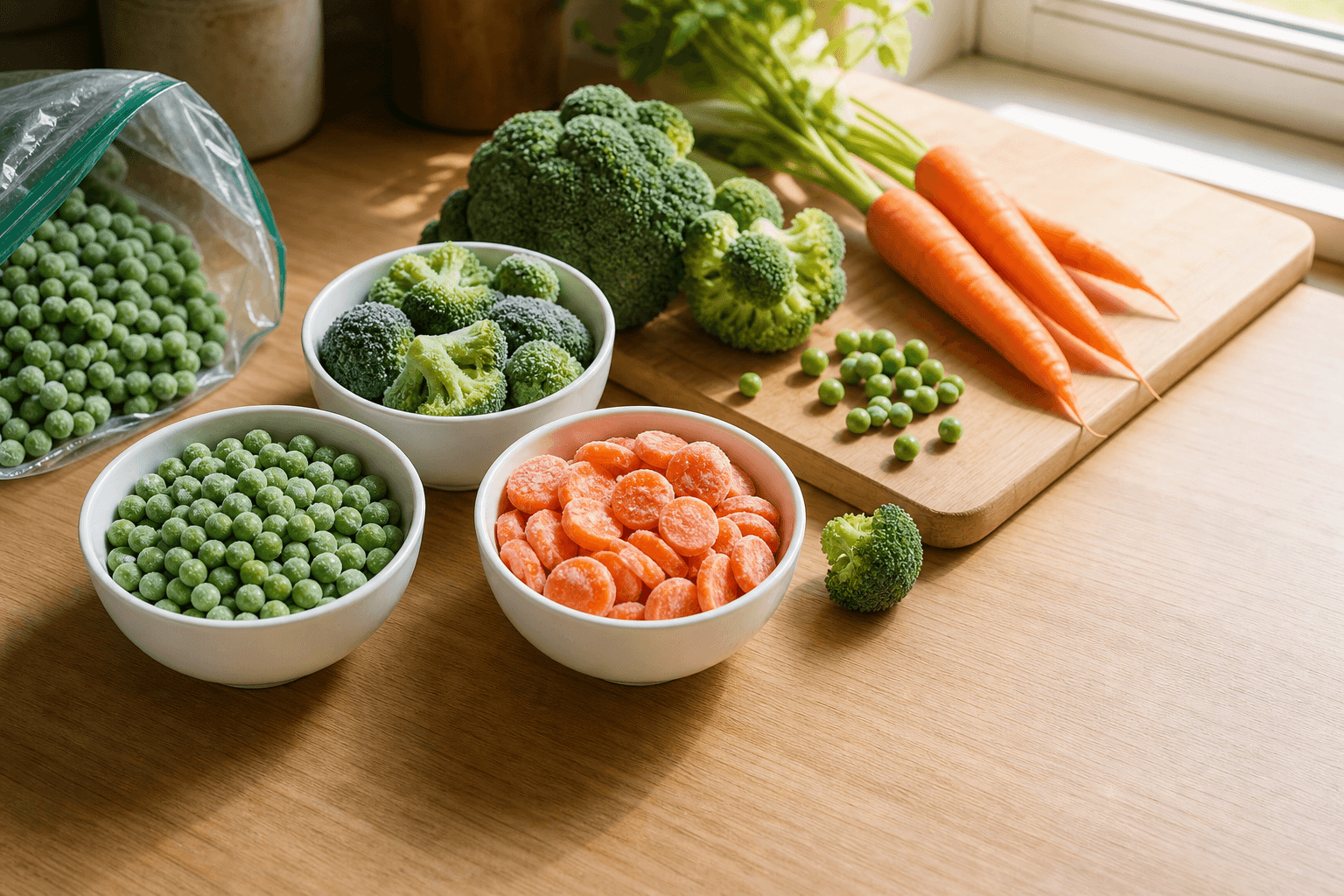
Yes. A UC Davis team compared eight crops in fresh and frozen form and found vitamin C statistically the same in five of them, and higher in the frozen version for the other three. Blanching does cost some water-soluble vitamin content up front, and what you get back is enzyme shutdown. Fresh peas held three weeks in a refrigerator lost 46% of their beta-carotene by wet weight. Frozen peas over those same three weeks were sitting still.
So compare frozen against the fresh produce you actually buy, the kind that rode a truck and then sat in your crisper, rather than against something picked an hour ago.
How frozen vegetables compare to fresh, nutrient by nutrient
| Nutrient | Frozen vs fresh | Best for | Watch out |
|---|---|---|---|
| Vitamin C (ascorbic acid) | No significant difference in 5 of 8 crops, higher in frozen in the other 3 | The nutrient people worry about most | Measured across corn, carrots, broccoli, spinach, peas, green beans, strawberries and blueberries |
| Riboflavin (B2) | No significant difference, except broccoli (higher frozen) and peas (lower frozen) | B-vitamin retention | Peas are the one clear loss in this data |
| Vitamin E (alpha-tocopherol) | Higher in frozen for 3 crops, no difference in the rest | A genuine point in frozen's favor | Rickman notes there are relatively few studies of vitamin E in produce |
| Beta-carotene | Fresh wins | Carrot and broccoli dishes | Blanching and freezing cut trans-beta-carotene 22% to 48% in broccoli and 10% to 36% in carrots |
| Minerals and fiber | Format barely matters | Iron, calcium, magnesium, zinc, copper, fiber | Losses come from peeling and trimming during processing, not from freezing or canning |
| Canned vegetables | Close, with a sodium asterisk | Shelf-stable backup | Draining and rinsing cuts sodium 9% to 23%, and costs 5% to 28% of the vitamin C |
How to swap frozen vegetables for fresh
- Match by weight, not by volume. Frozen vegetables arrive peeled and trimmed, so a bag weighs what it says. A head of broccoli does not.
- Skip the boil. Boiling leaches water-soluble vitamins into water you pour down the sink, and cooking method moves the needle more than fresh versus frozen does. Steam or roast instead.
- Add frozen vegetables later than you would add fresh in anything wet. Blanching already cooked them partway.
- For canned, drain and rinse when sodium matters, or buy no-salt-added and skip the tradeoff. Draining and rinsing costs 5% to 28% of the vitamin C, per USDA's Agricultural Research Service.
- Keep the fresh produce you do buy moving. Refrigerated spinach lost 10% of its beta-carotene by wet weight and 23% by dry weight over three weeks. An app that tracks expiration dates is a cheaper fix than buying better spinach.
What changes in taste and texture with frozen vegetables
Water is the difference you taste. Freezing ruptures cell walls, so frozen vegetables shed liquid as they heat and go soft faster than fresh ones. That suits soup, chili, curry and fried rice, where a little extra moisture disappears into the sauce. It shows up in a crowded stir-fry, where the released water steams the vegetables instead of searing them. Cook in batches or turn the heat up.
When not to swap frozen vegetables for fresh
Raw applications are the clear exception. Salads and slaws need the crunch that freezing takes away.
Beta-carotene is the other one, and it deserves a straight answer. Blanching and freezing cut trans-beta-carotene 22% to 48% in broccoli and 10% to 36% in carrots across two harvest years, with smaller carotene losses of 5% in green beans, 16% in peas and 12% in spinach. If carrots or broccoli are your main carotenoid source, fresh has a real edge.
Caveats worth knowing about frozen vegetable nutrition
Under-blanching is worse than not blanching at all, because it stimulates enzyme activity rather than stopping it (Colorado State University Extension). That is why a commercial bag is usually more reliable than a batch you blanched by guess. Steam blanching helps retain water-soluble vitamins if you freeze your own. Freezing your own greens is covered in kale without blanching.
Wet-weight comparisons need care. Moisture shifts during processing, so a nutrient can look more concentrated purely because water left. Rickman argues dry-weight comparison would be more appropriate.
Nutrient content varies more by cultivar, growing conditions and season than by preservation format. Rickman's conclusion is to eat a wide variety of produce in whatever form you can get it.
One disclosure: the 2015 UC Davis study was funded in part by the Frozen Food Foundation. It was peer reviewed in the Journal of Agricultural and Food Chemistry, and the beta-carotene finding cuts against the funder's interest. You should still know who paid.
Related frozen vegetable and canned swaps
Fresh vs frozen vs canned substitution ratios has the measuring conversions. Cooking with frozen vegetables vs fresh covers technique, and canned tomatoes instead of fresh covers the tomato side of the pantry.
Frozen vegetable questions people ask
Do frozen vegetables lose nutrients?
Some, at the blanching step. They then hold what remains for months, while fresh produce keeps losing nutrients every day it sits in the fridge. That is the trade: a one-time loss in exchange for stopping the enzymes that would otherwise degrade color, flavor and nutrients the whole time the food is frozen.
Are any frozen vegetables actually better than fresh?
Vitamin E was higher in frozen for three of the eight crops UC Davis tested, and vitamin C was higher in frozen for three of eight. Canned and cooked tomatoes also release their lycopene more readily than raw ones do.
What are frozen vegetables worse at than fresh?
Beta-carotene. Blanching and freezing cut trans-beta-carotene by 22% to 48% in broccoli and 10% to 36% in carrots across two harvest years.
Are canned vegetables as good as frozen vegetables?
Close on minerals and fiber, which are stable to processing, storage and cooking. The difference is added sodium, which you can cut 9% to 23% by draining and rinsing, or avoid by buying no-salt-added.
Cook the frozen vegetables you already have
Well Stockd's substitution engine suggests swaps from what is already in your kitchen when a recipe calls for something you are out of. Frozen and canned forms count, and you can reject any form you never want suggested. See also the best pantry inventory app and apps that cut food waste.
Sources: Bouzari, Holstege & Barrett, J. Agric. Food Chem. 2015, 63(3):957-962, PubMed 25526594; Rickman, Bruhn & Barrett, J. Sci. Food Agric. 2007, 87:1185-1196, Part II and Part I; USDA Agricultural Research Service, drained canned vegetables; University of Minnesota Extension; Colorado State University Extension; American Frozen Food Institute.
Track it in Well Stockd
Add what you have, see what you can cook tonight, and get a reminder before anything goes off.
