Fresh, frozen and canned: the substitution ratios
USDA yield numbers for swapping fresh, frozen and canned vegetables and tomatoes: cups per pound, cups per can, the tomato can ladder, and why frozen spinach breaks the rule.
Swap by finished volume, not package weight. A pound of frozen vegetables cooks down to about 2-1/2 cups. A 14.5-ounce can drains to about 1-1/4 cups. A 28-ounce can of tomatoes replaces about 2 pounds of fresh. Spinach breaks the rule at 1-3/8 cups per pound.
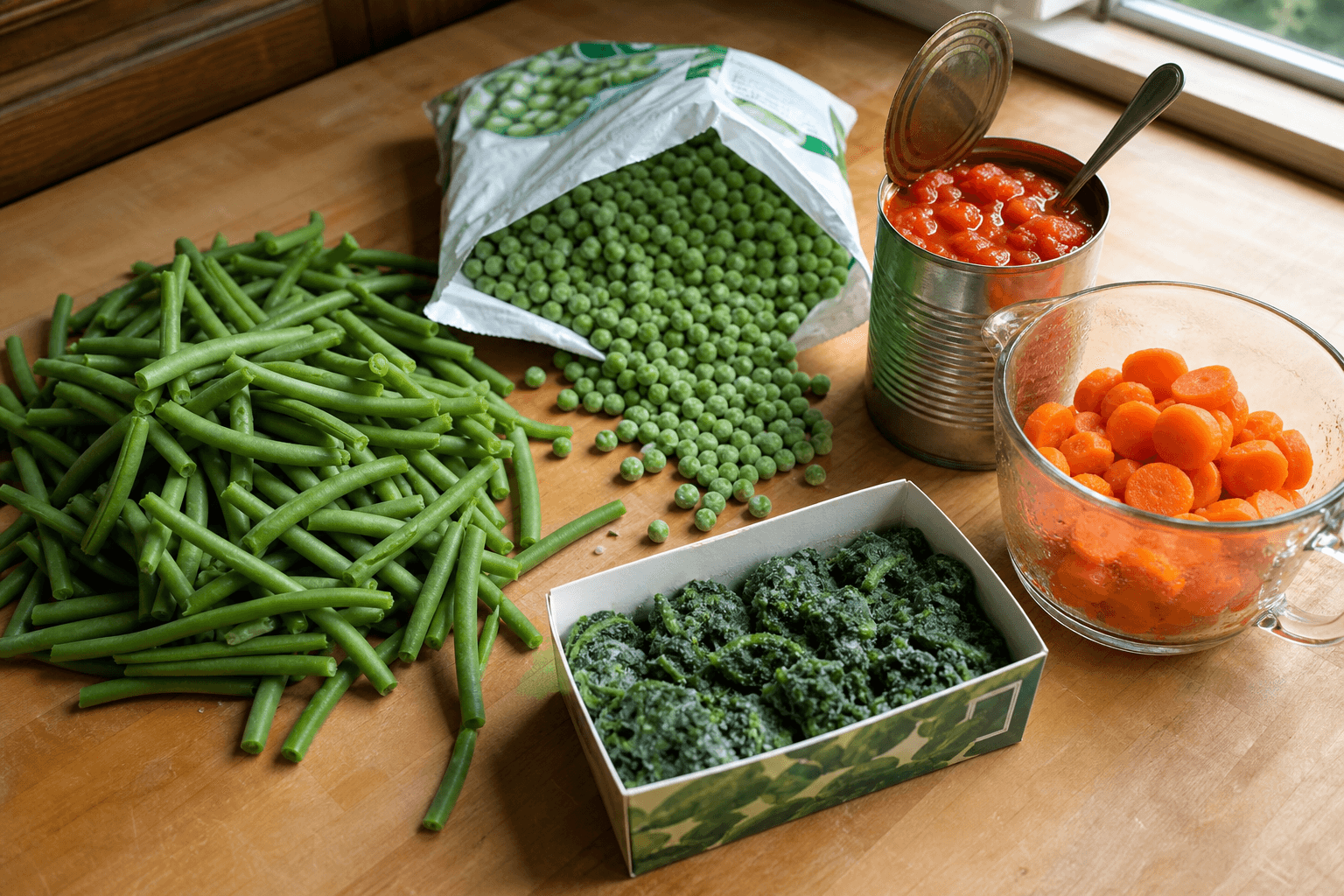
The short version of fresh, frozen and canned swaps
- Frozen for fresh: 1 pound frozen equals about 1 pound fresh trimmed, about 2-1/2 cups cooked and drained.
- Canned for fresh: one 14.5 to 15 ounce can equals about 1-1/4 cups drained, about half a pound of frozen.
- Canned tomatoes for fresh: one 28-ounce can equals about 2 pounds of fresh, one 14.5-ounce can about 1 pound.
- Frozen for canned: one 14.5-ounce can, drained, equals about 6 to 8 ounces of frozen.
- Leafy greens are the exception. One 10-ounce box of frozen spinach equals about 1 pound of fresh.
- Cook frozen from frozen. Canned vegetables are already cooked, so they go in near the end.
Every fresh, frozen and canned swap in one table
Package weight does not carry across the three formats. Canned weight includes packing liquid, frozen weight includes ice glaze, and fresh weight includes stems, cores and peel you throw away. That is why every row below is a volume.
| Substitute | Ratio | Best for | Watch out |
|---|---|---|---|
| Frozen for fresh vegetables | 1 lb frozen = about 1 lb fresh trimmed = about 2-1/2 cups cooked | Soups, stews, casseroles | Cook straight from frozen. Weak where texture carries the dish. |
| Canned for fresh vegetables | One 14.5 to 15 oz can = about 1-1/4 cups drained = about half a pound of frozen | Chili, soups, long-cooked dishes | Cooked already, so add near the end. Rinsing cuts sodium 9 to 23%. |
| Canned tomatoes for fresh tomatoes | One 28 oz can = about 2 lb fresh; one 14.5 oz can = about 1 lb fresh | Every cooked tomato dish, year round | Never for raw salads or salsa fresca. |
| Frozen for canned vegetables | One 14.5 oz can drained = about 6 to 8 oz frozen | Better texture in most recipes | Frozen needs real cooking time, canned needs heating. Add it earlier. |
| Frozen chopped greens for fresh greens | One 10 oz box frozen = about 1 lb fresh as purchased | Dips, fillings, lasagna | A pound of frozen spinach yields 1-3/8 cups cooked, not 2-1/2. |
How many cups is a pound of frozen or fresh vegetables?
About 2-1/2 cups cooked and drained for most of what you buy frozen. These USDA Food Buying Guide numbers are cups of cooked, drained vegetable per pound as purchased.
| Vegetable | 1 lb fresh, cooked | 1 lb frozen, cooked | Standard can, drained |
|---|---|---|---|
| Green beans, cut | 2-3/4 cups | 2-7/8 cups | 14.5 oz = 1-1/8 cups |
| Broccoli | 3-1/4 cups (trimmed florets) | 2-3/8 cups cut, 3-1/2 cups florets | Not commonly canned |
| Green peas | 2-5/8 cups (shelled) | 2-3/8 cups | 15.25 oz = 1-1/4 cups |
| Corn, whole kernel | 1-1/3 cups (ears, husks off) | 2-3/4 cups | 15.25 oz = 1-1/2 cups |
| Carrots, sliced or diced | 2-7/8 cups | 2-2/3 cups | 15 oz = 1-1/4 cups |
| Spinach | 3-1/8 cups wilted | 1-3/8 cups chopped, 1-5/8 cups leaf | About 1 cup |
| Tomatoes | 1-2/3 cups cooked | Rarely frozen | 28 oz whole = 2 cups |
Corn surprises people. A pound of fresh corn on the cob, husks off, cooks down to 1-1/3 cups of kernels. A pound of frozen kernels gives you 2-3/4 cups, double the food.
How do you substitute frozen vegetables for fresh?
Match the trimmed weight, then give the frozen vegetable more pan time than canned and less than raw. Frozen vegetables are blanched before freezing, so they start partly cooked, but their ice steals heat from the pan.
- Estimate the fresh amount after trimming. A pound of fresh trimmed green beans and a pound of frozen cut green beans land within a few tablespoons of each other.
- Keep the bag in the freezer until the pan is hot.
- Add the vegetable frozen, in a single layer, and let the water cook off before you stir.
Thawing first is the mistake that gave frozen vegetables their reputation: melt water sits in the pieces and steams them soft. See how to cook frozen vegetables so they taste good if texture is your sticking point. Two more pages in this cluster, cooking with frozen vegetables vs fresh and are frozen vegetables as healthy as fresh, cover that tradeoff.
How many fresh tomatoes equal a 28-ounce can?
About 2 pounds, with an honest range of 1-3/4 to 2-1/2 pounds. USDA Food Buying Guide volumes work out to 1.87 pounds of fresh per 28-ounce can. The National Center for Home Food Preservation reports that a 53-pound bushel yields 17 to 20 quarts of crushed tomatoes, an average of 2-3/4 pounds per quart, which scales to 2.41 pounds per can. The spread reflects how far down you cook the fresh tomatoes.
Can you swap one canned tomato product for another?
Yes, can for can, within about 8%. USDA volumes for a 28-ounce can are 3-1/8 cups whole with juice, 3-1/8 to 3-1/4 cups crushed and 3-3/8 cups diced. Texture changes more than quantity does.
| Canned tomato product | Cups with juice | Cups drained |
|---|---|---|
| Whole or stewed, 28 oz | 3-1/8 | 2 |
| Crushed, 28 oz | 3-1/8 to 3-1/4 | 2-1/8 |
| Diced, 28 oz | 3-3/8 | 2-1/4 |
| Whole or stewed, 14.5 oz | 1-1/2 | About 1 |
| Diced, 14.5 oz | 1-3/4 | About 1-1/8 |
| Tomato sauce, 15 oz | 1-3/4 | n/a |
| Tomato paste, 12 oz | 1-1/4 | n/a |
| Tomato paste, 6 oz | About 5/8 (10 Tbsp) | n/a |
That last row is why half a can of paste ends up in the fridge: ten tablespoons in a 6-ounce can, and most recipes want two. See what to do with leftover tomato paste. Pages on canned tomatoes instead of fresh, canned peeled tomatoes instead of tomato sauce, and a canned diced tomatoes substitute guide are queued in this cluster.
Why does frozen spinach break the ratio?
Leafy greens are mostly air and water when fresh, and neither survives the freezer. A pound of fresh spinach gives you 6-3/8 cups raw chopped and 3-1/8 cups wilted, per the USDA Food Buying Guide, while a pound of frozen chopped spinach gives you 1-3/8 cups. Trust the box instead of the scale: one 10-ounce box replaces about 1 pound of fresh.
Greens are the one place you should thaw. Squeeze the thawed block hard in a clean towel until it stops dripping, or a spinach dip turns into soup. Pages on substituting frozen spinach for fresh and on what a 10-ounce box equals in fresh are coming later in this series.
Should you drain and rinse canned vegetables?
Yes, if sodium matters to you. USDA Agricultural Research Service work by Haytowitz found that draining and rinsing cut sodium by 9 to 23%, with corn losing 9% on draining and another 12% on rinsing. The cost is 5 to 28% of the vitamin C, though in green beans and corn that vitamin C was not there in nutritionally significant amounts anyway.
Rinse in a colander under cool running water, then shake dry. The vegetable is fully cooked in the can, so add it in the last few minutes of a simmer.
How long do frozen and canned vegetables keep?
Frozen vegetables hold their quality for 8 to 12 months at 0 F, per University of Minnesota Extension. Colorado State University Extension puts the window at 12 to 18 months. Take the shorter number. Quality runs out before safety does.
Cornell Cooperative Extension gives high-acid cans such as tomatoes 12 to 18 months on the shelf, and low-acid cans such as vegetables and meat 2 to 5 years. The Wyoming Department of Health puts an opened high-acid can at 5 to 7 days in the fridge. Store cans at 50 to 70 F: University of Minnesota Extension warns that storage above 75 F increases nutrient loss and anything over 100 F is harmful. How long canned food is good after the expiration date covers older cans.
Safety limits on fresh, frozen and canned ratios
These are cooking ratios. Do not use them to modify a tested home-canning recipe. Substituting fresh for canned, or changing the proportion of tomatoes to other vegetables, changes acidity and heat penetration inside the jar. Only a tested National Center for Home Food Preservation recipe has been checked for that.
If you can tomatoes at home, acidify every jar: 2 tablespoons of bottled lemon juice or 1/2 teaspoon of citric acid per quart, 1 tablespoon or 1/4 teaspoon per pint. Use bottled lemon juice, because its acidity is consistent. Utah State University Extension says to discard any badly dented, bulging, rusty or leaking can without opening it.
Fresh, frozen and canned questions people ask
Is frozen or canned closer to fresh?
Frozen, for texture and for most nutrients. Canned is closest for tomatoes, where the canned product carries more lycopene than fresh.
How many cups is a pound of frozen vegetables?
About 2-1/2 cups cooked and drained for most vegetables. Spinach and other leafy greens yield only about 1-3/8 cups per pound.
Do you need to thaw frozen vegetables first?
No, and you should not. The exception is frozen spinach and other leafy greens, which you thaw and squeeze dry.
Can you use canned diced tomatoes when a recipe says crushed?
Yes, within about 8%. A 28-ounce can holds 3-1/8 cups whole, 3-1/8 to 3-1/4 crushed or 3-3/8 diced, per USDA.
Swap fresh, frozen and canned from what you already have
Ratios only help when you know what is in the freezer. Well Stockd keeps your fridge, freezer and pantry in one list, and when a recipe calls for something you are out of, the substitution engine offers swaps from what you have. Frozen and canned forms count, and you can reject any swap you would rather not see again.
For tools rather than ratios, start with the best pantry inventory app or an app to track food expiration dates. Dairy runs on its own math: the buttermilk substitute ratios show how different that looks.
Sources: USDA Food Buying Guide; USDA ARS, canned vegetable rinsing; NCHFP, canning tomatoes; NCHFP, crushed tomatoes; Colorado State Extension; UMN Extension, freezing; UMN Extension, storing canned food; Cornell Extension, food storage; Wyoming Health, storage times; Utah State Extension, cans.