Printable ingredient substitution chart (free PDF)
A printable ingredient substitution chart built from university extension publications, with the exact ratios for dairy, eggs, baking staples, herbs and canned goods, plus the swaps that break the usual rules.
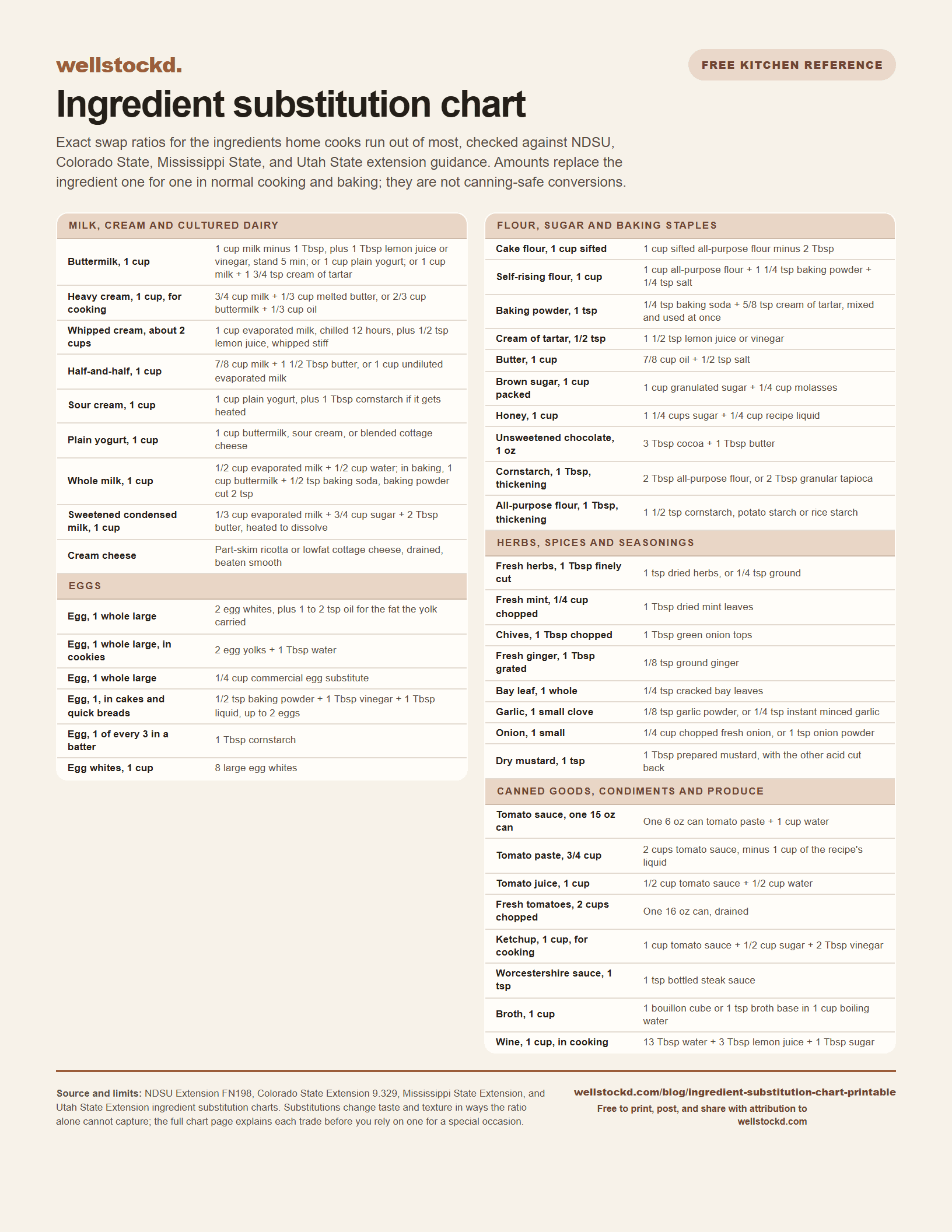
Print or download the ingredient substitution chart
Use the clean print layout below, or download the free letter-size PDF and high-resolution PNG. No email address is required.
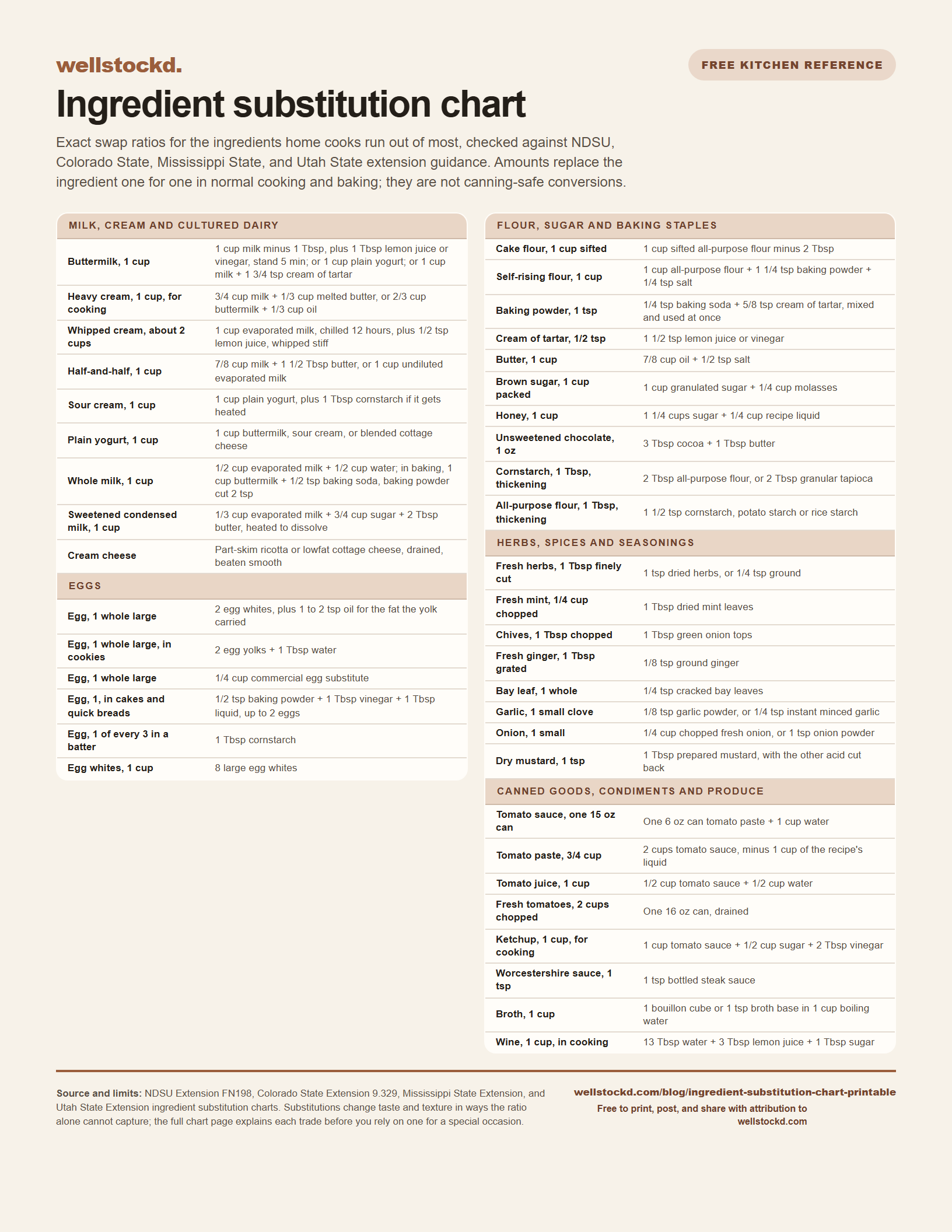
Primary references: NDSU Extension ingredient substitutions (FN198) and Colorado State Extension ingredient substitutions (9.329).
Free to print, post, and share with attribution to wellstockd.com.
Four swaps cover most kitchen emergencies. One cup of buttermilk is 1 cup of milk minus 1 tablespoon, plus 1 tablespoon of lemon juice or vinegar, rested 5 minutes. One tablespoon of cornstarch is 2 tablespoons of all-purpose flour. One small clove of garlic is 1/8 teaspoon of garlic powder. One tablespoon of chopped fresh herbs is 1 teaspoon of dried.
Every row traces to a university extension publication: NDSU FN198, Colorado State 9.329, Mississippi State, Utah State and Penn State. Where those disagree, I print the figure America's Test Kitchen tested. Download the free PDF or PNG above, no email required, and tape it to a cabinet door.
The printable ingredient substitution chart
Milk, cream and cultured dairy
| Recipe calls for | Use instead |
|---|---|
| Buttermilk, 1 cup | 1 cup milk minus 1 Tbsp, plus 1 Tbsp lemon juice or vinegar, stand 5 min; or 1 cup plain yogurt; or 1 cup milk + 1 3/4 tsp cream of tartar |
| Heavy cream, 1 cup, for cooking | 3/4 cup milk + 1/3 cup melted butter, or 2/3 cup buttermilk + 1/3 cup oil |
| Whipped cream, about 2 cups | 1 cup evaporated milk, chilled 12 hours, plus 1/2 tsp lemon juice, whipped stiff |
| Half-and-half, 1 cup | 7/8 cup milk + 1 1/2 Tbsp butter, or 1 cup undiluted evaporated milk |
| Sour cream, 1 cup | 1 cup plain yogurt, plus 1 Tbsp cornstarch if it gets heated |
| Plain yogurt, 1 cup | 1 cup buttermilk, sour cream, or blended cottage cheese |
| Whole milk, 1 cup | 1/2 cup evaporated milk + 1/2 cup water; in baking, 1 cup buttermilk + 1/2 tsp baking soda, baking powder cut 2 tsp |
| Sweetened condensed milk, 1 cup | 1/3 cup evaporated milk + 3/4 cup sugar + 2 Tbsp butter, heated to dissolve |
| Cream cheese | Part-skim ricotta or lowfat cottage cheese, drained, beaten smooth |
Eggs
| Recipe calls for | Use instead |
|---|---|
| Egg, 1 whole large | 2 egg whites, plus 1 to 2 tsp oil for the fat the yolk carried |
| Egg, 1 whole large, in cookies | 2 egg yolks + 1 Tbsp water |
| Egg, 1 whole large | 1/4 cup commercial egg substitute |
| Egg, 1, in cakes and quick breads | 1/2 tsp baking powder + 1 Tbsp vinegar + 1 Tbsp liquid, up to 2 eggs |
| Egg, 1 of every 3 in a batter | 1 Tbsp cornstarch |
| Egg whites, 1 cup | 8 large egg whites |
Flour, sugar and baking staples
| Recipe calls for | Use instead |
|---|---|
| Cake flour, 1 cup sifted | 1 cup sifted all-purpose flour minus 2 Tbsp |
| Self-rising flour, 1 cup | 1 cup all-purpose flour + 1 1/4 tsp baking powder + 1/4 tsp salt |
| Baking powder, 1 tsp | 1/4 tsp baking soda + 5/8 tsp cream of tartar, mixed and used at once |
| Cream of tartar, 1/2 tsp | 1 1/2 tsp lemon juice or vinegar |
| Butter, 1 cup | 7/8 cup oil + 1/2 tsp salt |
| Brown sugar, 1 cup packed | 1 cup granulated sugar + 1/4 cup molasses |
| Honey, 1 cup | 1 1/4 cups sugar + 1/4 cup recipe liquid |
| Unsweetened chocolate, 1 oz | 3 Tbsp cocoa + 1 Tbsp butter |
| Cornstarch, 1 Tbsp, thickening | 2 Tbsp all-purpose flour, or 2 Tbsp granular tapioca |
| All-purpose flour, 1 Tbsp, thickening | 1 1/2 tsp cornstarch, potato starch or rice starch |
Herbs, spices and seasonings
| Recipe calls for | Use instead |
|---|---|
| Fresh herbs, 1 Tbsp finely cut | 1 tsp dried herbs, or 1/4 tsp ground |
| Fresh mint, 1/4 cup chopped | 1 Tbsp dried mint leaves |
| Chives, 1 Tbsp chopped | 1 Tbsp green onion tops |
| Fresh ginger, 1 Tbsp grated | 1/8 tsp ground ginger |
| Bay leaf, 1 whole | 1/4 tsp cracked bay leaves |
| Garlic, 1 small clove | 1/8 tsp garlic powder, or 1/4 tsp instant minced garlic |
| Onion, 1 small | 1/4 cup chopped fresh onion, or 1 tsp onion powder |
| Dry mustard, 1 tsp | 1 Tbsp prepared mustard, with the other acid cut back |
Canned goods, condiments and produce
| Recipe calls for | Use instead |
|---|---|
| Tomato sauce, one 15 oz can | One 6 oz can tomato paste + 1 cup water |
| Tomato paste, 3/4 cup | 2 cups tomato sauce, minus 1 cup of the recipe's liquid |
| Tomato juice, 1 cup | 1/2 cup tomato sauce + 1/2 cup water |
| Fresh tomatoes, 2 cups chopped | One 16 oz can, drained |
| Ketchup, 1 cup, for cooking | 1 cup tomato sauce + 1/2 cup sugar + 2 Tbsp vinegar |
| Worcestershire sauce, 1 tsp | 1 tsp bottled steak sauce |
| Broth, 1 cup | 1 bouillon cube or 1 tsp broth base in 1 cup boiling water |
| Wine, 1 cup, in cooking | 13 Tbsp water + 3 Tbsp lemon juice + 1 Tbsp sugar |
How to use the ingredient substitution chart
Read the left column as the amount your recipe asks for, then scale the formula from there. For 1/2 cup of buttermilk, halve both halves: 1/2 cup of milk minus 1 1/2 teaspoons, plus 1 1/2 teaspoons of vinegar. Measures are standard US: 3 teaspoons to a tablespoon, 16 tablespoons to a cup.
Where a row tells you to pull liquid back out or change the leavening, that part is not optional. NDSU's warning belongs here: swapping one ingredient for another "may alter the taste, color, moisture content or texture of the product." Frozen and canned forms follow their own substitution ratios. And this is a pantry tool, not an allergy tool. Steak sauce for Worcestershire keeps the anchovy problem.
Ingredient substitution chart exceptions
Ginger is the big one. It dries down to roughly a twenty-fourth of its volume, so 1 tablespoon grated becomes 1/8 teaspoon ground, nowhere near 3:1. Mint runs 4:1, a quarter cup fresh to 1 tablespoon dried. Chives have no useful dried figure, so the extension charts send you to green onion tops instead. Fresh ginger left over? See whether you can freeze ginger.
The 3:1 herb rule has a job description. America's Test Kitchen limits it to oregano, rosemary, sage and thyme, in a dish with liquid that cooks 20 minutes or longer. Raw dishes and delicate leaves are a different problem, covered in the fresh to dried herb conversion chart.
Arrowroot splits the sources three ways. Colorado State calls it an even trade for cornstarch, NDSU calls it stronger, and America's Test Kitchen tested it and found it weaker: 1 1/2 teaspoons of arrowroot per 1 teaspoon of cornstarch, which is what I print. Colorado State also puts 1 1/2 tablespoons of butter in the half-and-half row where NDSU says 1/2 tablespoon; the chart takes the richer one. Self-rising flour splits the same way. I print Colorado State's 1 1/4 teaspoons of baking powder and 1/4 teaspoon of salt per cup of flour; NDSU runs it heavier at 1 1/2 teaspoons of baking powder and 1/2 teaspoon of salt, with 2 teaspoons of flour taken back out.
Ingredient substitution chart questions
What can I use instead of buttermilk?
Put 1 tablespoon of lemon juice or vinegar in a measuring cup, top up with milk to the 1-cup line, and stand it 5 minutes. Plain yogurt swaps 1:1. Four extension publications print both, and the buttermilk substitute breakdown covers which suits pancakes versus biscuits.
What replaces cornstarch for thickening?
Two tablespoons of all-purpose flour per tablespoon of cornstarch. Colorado State, NDSU, Mississippi State and Utah State print it identically. Flour clouds a sauce that cornstarch would leave clear.
How much garlic powder equals a clove of garlic?
An eighth of a teaspoon per small clove, or 1/4 teaspoon of instant minced garlic. USDA FoodData Central puts a raw clove at 3 grams.
Can I substitute milk and butter for heavy cream?
For cooking and baking, yes: 3/4 cup of milk plus 1/3 cup of melted butter makes 1 cup. Colorado State says plainly that this will not whip; for that, use the evaporated milk row above.
How much tomato sauce equals a can of tomato paste?
A 6 oz can of paste is about 3/4 cup, or roughly 2 cups of sauce, and you pull about 1 cup of liquid back out of the recipe.
Where the ingredient substitution chart stops
A chart tells you what a substitution costs. It cannot tell you which swaps you can make tonight. Well Stockd's substitution engine reads your own kitchen and suggests swaps from what you already have when a recipe calls for something you are out of. Frozen and canned forms count, and you can reject any swap you would rather not see again. That runs on a real inventory, which is what a pantry inventory app and an app to track food expiration dates keep for you.
Sources: NDSU FN198, Colorado State 9.329, Mississippi State, Utah State, Penn State, America's Test Kitchen, USDA FoodData Central.