Frozen vegetables vs fresh: cook them from frozen
When to use frozen vegetables instead of fresh, the skillet char ratio from America's Test Kitchen, roasting and simmer timings, and the five vegetables to always buy fresh.
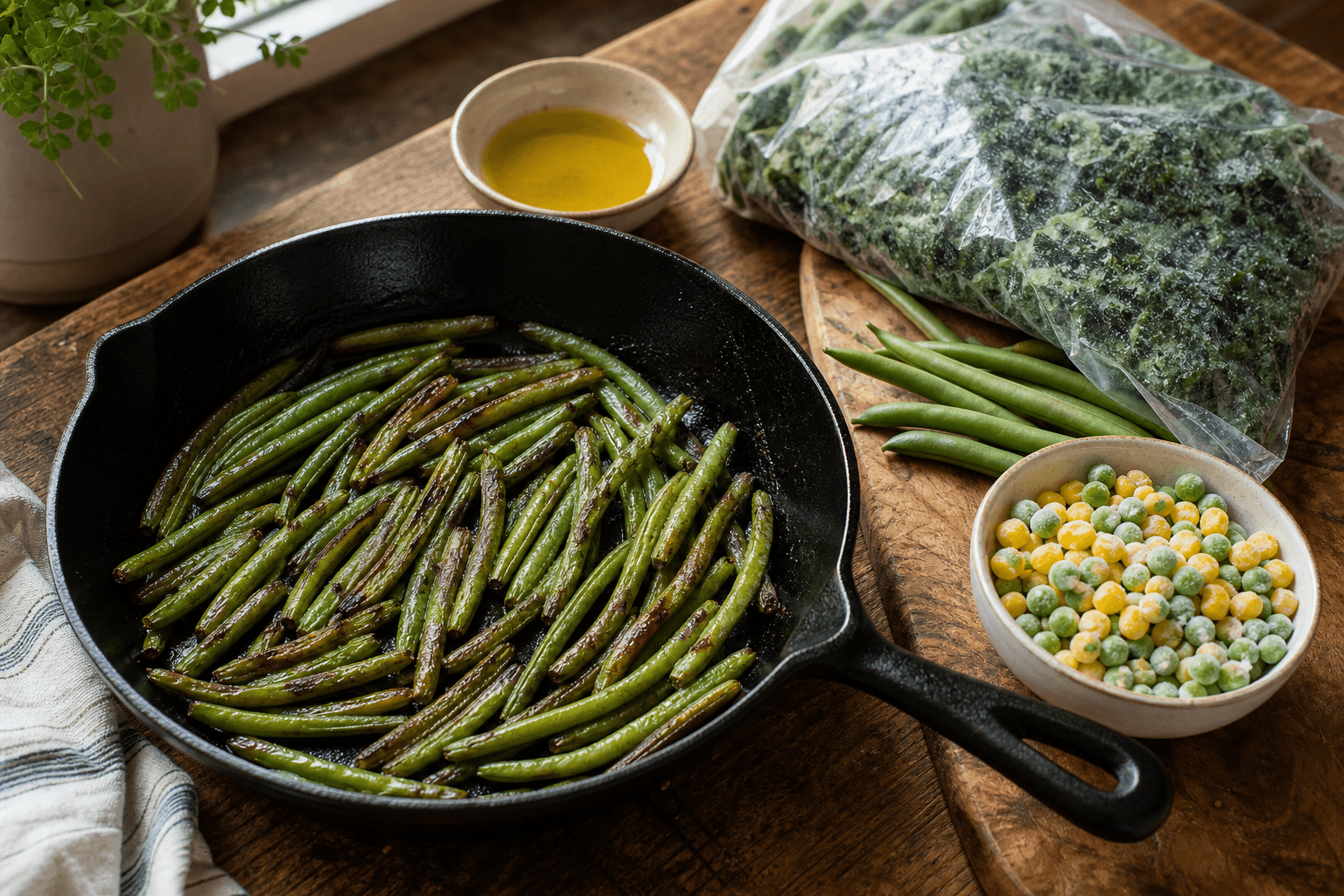
Cook frozen vegetables straight from the freezer, never thawed. America's Test Kitchen chars frozen green beans by heating 2 tablespoons of oil in a skillet until it just smokes, adding 1 pound of beans in a single layer, and leaving them alone until they soften and brown. Thawing melts the ice crystals into water, and that water steams the pieces soft before they can color. Frozen spinach is the one exception: thaw it, then squeeze it dry.
Frozen vegetable methods and ratios
| Substitute | Ratio | Best for | Watch out |
|---|---|---|---|
| Frozen green beans or corn, skillet char | 1 lb to 2 Tbsp oil | Browning and bite | Heat the oil until just smoking, add in one layer, do not stir |
| Frozen broccoli, cauliflower or carrots, roasted | Single layer on a preheated sheet pan, generously coated in oil | Hands-off side dishes | A crowded pan traps steam and you get soggy instead of roasted |
| Frozen peas, corn or spinach stirred into a simmer | Straight in for the last 3 to 5 minutes | Soups, stews, curries, fried rice, pot pies | They were blanched before freezing, so they are already partly cooked |
| Frozen chopped spinach, collards or kale, thawed and squeezed | One 10 oz box yields about 220 g cooked, roughly 1 to 1-1/4 cups | Dips, lasagna, quiche, stuffed shells, egg bakes | The only exception to the no-thaw rule. Unsqueezed spinach waters down a filling |
| Fresh | n/a | Raw dishes, and anything where the vegetable is the star | ATK says bell peppers, snow peas, snap peas, asparagus and mushrooms do not freeze well |
How to cook frozen vegetables instead of fresh
- Keep the bag in the freezer until the pan is fully preheated. Frozen vegetables left on the counter start weeping right away.
- For a skillet char, heat 2 tablespoons of oil per pound over high heat until it just smokes, then add the vegetables in a single layer.
- Leave them alone. Stirring drops the pan temperature and the vegetables steam instead of browning. Wait until the undersides color before you move anything.
- For roasting, preheat the sheet pan, coat the vegetables generously with oil, and spread them out with space between the pieces.
- Season after they have color. Salt at the start pulls moisture to the surface and works against browning.
- For soups, stews, curries, fried rice and pot pies, add frozen peas, corn or spinach in the last 3 to 5 minutes.
What changes in taste and texture with frozen vegetables
Frozen vegetables were blanched in boiling water or steam before freezing, which deactivates the enzymes that would degrade them in the freezer, per University of Minnesota Extension. Colorado State University Extension lists 4 minutes of boiling for green beans and 2-1/2 minutes for green peas. Blanching wilts and softens, so what comes out of the bag is already partly cooked. Follow the fresh-vegetable time in a recipe and you will overshoot.
Flavor sometimes runs the other way. America's Test Kitchen prefers frozen peas to fresh outright, because freezing halts the sugar-to-starch conversion that starts the moment peas are picked, which makes frozen peas reliably sweeter. ATK also prefers frozen corn to fresh except in summer, and says to skip frozen corn on the cob for poor texture.
When not to substitute frozen vegetables for fresh
ATK singles out bell peppers, snow peas, snap peas, asparagus and mushrooms as vegetables that do not freeze well. They carry too much water, and it ruins their texture on the way back out. If you still want to try mushrooms, see can you freeze mushrooms.
Broccoli, cauliflower, carrots and green beans sit in a different category. They work frozen in soups, stews and long-cooked dishes, where a little softness disappears into the pot. When one of them is the main component on the plate, buy fresh.
Raw dishes stay fresh. Nothing frozen makes a decent cucumber salad.
Caveats for cooking with frozen vegetables
There is no food-safety reason to thaw frozen vegetables before cooking. They are safe cooked from frozen, so the from-frozen rule costs you nothing there.
One 10 oz box of frozen chopped spinach cooks down to about 220 g, roughly 1 to 1-1/4 cups, per USDA FoodData Central. That is the number to plan around when a recipe asks for a set amount of cooked spinach. Squeeze it hard in a clean towel or over the sink first, or a dip turns to soup.
For oven roasting, coat the vegetables generously rather than measuring. The 2 tablespoons per pound figure is ATK's skillet ratio, and there is no equally tested number for the oven, so generous beats precise here.
Related frozen vegetable, fresh and canned swaps
Fresh vs frozen vs canned substitution ratios collects the conversions for the other forms in one place. Canned tomatoes instead of fresh handles the tomato version of this question, and the printable ingredient substitution chart is the one to tape inside a cabinet door.
Common questions about frozen vegetables
Should I thaw frozen vegetables before cooking?
No. Cook them from frozen. Thawing releases melt water into the pieces and steams them. The exception is leafy greens like spinach, which you thaw and squeeze dry. For kale, see can you freeze kale without blanching.
Why do my frozen vegetables come out soggy?
Almost always crowding or too little heat. Use a preheated pan, a single layer with space between the pieces, and resist stirring while they brown.
Are frozen vegetables already cooked?
Partly. They are blanched in boiling water or steam before freezing to deactivate enzymes, so they need less cooking time than fresh.
Which vegetables should I never buy frozen?
America's Test Kitchen singles out bell peppers, snow peas, snap peas, asparagus and mushrooms as too high in moisture to freeze well. Want to freeze peppers anyway? See can you freeze bell peppers.
Cook from the frozen vegetables you already have
Well Stockd's substitution engine suggests swaps from what is already in your kitchen when a recipe calls for something you are out of. Frozen and canned forms count as options, and you can reject any suggestion you never want to see again. If losing track of the freezer is the real problem, the food expiration date tracking guide and the pantry inventory app roundup cover that side of it.
Sources: America's Test Kitchen on charring frozen vegetables, America's Test Kitchen frozen vegetables guide, University of Minnesota Extension on freezing produce, Colorado State University Extension on freezing vegetables, USDA FoodData Central, frozen chopped spinach.
Track it in Well Stockd
Add what you have, see what you can cook tonight, and get a reminder before anything goes off.
