How much tomato sauce equals tomato paste?
The tomato sauce to tomato paste ratio, the liquid you have to take back out to make it work, and the rest of the tomato conversions from Colorado State and NDSU Extension.
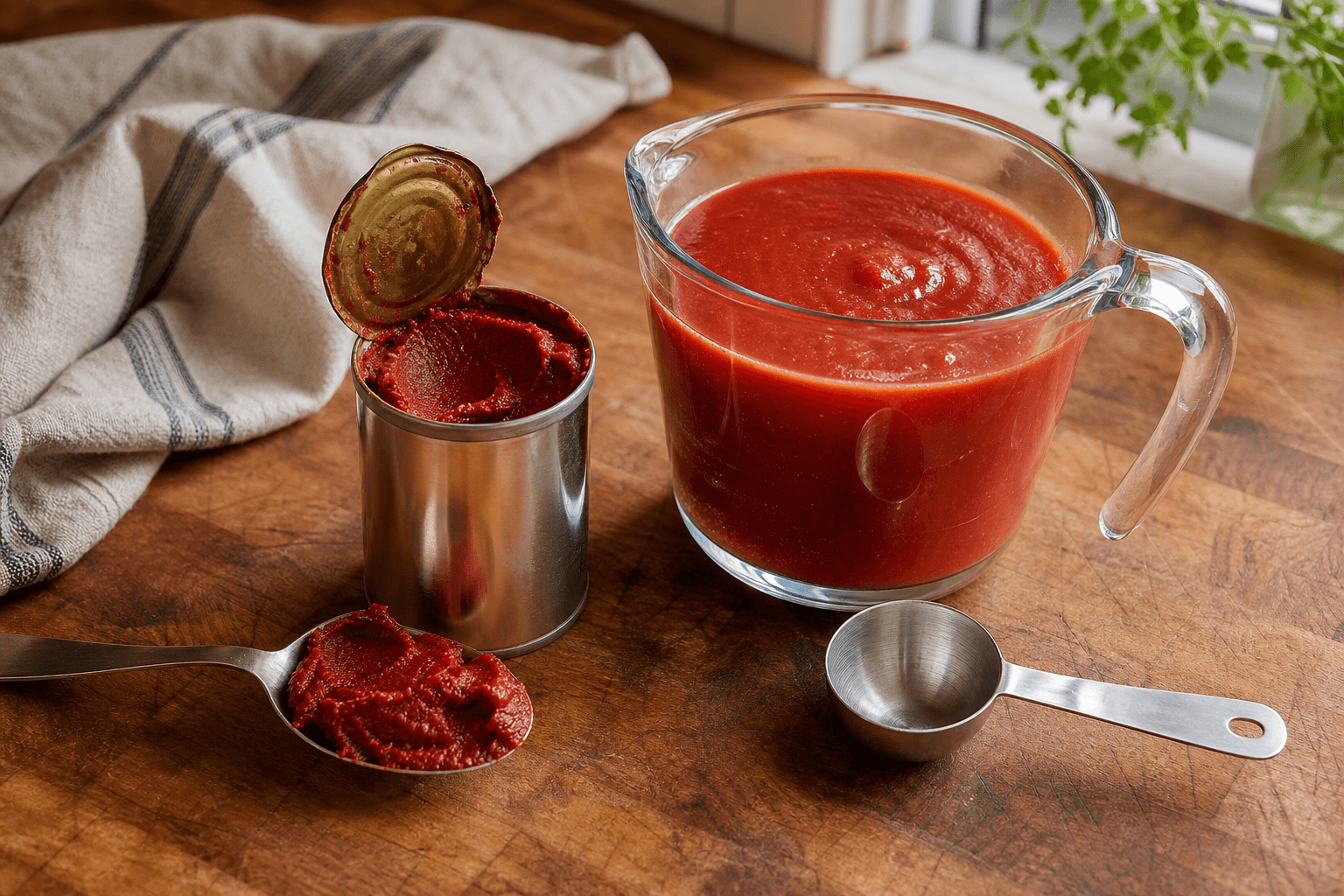
Use 3 tablespoons of tomato sauce for every 1 tablespoon of tomato paste, then take 2 tablespoons of other liquid out of the recipe. For a whole 6-ounce can of paste, about 3/4 cup, that comes to 2 cups of tomato sauce with 1 cup of liquid removed.
The second half of that sentence is the part people skip, and it decides whether your chili thickens. Colorado State University Extension prints the equation from the other direction: 2 cups of tomato sauce equals 3/4 cup of tomato paste plus 1 cup of water. Paste is one part. The other two parts are water you now have to pull back out.
Tomato sauce to tomato paste ratios
| Substitute | Ratio | Best for | Watch out |
|---|---|---|---|
| Tomato sauce, by the tablespoon | 3 Tbsp sauce per 1 Tbsp paste, minus 2 Tbsp of other liquid | Chili, ragu, stews, braises, soups | Forget the liquid removal and the pot stays thin |
| Tomato sauce for a full can of paste | 2 cups sauce per 3/4 cup paste, minus 1 cup of liquid | Big-batch chili and sauce | A 6 oz can may measure a little short of 3/4 cup |
| Tomato paste for tomato sauce (the reverse) | One 15 oz can sauce = one 6 oz can paste + 1 cup water | Recipes that want sauce when you only have paste | Paste and water tastes flat until you season it |
| Tomato puree or passata | About 3 Tbsp per 1 Tbsp paste, handled like sauce | Smooth sauces | Tasting Table prints 2 Tbsp for puree and 3 Tbsp for passata, so start low |
| Tomato juice | 1 cup juice = 1/2 cup tomato sauce + 1/2 cup water | Soups and braises | Convert it to sauce first, then apply the 3 Tbsp ratio |
| Condensed tomato soup | One 10 3/4 oz can = 1 cup tomato sauce + 1/4 cup water | Casseroles | The soup arrives seasoned and sweetened already |
You will see 2 tablespoons printed elsewhere. The Kitchn prints 2 tablespoons of sauce with 2 tablespoons of other liquid taken out; Tasting Table prints 2 tablespoons of sauce with 1 tablespoon taken out. Three tablespoons keeps the shape of the extension formula, 1 part paste plus 2 parts water making 3 parts sauce, and it rounds to whole spoons.
How to swap tomato sauce for tomato paste
- Count the tablespoons of tomato paste the recipe calls for and multiply by three. That number is your tomato sauce.
- Subtract 2 tablespoons of other liquid for every tablespoon of paste you replaced: stock, wine, water, whatever the recipe pours in next. A recipe asking for 2 tablespoons of paste gets 6 tablespoons of sauce and loses 1/4 cup of liquid.
- If there is no liquid to spare, simmer instead. Put the sauce in a small pan over medium heat for 3 to 5 minutes until it thickens, then add it. That cooks off roughly the same water you would otherwise have removed.
- Add the sauce with the other liquids rather than at the start. Recipes that tell you to cook the paste in the hot pan for a minute are after browning, and sauce will not do that.
- Taste before you salt.
What changes when you use tomato sauce instead of tomato paste
The finished dish is a shade lighter and a step back in depth. Frying tomato paste in fat caramelizes it, and that is where a lot of the deep, almost meaty note in a good ragu comes from. Tomato sauce carries too much water to caramelize, so it lands as tomato flavor rather than browned tomato flavor. In a long-simmered chili you will barely notice. In a quick pan sauce that leaned on the paste for that one job, you will.
Salt is the other change. USDA lists canned tomato sauce at about 474 mg of sodium per 100 grams, and a cup weighs 245 grams, so 2 cups of sauce brings in roughly 2,300 mg. Taste before you add any of the salt the recipe asks for.
When not to substitute tomato sauce for tomato paste
Skip the swap when the paste is doing structural work and there is nothing to take away. A glaze brushed on meatloaf, a thick pizza base, a pan sauce meant to cling to noodles: none of those have spare liquid to trade against, so reduce the sauce first or use something else. Ketchup is the other pantry option people reach for there, with its own sugar and vinegar tradeoffs.
Related tomato paste and pantry swaps
- Can I use ketchup instead of tomato paste?, the sweeter, tangier stand-in.
- Fresh vs frozen vs canned substitution ratios for produce.
- Ingredient substitution chart printable for the fridge door.
- Fresh to dried herb conversion chart for the basil in the same pot.
Tomato sauce and tomato paste questions
How much tomato sauce equals 1 tablespoon of tomato paste?
Three tablespoons of tomato sauce, with 2 tablespoons of other liquid removed from the recipe. If you cannot spare the liquid, simmer the 3 tablespoons of sauce for 3 to 5 minutes to cook the water off first.
How much tomato sauce equals a 6 ounce can of tomato paste?
About 2 cups of tomato sauce, with 1 cup of liquid taken out of the recipe. Colorado State Extension prints the equation the other way around: 2 cups of tomato sauce equals 3/4 cup of tomato paste plus 1 cup of water.
How much tomato paste equals a 15 ounce can of tomato sauce?
One 6-ounce can of tomato paste plus 1 cup of water, per NDSU Extension. Whisk it smooth, then season it, because paste and water on its own tastes flat. Salt, a pinch of sugar and dried herbs get it most of the way back.
How many tablespoons are in a 6 ounce can of tomato paste?
About 12 tablespoons, or 3/4 cup, by extension math. Weight-based conversions put it closer to 10 or 11 tablespoons, so measure the can out if you are scaling a recipe.
Find out you are out of tomato paste before you start cooking
Well Stockd suggests substitutions from what is already in your kitchen when a recipe calls for something you are out of. Frozen and canned forms count, and you can reject any swap you do not want to see again. It also handles tracking expiration dates on the cans at the back of the cupboard and keeping a pantry inventory you can check from the store.
Sources: Colorado State University Extension Fact Sheet 9.329, NDSU Extension FN198, Mississippi State University Extension, The Kitchn, Tasting Table, USDA FoodData Central.