How long are eggs good after the expiration date?
Raw eggs keep 3 to 5 weeks in the fridge, usually well past the printed date, since that's about quality, not safety. Inside: USDA storage times, spoilage signs, and how to store eggs so they last.
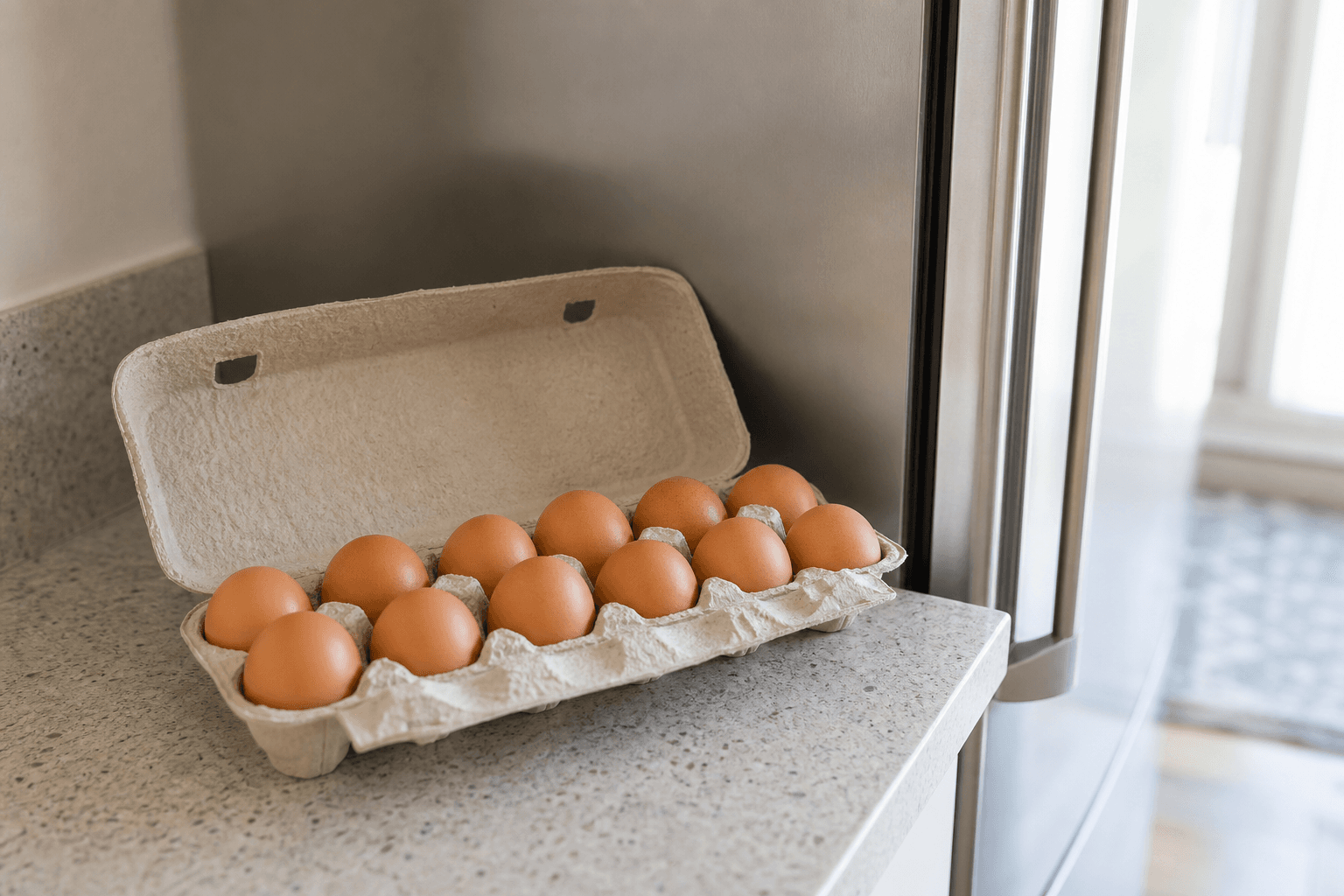
Eggs are good for 3 to 5 weeks in the fridge, which usually runs well past the sell-by or expiration date on the carton. That printed date is about peak quality, not safety. Keep raw eggs at 40°F or colder and they stay safe to eat for weeks.
The date on the carton isn't a hard stop. Under USDA rules, a sell-by date can be at most 30 days after the eggs were packed, and a use-by or best-by date can be at most 45 days after packing. Eggs kept properly in your fridge often outlast even that. For the carton of milk, see how long milk is good after expiry. The window that matters is 3 to 5 weeks from the day you bring them home.
This is part of our guide to how long food lasts.
How long do eggs last past the carton date?
Storage time depends on the form the egg is in: whole in the shell, cracked into a bowl, boiled, or stirred into a dish. The USDA cold storage chart breaks it down.
| Egg form | Refrigerator (40°F) | Freezer (0°F) | Room temperature |
|---|---|---|---|
| Raw eggs, in shell | 3 to 5 weeks | Do not freeze in shell | 2 hours max |
| Raw egg whites and yolks (out of shell) | 2 to 4 days | Whites up to 1 year; yolks do not freeze well | 2 hours max |
| Hard-cooked (hard-boiled) eggs | 1 week | Do not freeze | 2 hours max |
| Liquid egg substitute, opened | 3 days | Do not freeze | 2 hours max |
| Liquid egg substitute, unopened | 1 week | Do not freeze | 2 hours max |
| Cooked egg dishes and casseroles | 3 to 4 days | 2 to 3 months | 2 hours max |
A couple of things about the table. Those refrigerator times assume a steady 40°F or below. The 2-hour room-temperature limit drops to 1 hour if the kitchen is above 90°F, like on a hot day with no air conditioning. And a hard-boiled egg keeps for less time than a raw one, because boiling strips off the natural coating that protects the shell.
To check a carton before you crack it, see how to tell if eggs are still good for the float test and a few other quick checks.
How to tell if eggs have gone bad
Start with your nose. A bad egg gives off a sharp sulfur or rotten smell the second you crack it, and sometimes even through the shell. That smell is the clearest sign to throw it out.
Then look. Watch for these:
- A shell that's cracked, slimy, or has a powdery, chalky film
- An egg white or yolk that's pink, green, or iridescent, which points to spoilage bacteria
- A yolk or white that looks unusually discolored or watery
- Any mold on or around the shell
The float test can hint at age. Set the egg in a bowl of cold water. A fresh egg sinks and lays flat. An older egg stands on end because the air pocket inside has grown. One that floats is old. Keep in mind that the float test tells you about age, not whether bacteria are present, so pair it with a smell check rather than trusting it alone.
One caveat matters more than the rest. Not every problem shows up. Salmonella, the main safety risk with eggs, can live inside an egg that looks and smells completely normal. You can't see it or smell it. That's why the time rule wins: if raw eggs have sat in the fridge longer than about 5 weeks, don't talk yourself into using them because they seem fine. Cooking is what covers you. Cook eggs until both the white and yolk are firm, and cook egg dishes to an internal temperature of 160°F, which kills Salmonella.
For the full float-test walkthrough and every sensory check, see how to tell if eggs are still good.
How to store eggs so they last
Keep eggs in their original carton and put the carton in the main body of the fridge, toward the back where it's coldest. Skip the door. It looks like the natural spot, but it's the warmest part of the fridge and the temperature swings every time you open it.
The carton does real work. It keeps the eggs from absorbing strong fridge odors and slows moisture loss, and it keeps the pack or sell-by date in plain view. Don't wash store-bought eggs either. They're already cleaned before packing, and rinsing them at home removes a protective layer and can push bacteria through the shell.
One more habit: get eggs back into the fridge within 2 hours of leaving the store, and keep the fridge at 40°F or below.
Can you freeze eggs?
You can, just not in the shell, since the liquid inside expands and cracks the shell as it freezes. Crack the eggs, beat them lightly, and freeze them in an airtight container for up to a year. Whites freeze cleanly on their own. Yolks turn gummy unless you whisk in a pinch of salt or a little sugar first, so label the container so you know which way you went.
We walk through the exact steps, containers, and thaw times in our guide to freezing eggs.
When in doubt, throw it out
The USDA is blunt about this: a date on the carton isn't a safety date. Federal law doesn't even require one, except on infant formula. As the FSIS puts it, if the date passes while the food is in your fridge, it should still be safe and wholesome if it's been handled properly, right up until you see or smell signs of spoilage.
So trust the checks over the print. If a raw egg smells off, looks discolored, or the shell is cracked and slick, it goes in the trash. Same for hard-boiled eggs past a week or an egg dish past 3 to 4 days. When in doubt, throw it out. A single carton isn't worth a case of food poisoning. The same rule, trust your senses over the printed date, applies to raw meat too, so if chicken's on your list, here's how long raw chicken lasts in the fridge.
Track your eggs without the guesswork
Most wasted eggs aren't spoiled. They get forgotten, shoved behind the milk until you have no idea how old they are. That's why we built Well Stockd. You log a carton once, and the app remembers when you bought it and flags it while there's still time to use it. It'll even show you which of 3,800-plus recipes you can make with the eggs and whatever else is already in your fridge. If keeping a running list of expiration dates in your head sounds familiar, here's the app that tracks food expiration dates for you.
Frequently asked questions
Are eggs safe to eat 2 weeks after the sell-by date?
Usually, yes. A sell-by date is at most 30 days after the eggs were packed, and refrigerated eggs stay good for 3 to 5 weeks after you buy them. Two weeks past the sell-by date is well inside that window. Give them a smell check and cook them thoroughly to be safe.
Can you get sick from eating expired eggs?
The risk isn't the date, it's Salmonella, which can be present in raw or undercooked eggs even when they look fine. Age alone doesn't make an egg dangerous, and being fresh doesn't guarantee it's safe either. Cooking eggs until the white and yolk are firm, or to 160°F in a dish, is what protects you.
Why do eggs last so much longer than the date says?
Because the date measures quality, not safety. Eggs kept cold and in their carton hold up for weeks past the printed number. What keeps them good is steady, cold storage, not the stamp on the box. If a carton is running out of time, see what to make with eggs.
Sources: USDA FoodKeeper, USDA FSIS Cold Storage Chart, FoodSafety.gov, FDA.
Quick planning number: see the Eggs fridge shelf-life reference.
Track it in Well Stockd
Add what you have, see what you can cook tonight, and get a reminder before anything goes off.
