Can I use Greek yogurt instead of buttermilk?
Greek yogurt works as a buttermilk substitute at 1 part yogurt to 2 parts milk, or thinned to the consistency of heavy cream and used 1:1. Ratios, steps, what changes in the crumb, and the one time to leave it out.
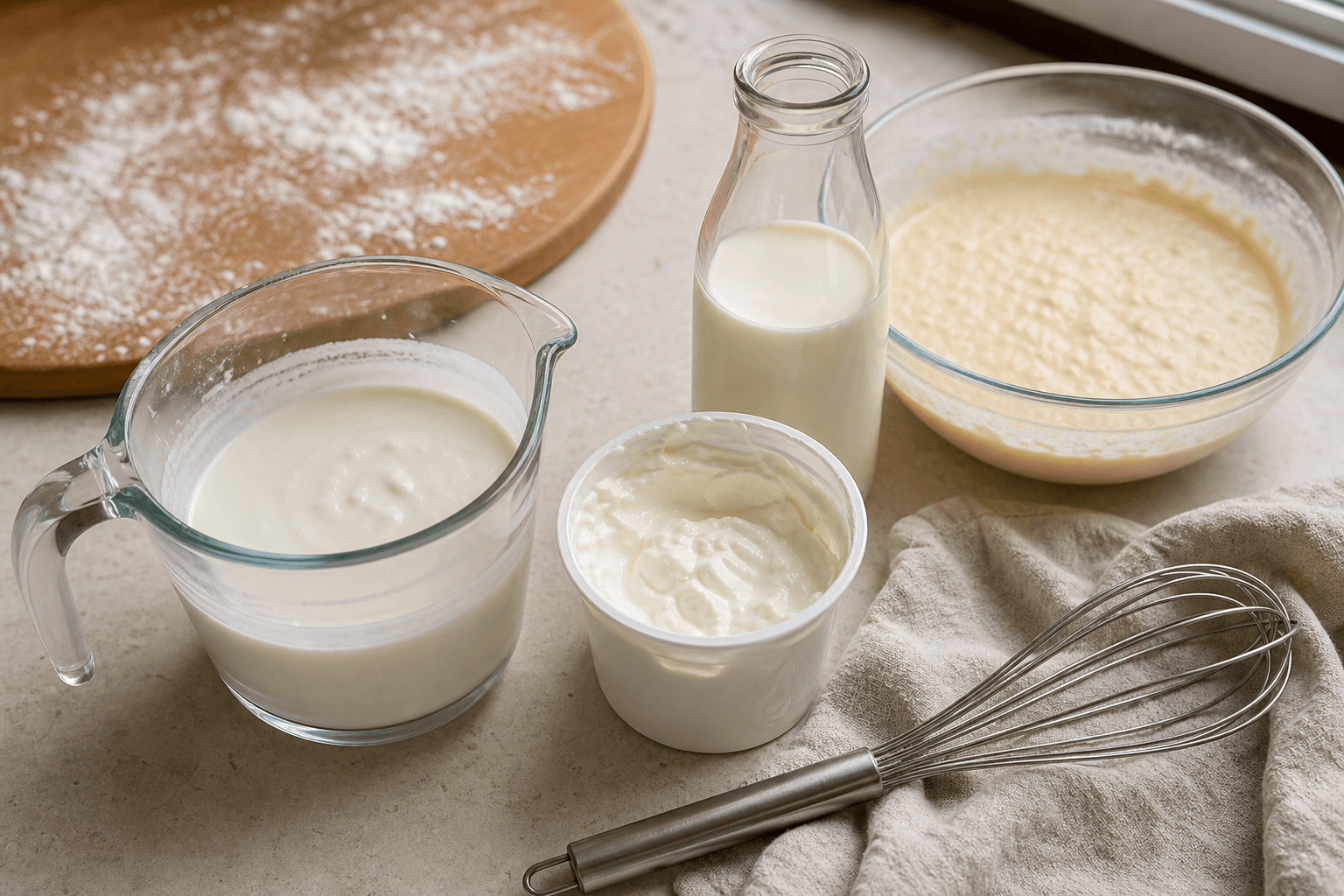
Yes, you can use Greek yogurt instead of buttermilk if you thin it first: 1 part Greek yogurt to 2 parts milk. King Arthur Baking's worked example is one 5.3-ounce container of Greek yogurt plus 1 1/3 cups of milk, which gives you 2 cups of buttermilk substitute. Straight from the tub, Greek yogurt is far too thick to pour into a batter.
Greek yogurt to buttermilk ratios
| Substitute | Ratio | Best for | Watch out |
|---|---|---|---|
| Greek yogurt + milk | 1 part yogurt to 2 parts milk. One 5.3 oz container + 1 1/3 cups milk = 2 cups | Pancakes, biscuits, cakes, muffins, cornbread, scones | Whole-milk Greek yogurt matches closest. Nonfat works but gives a leaner crumb |
| Greek yogurt thinned by feel | Thin with milk or water to the consistency of heavy cream, then use 1:1 | Cooking without the measuring cups out | The target is a texture, not a fixed volume |
| Plain regular yogurt | 1 cup plain yogurt = 1 cup buttermilk | Quick breads, muffins, cakes | Regular yogurt already sits near buttermilk thickness, so it needs little or no thinning |
| Greek yogurt + milk + lemon juice | Thin to pourable, add lemon juice to taste | Ranch dressing, marinades, fried chicken soaks | Skip the measuring here. You want tang and acid, and yogurt supplies both |
| Buttermilk in place of yogurt | 1 cup buttermilk = 1 cup plain yogurt | Using up buttermilk in a recipe that wants yogurt | The reverse swap loses thickness. Fine in a batter, poor in anything served as is |
Both plain yogurt rows come from Purdue Extension's substitution list, which prints that swap in both directions.
How to swap Greek yogurt for buttermilk
- Work out the split. By volume it is one third Greek yogurt and two thirds milk. For 2 cups of buttermilk, that is a 5.3-ounce container of yogurt and 1 1/3 cups of milk.
- Whisk the milk into the yogurt a splash at a time. Pouring it all in at once leaves lumps that never fully whisk out.
- Stop when it pours like heavy cream. King Arthur Baking uses that consistency as the target, and it beats the measurements when your yogurt is thicker or looser than the last tub you bought.
- Use it 1:1 anywhere the recipe says buttermilk. Mix only as much as the recipe calls for.
Plain regular yogurt skips the first two steps. It is already close to buttermilk's thickness, so a cup of it goes in for a cup of buttermilk.
How Greek yogurt changes taste and texture
Greek yogurt is strained, which is why it sits at roughly sour cream thickness rather than buttermilk's. Diluted, it behaves the way buttermilk does in a batter. In baking the acid is the point, since it reacts with baking soda for lift, and Greek yogurt brings plenty of its own. You do not need to add vinegar or lemon juice for a bake.
Fat is the other variable. Whole-milk Greek yogurt gives the closest match. Nonfat still works, with a slightly leaner crumb.
Use plain, unsweetened yogurt. Vanilla and fruit yogurts carry sugar and flavor that will shift the balance of the recipe.
When not to substitute Greek yogurt for buttermilk
Two situations to avoid. The first is undiluted yogurt in a pourable batter. Sour cream thickness in a pancake, cake or muffin batter gives you a stiff mix and a dense, gummy result, so thin it every time.
The second is sustained high heat. America's Test Kitchen puts 1 cup of whole-milk Greek yogurt at around 11 grams of fat against sour cream's 40 grams, which is why yogurt breaks in a hot pan. That matters for stovetop sauces and pan gravies. It does not matter for a batter headed straight into the oven.
Check dates before you commit to the swap. USDA puts yogurt at 1 to 2 weeks in the refrigerator and buttermilk at about 2 weeks, so the tub you forgot about may not be the one to bake with.
Related buttermilk swaps
- Buttermilk substitute lays every option out side by side
- Buttermilk substitute with milk and vinegar covers the version most people already know
- Substitute for buttermilk in pancakes if pancakes are the reason you are here
- Ingredient substitution chart printable for the fridge door
Greek yogurt and buttermilk questions
How much milk do I add to Greek yogurt to make buttermilk?
Two parts milk to one part yogurt. A 5.3-ounce container plus 1 1/3 cups of milk yields 2 cups.
Can I use Greek yogurt straight, without thinning it?
Not in a pourable batter. It is roughly sour cream thickness and will make the batter far too stiff.
Does the Greek yogurt have to be full fat?
Whole-milk Greek yogurt matches buttermilk best, but nonfat works with a slightly leaner result.
Is regular yogurt better than Greek yogurt as a buttermilk substitute?
It is easier. Plain regular yogurt goes in 1:1 for buttermilk with little or no thinning, so there is nothing to whisk.
Cook from the Greek yogurt you already have
Well Stockd's substitution engine reads what is in your kitchen and suggests swaps when a recipe calls for something you are out of. Frozen and canned forms count, and you can reject any swap you would rather not see again. Pair it with tracking what is in the fridge and the yogurt gets used while it is still good. If your shelves are the bigger problem, start with our notes on a pantry inventory app.
Sources: King Arthur Baking, Purdue Extension / NDSU Extension FN198, America's Test Kitchen, USDA FSIS.
Quick planning number: see the Greek Yogurt fridge shelf-life reference.
Track it in Well Stockd
Add what you have, see what you can cook tonight, and get a reminder before anything goes off.
