The best buttermilk substitute, with exact ratios
Every buttermilk substitute with the exact ratio: soured milk, cream of tartar, plain yogurt, thinned Greek yogurt, sour cream, kefir and dried buttermilk powder, sourced to King Arthur Baking, Purdue Extension, America's Test Kitchen and USDA.
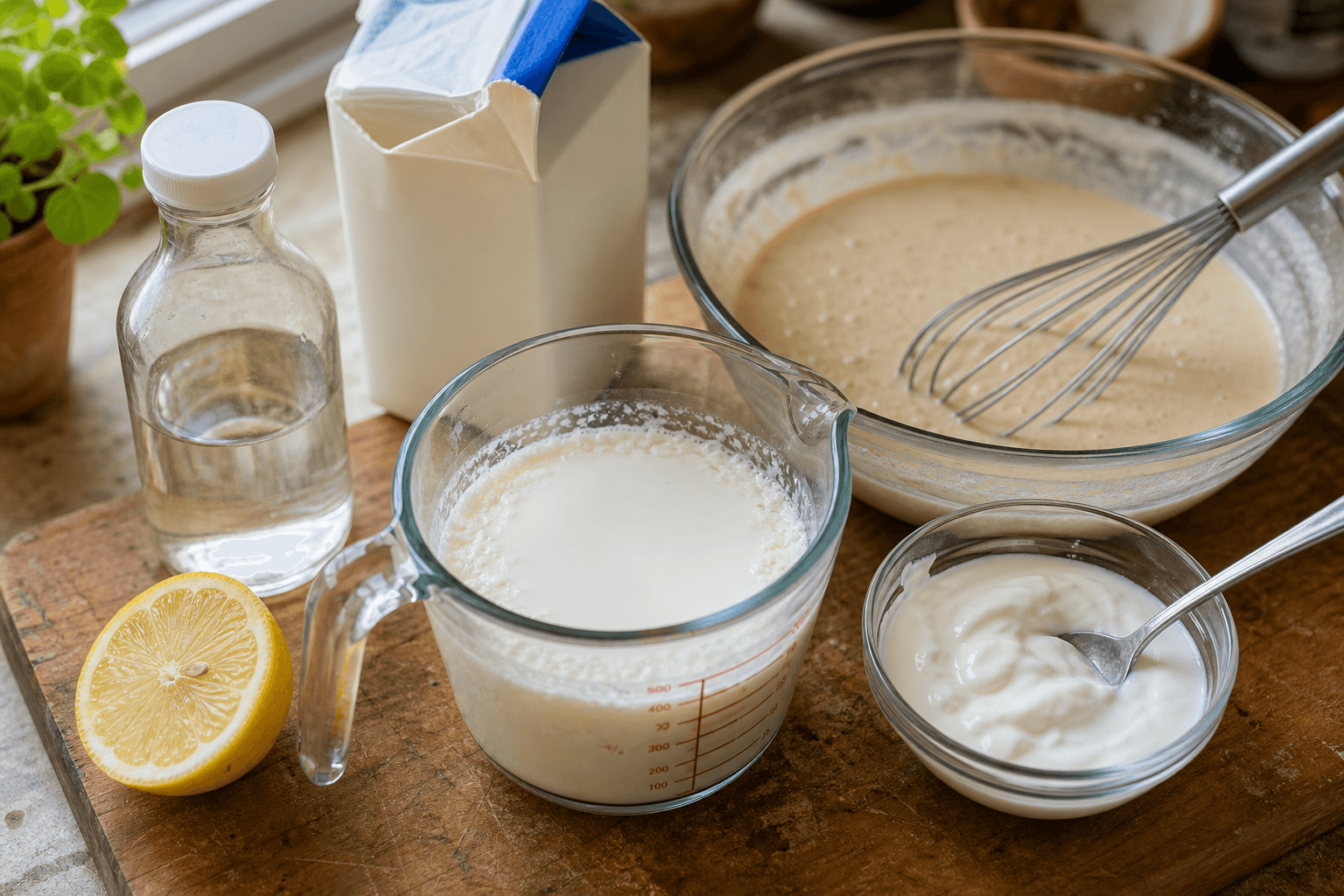
Measure 1 tablespoon of lemon juice or white vinegar into a measuring cup, then fill to the 1-cup line with milk. Let it stand 5 to 10 minutes until it looks slightly thickened. That soured milk replaces 1 cup of buttermilk in any recipe leavened with baking soda.
The short version on buttermilk substitutes
- 1 tablespoon of lemon juice or white vinegar plus milk to the 1-cup line, rested 5 to 10 minutes, is the swap you can make with what is already in the fridge.
- Soured milk gives you the acid that buttermilk provides. It does not give you the body, so batter pours looser.
- Plain yogurt goes in 1:1. Greek yogurt goes in at 1 part yogurt to 2 parts milk.
- Cream of tartar acidifies milk without adding flavor, at 1 3/4 teaspoons per cup.
- Plain milk with no acid is the one swap to avoid in a baking-soda recipe. King Arthur Baking says so outright.
- Real cultured buttermilk keeps about two weeks refrigerated, per USDA.
Every buttermilk substitute, with ratios
| Substitute | Ratio | Best for | Watch out |
|---|---|---|---|
| Milk + lemon juice or white vinegar | 1 Tbsp acid, then milk to the 1-cup line, rested 5 to 10 min | Pancakes, waffles, biscuits, quick breads, cornbread, marinades, fried-chicken brines | Thin. Supplies the acid, not the body, so the crumb comes out slightly less tender |
| Milk + cream of tartar | 1 cup milk + 1 3/4 tsp cream of tartar | Pancakes and waffles where lemon or vinegar flavor would show | Clumps if you stir it into milk. Whisk it into the dry ingredients instead |
| Plain yogurt | 1 cup yogurt = 1 cup buttermilk | Muffins, cakes, quick breads, scones | Much thicker than buttermilk. Thin with milk or water to heavy-cream consistency for a pourable batter |
| Greek yogurt + milk | 1 part yogurt to 2 parts milk | Pancakes, biscuits, layer cakes, anything that needs real body | Use whole-milk Greek yogurt. Nonfat gives a leaner crumb |
| Sour cream + milk or water | Thin to heavy-cream consistency, then 1:1 | Rich quick breads, coffee cakes, biscuits | Adds noticeably more fat than buttermilk, which is usually low-fat |
| Plain unsweetened kefir | 1:1 | Pancakes, quick breads, dressings | King Arthur lists it but did not test it. It has to be plain and unsweetened |
| Dried buttermilk powder | 1/4 cup (30g) powder + 1 cup (227g) water or milk = 1 cup buttermilk | Anyone who bakes with buttermilk a few times a year and keeps tossing the carton | Do not reconstitute it separately. Whisk the powder in with the flour |
| Buttermilk + baking soda (reverse swap) | 1 cup whole milk = 1 cup buttermilk + 1/2 tsp baking soda, and decrease the recipe's baking powder by 2 tsp | Using up buttermilk in a recipe written for regular milk | Skip the leavening change and the acid stays unneutralized, giving a sour, flat bake |
| Plain milk, no acid | Not recommended | Nothing leavened with baking soda | Baking soda needs an acid to react with. Without it the bake goes flat and can taste soapy |
How do you make a buttermilk substitute with milk and vinegar?
- Pour 1 tablespoon of lemon juice or white vinegar into a liquid measuring cup.
- Add milk until the liquid hits the 1-cup line. You end up with 1 cup minus 1 tablespoon of milk plus the acid, which keeps the recipe's total liquid correct.
- Stir once and let it stand 5 to 10 minutes. It will look slightly thickened and a little curdled at the edges, and up to 15 minutes does no harm.
- Use it anywhere the recipe asks for 1 cup of buttermilk.
Purdue Extension writes this as 1 cup minus 1 tablespoon of milk, while King Arthur pours the tablespoon of acid into a full cup. One extra tablespoon of liquid will not wreck a batter either way, so use whichever is easier to measure. A deeper guide to the milk-and-vinegar method, published as buttermilk substitute with milk and vinegar, follows this article in early November.
What is the best buttermilk substitute for pancakes?
Soured milk works fine, and pancakes are also where its thinness shows most: the batter pours faster and the stack sits a little lower. If you would rather not taste the vinegar, cream of tartar acidifies milk without any flavor of its own. King Arthur and Purdue Extension both put the dose at 1 3/4 teaspoons per cup of milk, and that is the number to start from. America's Test Kitchen runs slightly leaner at 1 1/2 teaspoons and whisks the powder into the dry ingredients rather than the milk, because it clumps in liquid. The pancake-specific leavening math gets its own guide, substitute for buttermilk in pancakes, later in the run.
Can you use Greek yogurt instead of buttermilk?
Yes, once you thin it. King Arthur's ratio is 1 part Greek yogurt to 2 parts milk, and their worked example is one 5.3-ounce container whisked with 1 1/3 cups of milk to make 2 cups of buttermilk substitute. Reach for whole-milk Greek yogurt when you have the choice, since nonfat gives a leaner crumb. Plain regular yogurt is simpler still: it goes in 1:1, loosened with a splash of milk or water to about the consistency of heavy cream if the batter needs to pour. A full walkthrough is coming as can I use Greek yogurt instead of buttermilk.
Can you use sour cream instead of buttermilk?
Yes. Thin it with milk or water until it moves like heavy cream, then use it 1:1. Sour cream carries a lot more fat than buttermilk, which is typically low-fat, so a coffee cake or a rich quick bread takes it better than a lean pancake batter does. If the sealed tub at the back of the fridge is past its printed date, is expired sour cream safe to eat if unopened covers what that date actually means. Two more guides in this run cover sour cream in baking and Greek yogurt in place of sour cream.
Can you use plain milk instead of buttermilk?
Not when baking soda is doing the lifting. King Arthur is explicit about it: baking soda needs an acid to react with, and without one the bake comes out flat and can taste soapy. Stirring in a tablespoon of vinegar takes five seconds, so there is rarely a reason to skip it. In a recipe leavened only with baking powder, the acid is not load-bearing and plain milk is a much smaller change.
Is dried buttermilk powder worth keeping in the pantry?
If you bake with buttermilk a few times a year and keep pouring the rest of the carton away, yes. King Arthur's ratio is 1/4 cup (30g) of dried buttermilk plus 1 cup (227g) of water or milk for 1 cup of liquid buttermilk. Their advice is to skip the reconstituting step entirely: whisk the powder into the dry ingredients with the flour, then add the water at the point the recipe calls for buttermilk.
What if you have buttermilk and the recipe wants regular milk?
Run the swap backwards. Purdue Extension gives 1 cup of whole milk as 1 cup of buttermilk plus 1/2 teaspoon of baking soda, with the recipe's baking powder decreased by 2 teaspoons. That leavening adjustment is the whole trick, because skipping it leaves the acid unneutralized and the bake turns out sour and flat. For the rest of the carton, what to do with leftover buttermilk has more ideas.
What to watch when you swap buttermilk
Buttermilk swaps matter most in recipes leavened with baking soda, where the acid is doing chemical work rather than flavoring anything. Soured milk is a thin liquid, so when a recipe leans on buttermilk for thickness, like tall biscuits or thick pancakes, thinned yogurt or kefir is a closer match than milk plus vinegar. Real cultured buttermilk keeps about two weeks refrigerated per USDA, and soured milk is worth making fresh each time rather than storing. Purdue also runs the same chemistry the other way, listing 1 1/2 teaspoons of lemon juice or vinegar in place of 1/2 teaspoon of cream of tartar, which is handy when the shortage is in the spice drawer.
The wider principle shows up all over the kitchen: form matters in some dishes and disappears in others, the same way it does when you swap fresh produce for frozen or canned.
Buttermilk substitute FAQ
How much vinegar do you need for 1 cup of buttermilk?
One tablespoon of white vinegar or lemon juice, topped up with milk to the 1-cup line and rested 5 to 10 minutes. The two acids work at the same dose, so use whichever bottle is already open.
Does milk and vinegar taste like buttermilk?
No. It delivers the acidity baking soda needs. The thickness and the cultured tang do not come with it. Thinned yogurt or plain kefir tastes closer to the real thing.
How long does real buttermilk last in the fridge?
About two weeks refrigerated, according to USDA. That is roughly the window worth planning around, and how long is milk good after opening covers the regular-milk side of the same question.
What is the best buttermilk substitute if you want it thick?
Plain yogurt straight, at 1:1. Or Greek yogurt cut with milk at 1 part yogurt to 2 parts milk. Both keep the body that milk plus vinegar loses.
Track your buttermilk with Well Stockd
Well Stockd keeps a running picture of what is in your kitchen, so when a recipe calls for buttermilk it suggests swaps from what you already have. Frozen and canned forms count as matches, and you can reject any swap you would rather it stopped offering. If you are still comparing tools, we wrote up apps that track food expiration dates and the best pantry inventory apps too.
Sources: King Arthur Baking, how to substitute for buttermilk | King Arthur Baking, why you should keep dried buttermilk in your pantry | Purdue Extension / NDSU Extension, FN198 Ingredient Substitutions | America's Test Kitchen, buttermilk substitutes for pancakes | USDA FSIS, how long you can keep dairy products in the refrigerator