Buttermilk substitute with milk and vinegar
The milk and vinegar buttermilk substitute in exact numbers: 1 tablespoon of vinegar or lemon juice, milk to the 1-cup line, 5 to 10 minutes of resting. Includes a ratio table, a half batch, the cream of tartar option, and the recipes where soured milk is the wrong call.
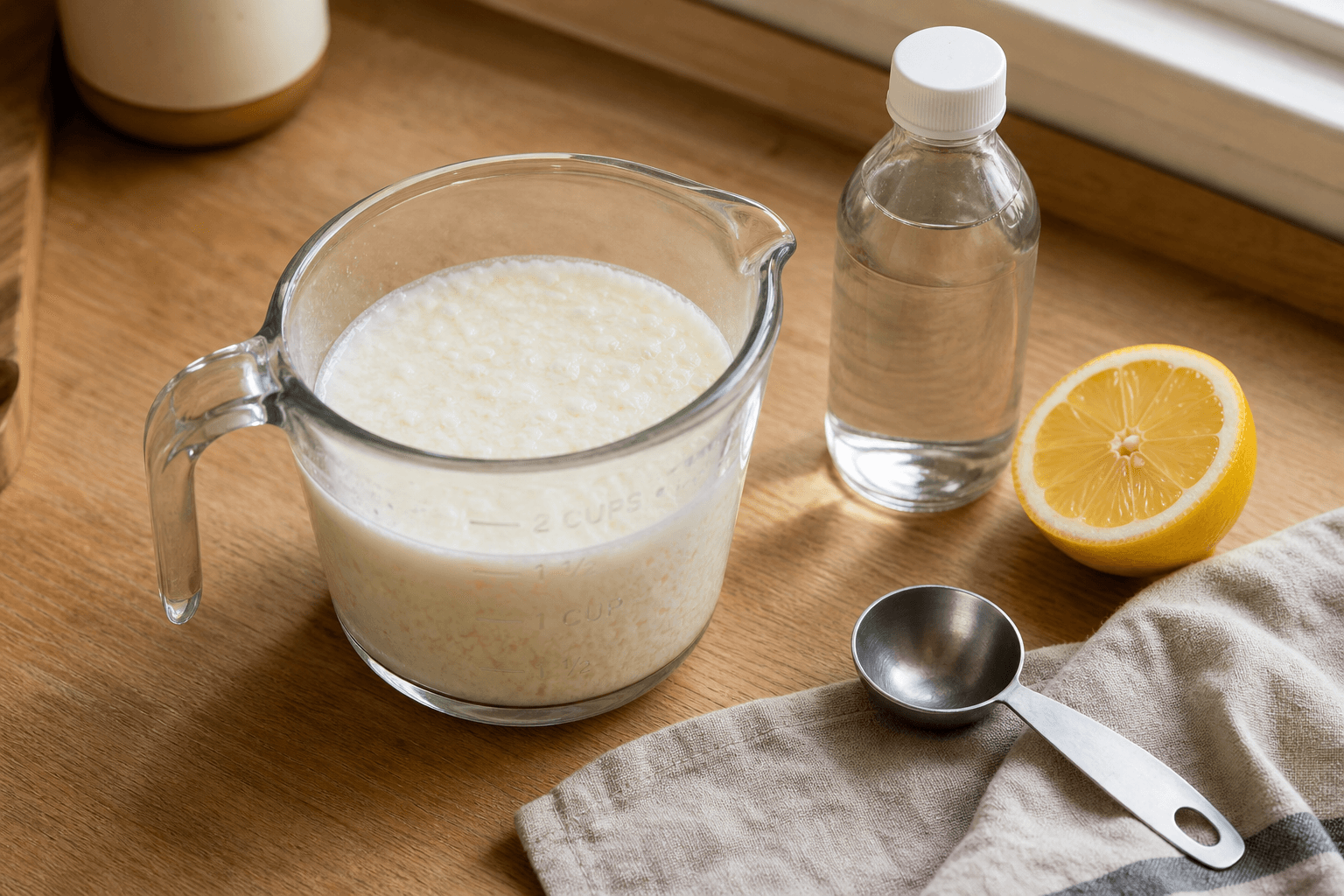
Pour 1 tablespoon of white vinegar into a liquid measuring cup, add milk up to the 1-cup line, stir once and let it stand 5 to 10 minutes until it looks slightly thickened and lightly curdled. That gives you 1 cup of buttermilk substitute. Lemon juice does the same job at the same dose.
Purdue Extension and NDSU Extension print the ratio as 1 cup minus 1 tablespoon of milk plus 1 tablespoon of lemon juice or vinegar, rested 5 to 10 minutes. That phrasing keeps your total liquid at exactly 1 cup, which is why it leads here. King Arthur Baking stirs the same tablespoon of acid into a full cup of milk and rests it 10 to 15 minutes. Both work. King Arthur's extra tablespoon of liquid will not ruin anything, so use whichever version you can measure without thinking about it.
Milk and vinegar buttermilk substitute ratios
| Substitute | Ratio | Best for | Watch out |
|---|---|---|---|
| White vinegar and milk, volume accurate | 1 Tbsp vinegar, then milk to the 1-cup line, stand 5 to 10 min | Pancakes, biscuits, cornbread, quick breads, cakes, marinades | Purdue and NDSU keep the total liquid at exactly 1 cup, which matters in a precise batter |
| Vinegar stirred into a full cup of milk | 1 Tbsp vinegar or lemon juice into 1 cup milk, stand 10 to 15 min | Everyday baking where one extra tablespoon of liquid is immaterial | King Arthur's version. In a fussy cake, use the volume accurate one instead |
| Half batch | 1 1/2 tsp vinegar, then milk to make 1/2 cup | Small-batch pancakes and single-layer cakes | Halved from the sourced 1 Tbsp per cup ratio, so it is arithmetic rather than a separately published figure |
| Lemon juice, apple cider vinegar, or white wine vinegar | 1 Tbsp per cup, same as white vinegar | Whatever you have. Lemon juice is mildest, cider vinegar adds a faint fruitiness | Skip balsamic and other strongly colored vinegars, which tint the batter and carry their own flavor |
| Cream of tartar and milk | 1 3/4 tsp cream of tartar per cup of milk | Avoiding any vinegar or lemon flavor | It clumps in milk. America's Test Kitchen says to whisk it into the dry ingredients and pour plain milk in as the liquid |
How to make the milk and vinegar buttermilk substitute
- Measure 1 tablespoon of white vinegar into a liquid measuring cup.
- Pour milk in until the liquid reaches the 1-cup line.
- Stir once. You are combining it, not whipping it.
- Let it stand 5 to 10 minutes. Longer does no harm, and King Arthur rests theirs as long as 15 minutes.
- Look for a barely thickened surface with fine curds through it, then stir it back together and use it cup for cup wherever the recipe says buttermilk.
What changes when you swap milk and vinegar for buttermilk
You are making soured milk. It delivers the acid that reacts with baking soda, and it does not bring the thickness or the cultured flavor of real buttermilk. Your batter will pour looser than a buttermilk batter would.
That trade disappears in pancakes and most quick breads. It shows up where buttermilk is the flavor rather than the leavening, like a dressing you taste straight off the spoon.
If your recipe is leavened only with baking powder, the acid is not doing much work, and plain milk would also be acceptable. The swap earns its keep when baking soda is on the ingredient list. King Arthur is blunt about that one: do not substitute plain milk in a recipe that uses baking soda.
When not to substitute milk and vinegar for buttermilk
Skip it when the recipe wants buttermilk for body rather than acid. A thick dressing or a very tall biscuit leans on the viscosity, and soured milk pours like milk. Thinned yogurt is the better call in those.
Use it the day you make it. No cultured bacteria are doing preservation work here, so it keeps no longer than the milk it was made from. The carton's date is your ceiling.
You have probably read somewhere that ultra-pasteurized milk will not work. That advice is not verifiable in an authoritative source, so it is not printed here as fact. If your cup stays completely liquid, cold milk is the likelier reason, and the acid is present either way.
Related buttermilk and dairy swaps
- Buttermilk substitute walks through the full option set, yogurt and sour cream included.
- Substitute for buttermilk in pancakes if Saturday morning is the only reason you were going to buy a quart.
- Ingredient substitution chart printable is the one-page version you can tape inside a cabinet door.
FAQ about the milk and vinegar buttermilk substitute
How much vinegar per cup of milk for buttermilk?
One tablespoon per cup, rested 5 to 10 minutes.
Does vinegar or lemon juice matter in a buttermilk substitute?
Chemically, no. The dose and the effect are the same. Lemon juice tastes milder in a delicate batter.
How long do you let milk and vinegar sit for a buttermilk substitute?
5 to 10 minutes, until it looks slightly thickened and lightly curdled. Up to 15 minutes is fine.
Can you make the milk and vinegar buttermilk substitute ahead?
Make it fresh. It has no cultured bacteria and does not keep the way real buttermilk does.
Finding your buttermilk substitute without a store trip
Well Stockd tracks what is actually in your kitchen, and its substitution engine suggests swaps from your own shelves when a recipe calls for something you are out of. Frozen and canned forms count as candidates, and you can reject any suggestion you would rather not see again. If the tracking side is what you need first, read about an app to track food expiration dates or the best pantry inventory app.
Sources: Purdue Extension and NDSU Extension, FN198, King Arthur Baking, America's Test Kitchen.