Can I use canned peeled tomatoes instead of tomato sauce?
How to use canned peeled tomatoes in place of tomato sauce: the blend-and-reduce ratio, the tomato paste shortcut, puree and paste swaps, and the dishes where the straight swap goes wrong.
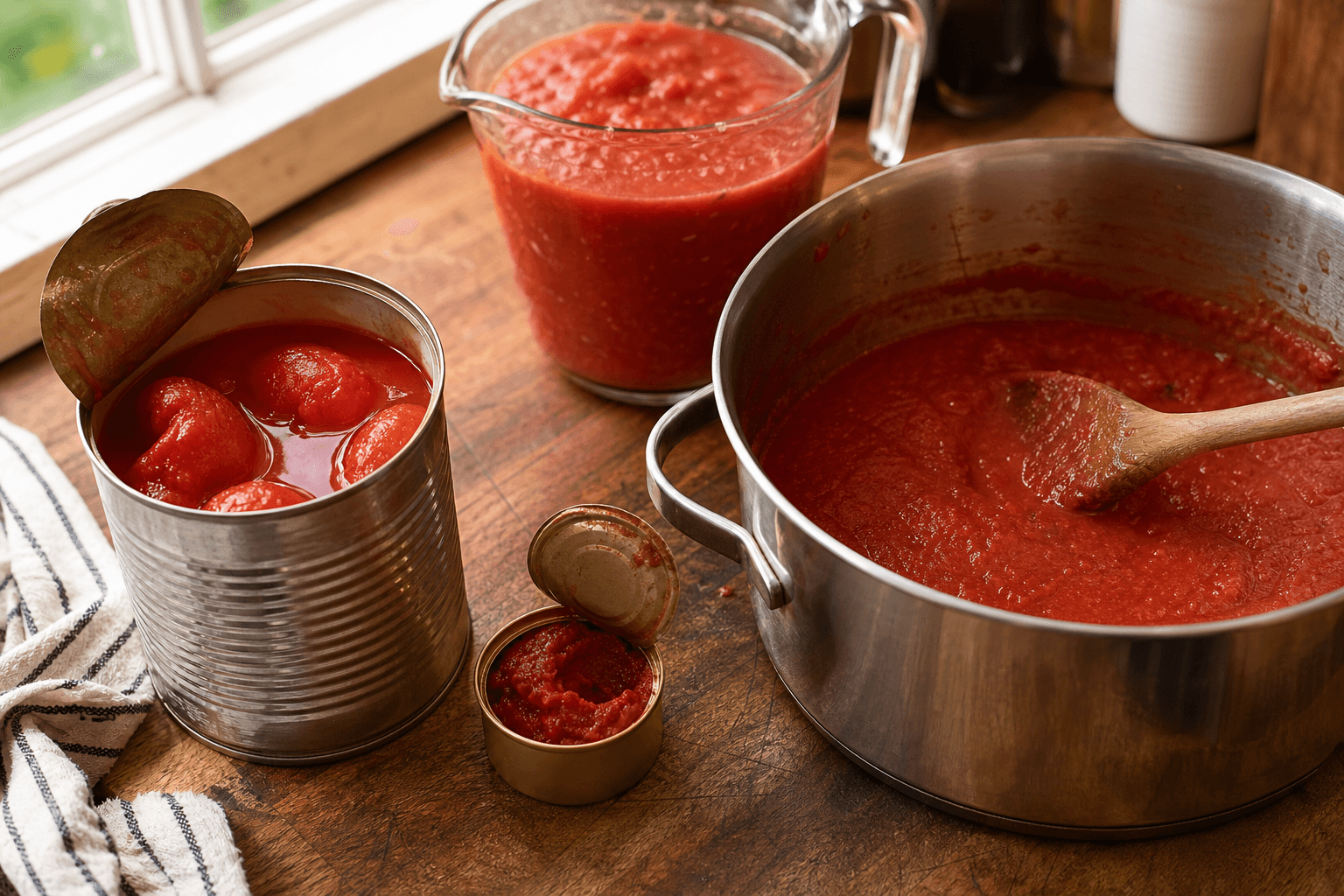
Yes. Blend one 28-ounce can of whole peeled tomatoes and simmer it down to about 1-3/4 to 2 cups, and you have the equivalent of one 15-ounce can of tomato sauce.
That simmer is doing real work. Canned whole tomatoes measure about 5.5% tomato soluble solids and canned tomato sauce measures about 9.0%, per the UC Davis analysis by Rickman, Bruhn and Barrett. The difference is water you cook off, about a 40% reduction by volume. The USDA Food Buying Guide agrees with the pan: a 28-ounce can of whole tomatoes is 3-1/8 cups with its juice, and a 15-ounce can of sauce is 1-3/4 cups.
If you would rather not stand at the stove for 15 to 25 minutes, tomato paste closes the same gap in about two.
Ratios for using canned peeled tomatoes instead of tomato sauce
| Substitute | Ratio | Best for | Watch out |
|---|---|---|---|
| Whole peeled, blended and reduced | One 28 oz can (3-1/8 cups) down to 1-3/4 to 2 cups = one 15 oz can of sauce | Pizza sauce, pasta sauce, any dish built on the sauce | 15 to 25 minutes of simmering. Salt after it reduces |
| Whole peeled, blended, plus tomato paste | 1 cup blended tomatoes plus 2 to 3 Tbsp paste, to taste = about 1 cup of sauce | Weeknights with no time to reduce | Rawer flavor. Bloom the paste in oil first if you can |
| Whole peeled, crushed by hand | 1-3/4 cups crushed for one 15 oz can of sauce | Soups, chili, braises and stews that simmer anyway | Thinner and brighter, so it is wrong for a sauce that has to cling |
| Canned tomato puree | 1:1 by volume | The closest single-can substitute | Unseasoned, so salt it |
| Tomato paste thinned with water | About 1 part paste to 2 parts water | When paste is all you have | At least 24% solids, roughly three times sauce. Thin, then salt |
How to turn canned peeled tomatoes into tomato sauce
- Blend the whole can, juice and all, until smooth. Crushing by hand leaves pieces that read as crushed tomatoes rather than sauce.
- Pour it into a wide saucepan over medium-low with the lid partly off, and stir every few minutes. Tomato puree scorches easily and a scorched batch cannot be rescued.
- Simmer 15 to 25 minutes, until you are down to 1-3/4 to 2 cups. Measure it rather than eyeballing the pan.
- Season at the end. Reducing concentrates whatever salt was already in the can, so tasting early sends you the wrong way.
- In a hurry, stop after step 1 and stir 2 to 3 tablespoons of tomato paste into each cup of blended tomatoes, to taste.
What changes when you swap in canned peeled tomatoes
Canned tomato sauce shows up lightly salted, sometimes with onion or garlic powder in it. Blended whole tomatoes show up with nothing, so your reduced sauce tastes cleaner and more like plain tomato, and flat until you salt it.
Blending and reducing gives you a smooth sauce with body. Blending alone leaves it thin enough to run off a pizza crust.
America's Test Kitchen notes that imported San Marzano style tomatoes are packed without calcium chloride and break down silkier, while US whole tomatoes stay firmer. If your blended sauce keeps a little grain, that firming agent is why.
When not to use canned peeled tomatoes instead of tomato sauce
Skip the straight swap when the recipe leans on sauce for structure and does not cook long. A 10-minute skillet dinner or a baked pan of stuffed shells has nowhere to send the extra water. Use canned puree at 1:1 there, or take the time to reduce.
Long-simmered dishes are the opposite case. For chili, a braise or a pot of soup, put in 1-3/4 cups of hand-crushed tomatoes and let the pot do the reducing.
Caveats worth knowing about tomato sauce
Tomato sauce is not a standardized product. The FDA tomato concentrates rule, 21 CFR 155.191, defines tomato puree or pulp as not less than 8.0% and less than 24.0% tomato soluble solids, and tomato paste as 24.0% or more. It never defines tomato sauce. That is why one brand's can is thick and seasoned while another's is watery. Puree is the closest thing on the shelf, at 9.5% measured solids against sauce's 9.0%.
Whole peeled tomatoes are the most useful can to keep, because you can make diced, crushed, puree or sauce out of them. You cannot go the other direction.
Canning is a different job from cooking, and this is cooking advice. If sauce is going into jars for the shelf, follow the National Center for Home Food Preservation's standard tomato sauce process, which covers the acidification and processing that make jars safe.
Related tomato sauce and pantry swaps
If the can in your hand is the wrong form of tomato in some other direction, start here: canned tomatoes instead of fresh, how much tomato sauce equals tomato paste, and a substitute for tomato paste in chili. For the wider pattern, see our fresh, frozen and canned substitution ratios and the printable ingredient substitution chart.
Questions people ask about canned peeled tomatoes and tomato sauce
How much tomato sauce does a 28 oz can of whole tomatoes make?
About 1-3/4 to 2 cups after you blend it and simmer it down, which is right about one 15-ounce can of tomato sauce.
Can I just blend whole tomatoes and use them as tomato sauce?
In a dish that simmers a while, yes. For pizza or anything that needs to cling, reduce the tomatoes first or the result is watery.
What is the difference between tomato sauce and tomato puree?
Puree is a defined concentrate, 8.0% to under 24.0% tomato soluble solids by the FDA standard. Tomato sauce is not standardized and is usually lightly seasoned, measuring around 9.0% solids.
How much is one can of tomato sauce in cups?
A 15-ounce can is 1-3/4 cups, per the USDA Food Buying Guide.
Finding a tomato sauce swap in the cans you already have
Well Stockd's substitution engine suggests swaps out of what is already in your kitchen when a recipe calls for something you are out of. Canned and frozen forms count as candidates, and you can reject any suggestion you do not want offered again. Same idea as a pantry inventory app or an app to track food expiration dates, applied while you cook.
Sources: USDA Food Buying Guide, Vegetables Yield Table | Rickman, Bruhn & Barrett, J Sci Food Agric 2007, Table 15 (UC Davis) | eCFR, 21 CFR 155.191 Tomato concentrates | America's Test Kitchen, Cooking With Canned Tomatoes | National Center for Home Food Preservation, Standard Tomato Sauce
Track it in Well Stockd
Add what you have, see what you can cook tonight, and get a reminder before anything goes off.
