How long does cut fruit last in the fridge?
Cut fruit lasts 3 to 4 days in the fridge. Cut melon needs a shorter, more careful window because of listeria risk. Below are the USDA numbers, signs of spoilage, storage tips, and freezing advice.
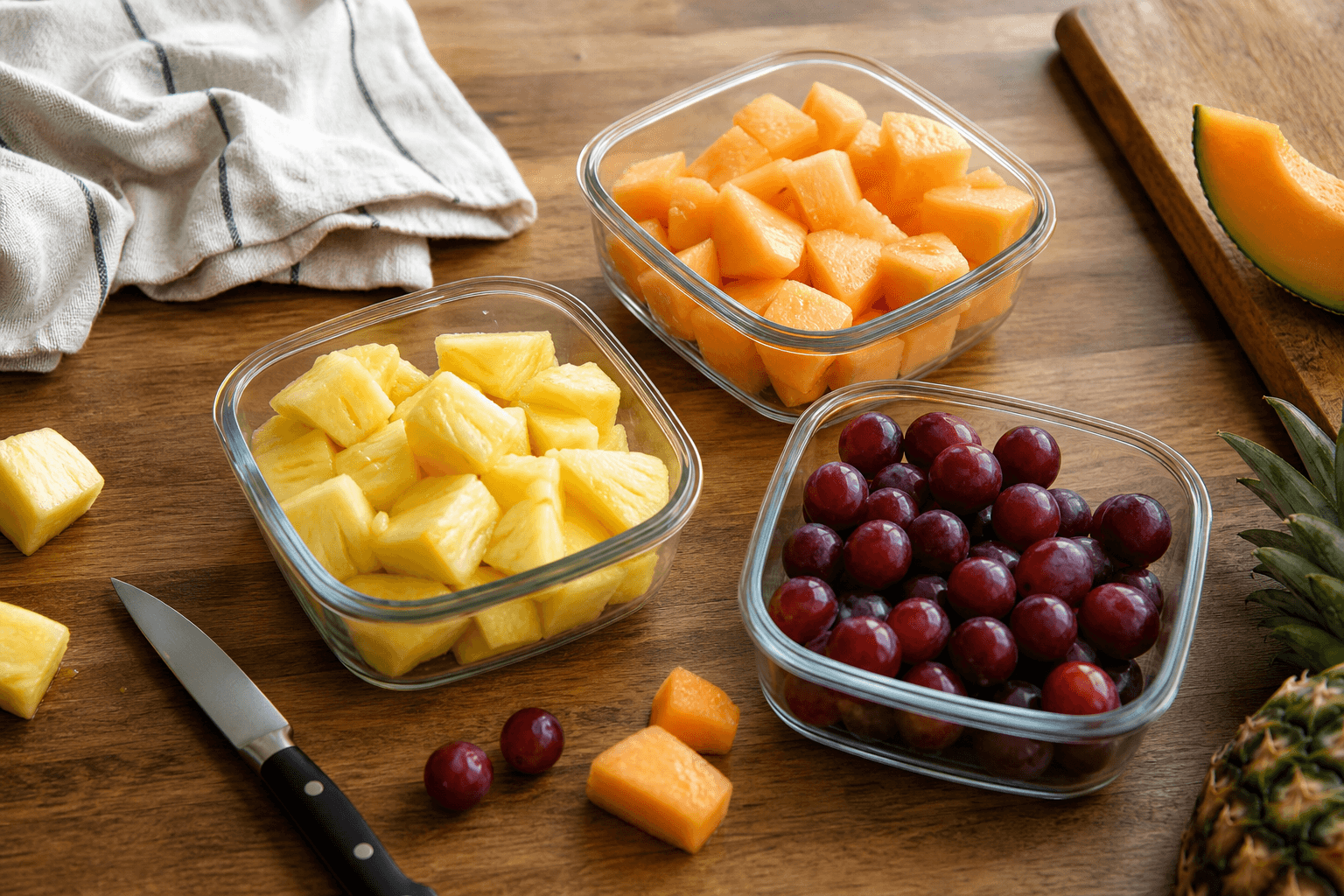
Most cut fruit keeps for 3 to 4 days in the refrigerator, according to the USDA. Cut melon is the exception: because it carries a higher listeria risk, use it within 2 to 4 days and keep it in a vented container at 40°F or below.
How long does cut fruit last in the fridge?
The 3 to 4 day window applies to most fruit once you slice, peel, or dice it: apples, pineapple, mango, grapes, pears, and stone fruit like peaches and plums all fall into this group. Melon gets its own, more cautious number because bacteria on the rind can spread to the flesh during cutting, and that flesh is a comfortable place for listeria to grow, even in a cold fridge. For a broader rundown of shelf life across your fridge, see our guide to how long food lasts.
| Cut fruit | Refrigerator (40°F or below) | Notes |
|---|---|---|
| Most cut fruit (apples, pineapple, mango, grapes, pears, stone fruit) | 3 to 4 days | Store in a clean, covered container |
| Cut melon (cantaloupe, honeydew, watermelon) | 2 to 4 days | Higher listeria risk; use a vented, single-layer container; refrigerate at 40°F or below right away |
| Fruit salad or mixed cut fruit | 3 to 4 days | Only as good as its shortest-lived ingredient |
| Cut fruit left out at room temperature | Discard after 2 hours (1 hour above 90°F) | Refrigerate right away instead |
| Cut fruit in the freezer | 8 to 12 months for best quality | Safe indefinitely at 0°F, though texture softens |
A note on melon: commercial food-safety codes require cut melon to be held at 41°F or colder and date marked for use within 7 days, but that standard was written for retail kitchens with calibrated coolers. For a home fridge, 2 to 4 days is the safer target. Cut cantaloupe you cannot finish? See can you freeze cantaloupe.
How to tell if cut fruit has gone bad
Your senses are a good first check, but the clock matters more. Cut fruit that has spoiled usually shows one or more of these signs:
- A sour, fermented, or alcohol-like smell as the natural sugars break down
- Sliminess or a slick film on the surface
- Visible mold, which can look fuzzy, white, or greenish depending on the fruit
- Extra liquid pooling in the container
- Flesh that has gone mushy or noticeably darker than normal browning
Some browning is just oxidation, a cosmetic reaction where cut flesh meets air, and it does not mean the fruit is unsafe. But bacteria like listeria and salmonella do not always announce themselves with a smell or a visible change. Cut fruit can look and smell completely normal and still make someone sick. That is why the time rule matters more than a sniff test. If it has been in the fridge longer than the window above, let it go, even if it still looks fine.
How to store cut fruit so it lasts
- Refrigerate cut fruit within two hours of cutting it, or within one hour if your kitchen is hotter than 90°F.
- Use a clean, airtight or covered container. For melon, pick one with ventilation so condensation does not build up against the fruit.
- Keep your fridge at 40°F or below, and a few degrees colder for melon if you can manage it. A cheap fridge thermometer takes the guesswork out. Cut watermelon you cannot finish? See can you freeze watermelon.
- Store cut fruit on an inside shelf rather than in the door, where the temperature swings more with every open and close.
- Keep cut fruit away from raw meat, poultry, and seafood to avoid cross contamination.
- Pack an ice pack with cut fruit that will sit outside the fridge, like in a lunch box, so it stays under the two-hour clock.
- Label the container with the date you cut it. The same two-hour clock and short fridge window apply to other perishables you might be prepping at the same time, like cooked rice or raw chicken, so a consistent labeling habit pays off across the whole fridge.
If keeping track of cut dates by memory is not working for your household, an app that tracks expiration dates for you can log when you cut something and nudge you before the window closes.
Can you freeze cut fruit?
Yes, most cut fruit freezes well, especially fruit you plan to blend into smoothies or bake into muffins and pies. Spread the pieces on a tray to freeze individually before bagging them, so they do not clump into one solid mass. Frozen fruit stays safe indefinitely at 0°F, though the USDA recommends using it within 8 to 12 months for the best flavor and texture. You'll get softer, juicier fruit after thawing, since ice crystals break down the cell walls as they form. That texture change is fine for smoothies and baking, but it is noticeable if you were hoping to eat the fruit fresh.
When in doubt
USDA's own advice is the simplest rule in food safety: when in doubt, throw it out. If cut fruit has sat in the fridge past the window above, sat out too long, or just seems off, it is not worth the gamble to find out. Spoiled fruit on its own is rarely dangerous, but the pathogens that can grow on cut produce, including listeria and salmonella, can cause serious illness, especially in pregnant people, older adults, young children, and anyone with a weakened immune system.
Frequently asked questions
Does cut fruit last longer if I add lemon juice?
Lemon juice slows browning by limiting the fruit's exposure to oxygen, but it does not extend the food-safety window. Treat lemon-treated fruit the same as any other cut fruit: 3 to 4 days in the fridge for most types, 2 to 4 days for melon. Got extra lemons? Here is how to freeze lemons.
Can I still eat cut fruit that has browned?
Browning alone is usually just oxidation, a cosmetic reaction that does not affect safety. Check for sliminess, mold, or a sour smell before deciding, and do not keep the fruit past the time window regardless of how it looks.
Is store-bought pre-cut fruit different from fruit you cut yourself?
Not once you open it. Treat an opened container of store-cut fruit the same as fruit you sliced at home, 3 to 4 days refrigerated (2 to 4 for melon), counting from when you opened it rather than the sell-by date on the package.
Sources: USDA AskUSDA, How should I store cut fruit and vegetables?, FoodSafety.gov, Cold Food Storage Charts, USDA FSIS, Freezing and Food Safety, Wisconsin DATCP Food Code Fact Sheet on cut melon handling (based on the FDA Food Code).
Track it in Well Stockd
Add what you have, see what you can cook tonight, and get a reminder before anything goes off.
