How to split groceries with roommates without a fight
How to split groceries with roommates, shown with numbers: one month of receipts for three roommates run through four systems (shared basics, item by item, rotating shops, separate shelves), with each person's share, the settle-up payments, a one-evening setup, and answers on the 3-3-3 and 5-4-3-2-1 grocery rules.
The fairest way to split groceries with roommates is usually to share the staples everyone uses, split them equally or by who uses each item, and have each person pay for their own extras. Agree on the system before the first shop, keep every receipt, and settle up on a fixed day.
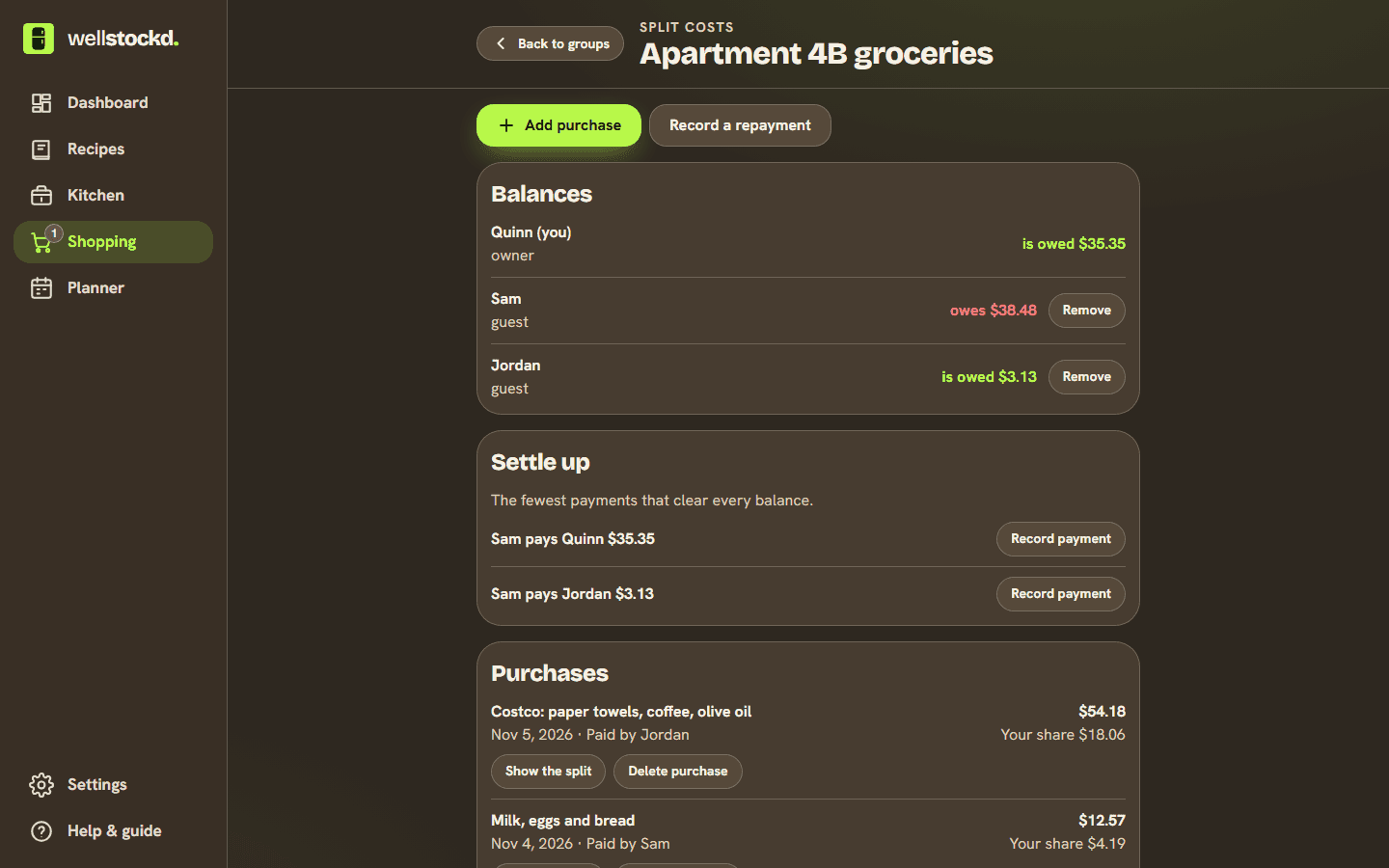
Grocery arguments between roommates start more easily when the deal is vague and nobody records who paid. Below, one example month of receipts for three roommates runs through four systems, so you can see what each person ends up paying under each. The pros and cons of each method are in our guide to splitting groceries with roommates, along with a free way to keep the tab.
The example: one month, three roommates
Quinn, Sam and Jordan share a kitchen. They shop once a week, and this month the shops were paid like this:
- Quinn paid for two shops, $120.00 and $95.00
- Sam paid for one shop, $85.00
- Jordan paid for one shop, $90.00
That's $390.00 in total. Of it, $150.00 was personal: Quinn's yogurt and protein bars ($45.00), Sam's oat milk, frozen pizza and energy drinks ($75.00), and Jordan's sparkling water and snacks ($30.00). The other $240.00 was shared staples:
| Shared item | Cost this month | Who uses it |
|---|---|---|
| Milk | $28.00 | All three |
| Eggs | $24.00 | All three |
| Bread | $20.00 | Quinn and Jordan |
| Coffee | $36.00 | Quinn and Sam |
| Cooking oil | $12.00 | All three |
| Rice and pasta | $20.00 | All three |
| Produce for shared dinners | $80.00 | All three |
| Spices and condiments | $20.00 | All three |
| Total | $240.00 |
Four systems, same receipts
1. Shared basics, split equally
The $240.00 of staples splits three ways, $80.00 each, and everyone pays for their own extras. Quinn owes $125.00, Sam $155.00 and Jordan $110.00. Quinn paid $215.00 at the register, so Sam pays Quinn $70.00 and Jordan pays Quinn $20.00, and the month is square.
It takes one division and one list of what counts as shared. The catch: Jordan pays a third of the coffee and never drinks it.
2. Item by item
Each shared item splits only among the people who use it. Coffee goes to Quinn and Sam, bread to Quinn and Jordan, and everything else three ways, rounded to the cent. Quinn's staples come to $89.35, Sam's to $79.34 and Jordan's to $71.31. With their own extras, Quinn owes $134.35, Sam $154.34 and Jordan $101.31. Sam pays Quinn $69.34 and Jordan pays Quinn $11.31.
This is the fairest version, and the most work by hand: every receipt line needs a name next to it.
3. Rotating shops
Each person does the whole shop in turn and pays for all of it, with no settling up. This month that leaves Quinn at $215.00, Sam at $85.00 and Jordan at $90.00, because Quinn landed the big restock and a fourth week. Next month the rotation may land on Sam instead, but it only evens out if someone keeps count.
4. Separate shelves
Everyone buys and labels their own food and nothing is shared, so each person pays exactly their own receipts and nobody owes anybody. The cost shows up elsewhere: three bottles of oil, three bags of rice and three jars of every spice, more food going off before anyone finishes it, and the awkward moment when someone uses the last of somebody else's milk.
Side by side
| System | Quinn pays | Sam pays | Jordan pays | To settle the month |
|---|---|---|---|---|
| Shared basics, equal | $125.00 | $155.00 | $110.00 | Sam pays Quinn $70.00, Jordan pays Quinn $20.00 |
| Item by item | $134.35 | $154.34 | $101.31 | Sam pays Quinn $69.34, Jordan pays Quinn $11.31 |
| Rotating shops | $215.00 | $85.00 | $90.00 | Nothing, so Quinn carries the month |
| Separate shelves | Own food only | Own food only | Own food only | Nothing, but staples are bought three times |
What is the best way to split grocery costs with my roommates?
Shared basics with your own extras, if you all use the same staples and each buy a few things of your own. It's fair enough that nobody feels cheated, and simple enough that people keep doing it. Move to item by item when habits differ a lot, as with one coffee drinker and one gluten-free roommate, because a few lines that only some people use can shift the totals. Rotating works for people who cook and eat together most nights, as long as someone writes down who paid. Separate shelves suit roommates who barely overlap.
Whichever you choose, write each purchase down the day it happens, with who paid. Rebuilding three weeks of receipts from memory is much harder than noting one at the kitchen table.
How to set it up in one evening
- Write the list of shared staples together, and keep it short. Anything not on the list is personal.
- Decide how shared items split: equally, or by who uses each one.
- Decide who pays at the register: whoever shops, one person every time, or a rotation.
- Pick one place to record every receipt, with who paid and who shares it.
- Pick a settle-up day, such as every other Sunday, and stick to it. Small, regular payments are easier than one big bill.
A shared list helps as much as the split does. If everyone can see what the house already has, nobody buys a third jar of peanut butter. A shared pantry app keeps that list in one place, and our roundup of roommate grocery apps compares the options.
What is the 3-3-3 rule for groceries?
It's a shopping method that circulates on social media, and versions vary. One version is three vegetables, three proteins and three carbohydrates for the week, mixed and matched into different meals. For roommates, it can be the backbone of the shared list: agree on the nine shared items, and everything beyond them is personal.
What is the 5 4 3 2 1 rule for groceries?
Another list method: five vegetables, four fruits, three proteins, two sauces or spreads and one grain, with some versions adding one treat. In a shared kitchen, decide which of the numbers are shared. Proteins and grains are easy to share, while fruit and treats come down to personal taste.
Keep the tab in one place
Sharing staples is one of the easier ways to bring the bill down, and there are more ways to save on groceries once the system is running. To see where the money goes month to month, a grocery budget app helps.
For the split itself, Well Stockd has split groups. You invite roommates with a link (joining needs a free account) or add someone by name as a guest. Any member with an account can add a purchase, say who paid, and choose who shares each line. Well Stockd keeps the running balance, and Settle up shows the fewest payments that clear it. No money moves through Well Stockd: you pay each other however you like, then record it. Splitting by hand is free, and with Pro a scanned receipt becomes the split line by line. Start with the roommate grocery split guide.