Printable food waste log sheet (free template and how to use it)
A printable food waste log sheet takes two minutes a day and cuts household waste by about 20 percent, just from writing it down. Below: the exact template, a four-step method, and what the pattern usually reveals.

Print or download the food waste log sheet
Use the clean print layout below, or download the free letter-size PDF and high-resolution PNG. No email address is required.
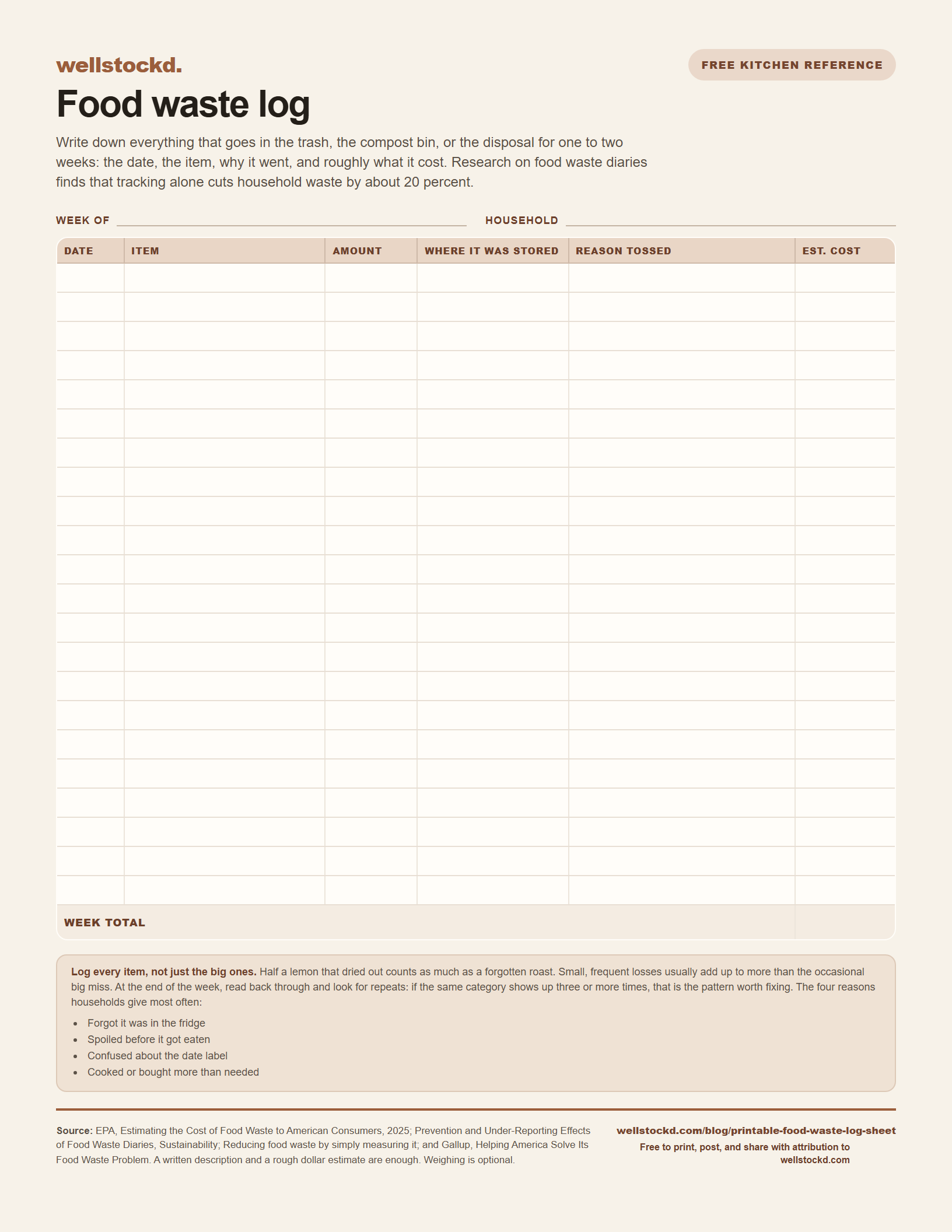
Free to print, post, and share with attribution to wellstockd.com.
A printable food waste log sheet is a simple table where you write down every food item you throw out, why it happened, and roughly what it cost, for one to two weeks straight. Research on food waste diaries finds that the act of tracking alone, before you change a single habit, cuts household waste by about 20 percent.
What is a food waste log sheet?
It's a one-page tracker, on paper or in a notes app, with a row for every item that goes in the trash, the compost bin, or down the disposal. Each row captures four things: the date, the item, the reason it was tossed, and an estimated dollar value. That's the whole tool. You don't need an app or special equipment: a pen stuck to the fridge works fine, or a spreadsheet tab you check once a day.
Restaurants and school cafeterias have used waste logs for years to find where food and money are leaking out of the kitchen. The same idea works at home, just smaller and less formal.
How to use a printable food waste log
Step 1: Pick a window. Two weeks gives you a fuller picture, but even seven days will surface a pattern. Studies on food waste diaries typically run four to six weeks for lasting behavior change, so if the first two weeks are eye-opening, keep going.
Step 2: Put it somewhere you'll see it. Tape the sheet to the inside of a cabinet door, stick it to the fridge with a magnet, or pin a note in your phone. If logging means walking to another room, it won't happen.
Step 3: Log every item, not just the big ones. Half a lemon that dried out counts as much as a forgotten roast. Small, frequent losses (herbs, bread heels, the last third of a jar of sauce) usually add up to more than the occasional big miss.
Step 4: Review it at the end of the week. Read back through your entries and look for repeats. If the same category shows up three or more times, that's the pattern worth fixing, not a random unlucky week.
What to write down for each entry
Keep the columns short enough that you'll fill them in. Print the free letter-size PDF or PNG from the download box at the top of this page, or copy the template below into a notebook, a spreadsheet, or your phone's notes app. A few example entries show how it works.
| Date | Item | Amount | Where it was stored | Reason tossed | Estimated cost |
|---|---|---|---|---|---|
| Mon | Spinach, bagged | Half bag | Crisper drawer | Slimy, forgot it | $2.00 |
| Tue | Rotisserie chicken | 1 cup | Back of fridge shelf | Never used, past 4 days | $3.50 |
| Wed | Bread, sandwich loaf | 3 slices | Counter | Went stale | $1.00 |
| Thu | Yogurt, single cup | 1 cup | Fridge door | Date label, unopened | $0.90 |
| Fri | Bell peppers | 2 | Crisper drawer | Went soft, forgot | $2.50 |
By day seven, patterns tend to jump off the page. Maybe it's always the crisper drawer, always leftovers past day four, or always something bought in bulk that never got used up.
Why writing it down works
This isn't only a feel-good habit. It holds up in research: studies on household food waste diaries find a real prevention effect from logging alone, separate from any advice or coaching. In one multi-week study, fresh produce waste dropped by more than a quarter once households started keeping a diary. A broader review found that the simple act of measuring and recording waste produced roughly a 20 percent reduction on its own.
Writing something down forces you to notice it, and that alone changes behavior. Diary studies find people shift toward better habits once they start logging: making a shopping list before they shop, freezing food before it turns, using up leftovers instead of pushing them to the back of the shelf. Date-label confusion tends to ease too: once people are checking the food itself instead of going straight by the sticker, fewer items get tossed for the date alone.
What most people find when they start logging
A week or two of honest logging usually turns up the same handful of culprits. National surveys back this up.
| Common reason people give | How often it comes up | What to note in your log |
|---|---|---|
| Forgot it was in the fridge | Cited by roughly three out of four people | Where in the fridge it was sitting |
| Spoiled before it got eaten | Just over half of people say this is their top reason | How many days old it was |
| Confused about the date label | A major driver of otherwise-good food being tossed | Whether it was a "sell-by" or "use-by" date |
| Cooked or bought more than needed | A steady contributor across households | Portion size or pack size |
If "forgot it was in the fridge" is your biggest column, our guide on organizing your fridge so food stops expiring unnoticed walks through storage fixes that address that exact problem. If the pattern is more about groceries wilting before you get to them, see what to cook with what's in your fridge.
From a paper log to a system that runs itself
A printable log is the right starting point because it costs nothing and takes two minutes a day. But most people who keep one for a couple of weeks run into the same wall: they can write down what they wasted, but they still forget what's sitting in the fridge until it's too late to use it. A digital pantry and fridge inventory covers that gap. It flags items as they get close to their date, instead of waiting for you to notice a smell. Well Stockd works this way, and our guide on keeping a pantry inventory that stays accurate covers how that kind of tracking compares to a paper log once you're past the first couple of weeks.
How long should you keep a food waste log?
Two weeks is enough to see your top two or three waste categories clearly. If you want the habit changes to stick, research on food waste diaries points to four to six weeks as the point where lasting change shows up. You don't need to log forever: once you know your pattern (say, produce dying in the crisper or leftovers getting lost), you can drop the log and fix that one thing. For a broader starting point on cutting household waste, our guide on a practical way to reduce food waste at home covers the habits that pair well with a week or two of tracking.
Frequently asked questions
Do I need to weigh my food waste to make a log useful? No. Weighing gives you more precise numbers, but a written description and a rough dollar estimate is enough to spot patterns. The goal is awareness, not a lab-grade audit.
What if I don't throw anything out for a few days? Write "nothing" for that day and keep going. A few empty days are useful data too, and they usually show you which days of the week are the risky ones.
Should I log food I feed to pets or compost? Yes, if it's food that was originally bought for people to eat. The point of the log is tracking what didn't get used as planned, whether it ends up in the trash, the compost bin, or a pet bowl.
Sources: