Printable freezer inventory list: how to build one that actually works
A printable freezer inventory list is a one-page sheet with four columns: item, date frozen, quantity, and use-by month. Here's how to set one up and how long common foods last once they're in the freezer.
Print or download the freezer inventory list
Use the clean print layout below, or download the free letter-size PDF and high-resolution PNG. No email address is required.
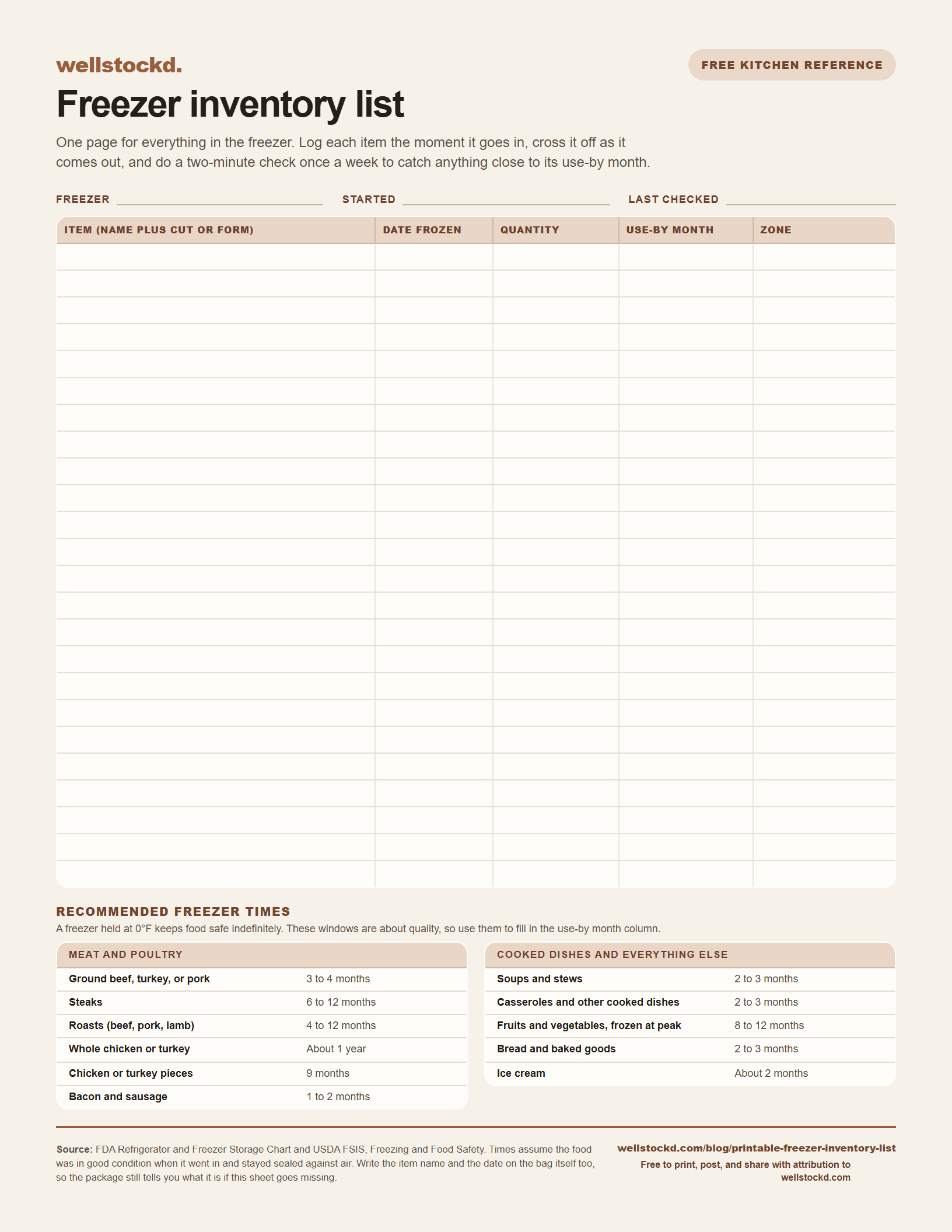
Primary references: FDA and USDA cold storage chart and USDA FSIS freezing guidance.
Free to print, post, and share with attribution to wellstockd.com.
The fastest way to build a printable freezer inventory list is a single page with four columns: item, date frozen, quantity, and use-by month, taped to the freezer door or lid. Update it the moment something goes in or comes out, and you stop losing food to freezer burn at the bottom of the drawer.
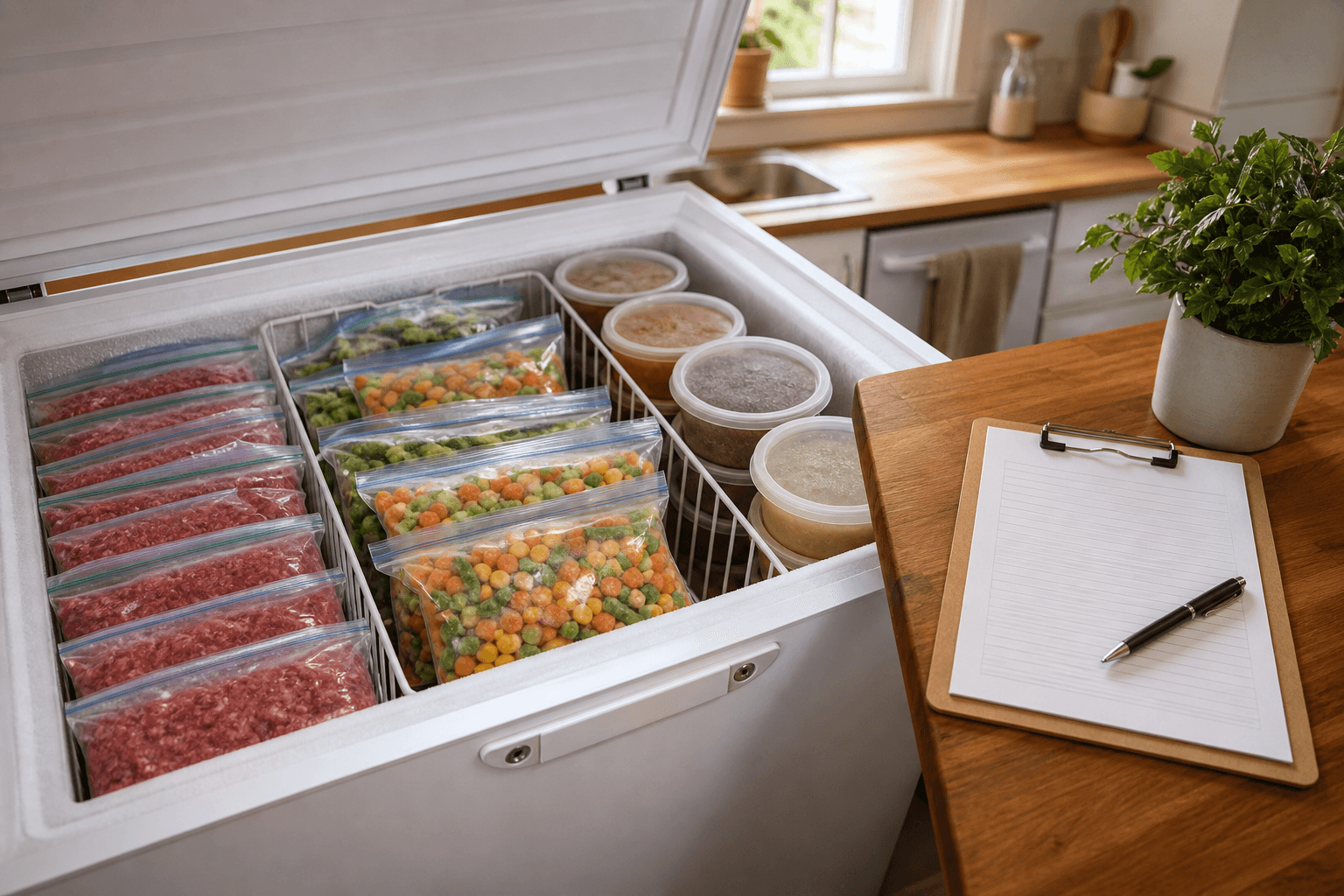
A freezer is the one part of the kitchen where "out of sight, out of mind" costs real money. Ground beef gets buried under bags of peas, a container of soup slides behind the ice trays, and six months later you find it covered in frost, freezer-burned past the point of wanting to eat it. A printable list fixes that by putting everything you own in one place you can glance at before you shop or start cooking, so you don't forget what's already in there. It works the same way a kitchen inventory system works for the rest of your food storage: write it down once, then keep it current.
How do you make a printable freezer inventory list?
You do not need fancy software. A sheet of paper, a pen, and five minutes of setup get you most of the way there, and if you would rather not draw the columns yourself, the free letter-size PDF and PNG in the download box at the top of this page are the same list already laid out.
- Pick a layout that matches your freezer. A single column works for a small over-fridge freezer. A grid divided by zone (door, top shelf, bottom drawer, or left and right side of a chest freezer) works better for a standalone unit, because you can note where each item lives, not just that it exists.
- Set up four columns. Item, date frozen, quantity or number of portions, and use-by month. A fifth "notes" column is worth adding if you freeze things in bulk, so you can write "4 bags, 1 lb each" instead of guessing later.
- Print two or three copies, or laminate one. A laminated sheet or one slipped into a plastic page protector lets you write on it with a dry-erase marker and wipe it clean instead of reprinting every month.
- Attach it where you will see it. Tape it to the freezer door at eye level, or clip it to the wall next to a chest freezer's lid. If the list is in a drawer, you will not check it before you shop.
- Log items the moment they go in. Waiting until "later" is how half the sheet stays blank. Write the date and quantity as you bag and label the food, not after it is already stacked inside.
- Cross off or erase items as they come out, and do a two-minute check once a week to catch anything close to its use-by month before it turns into freezer burn.
What should each line on the sheet include?
Keep the columns simple enough that you will fill them in every time. This is the format that holds up over months of real use.
| Column | What to write | Example |
|---|---|---|
| Item | Name plus cut or form | Ground beef, 1 lb portions |
| Date frozen | The day you bagged it | 7/12 |
| Quantity | Number of bags or containers | 4 bags |
| Use-by month | Date frozen plus the recommended window | Best by 11/2026 |
| Zone | Where it lives in the freezer | Door shelf 2, Drawer 3 |
If you are also tracking pantry inventory on a separate sheet, use the same column layout for both so you only have to remember one system.
How long can you actually keep food in the freezer?
A freezer held at 0°F keeps food safe to eat indefinitely. What changes over time is quality, not safety, according to the USDA Food Safety and Inspection Service. That said, these are the windows worth writing on your use-by column so food gets eaten while it still tastes good.
| Food | Recommended freezer time |
|---|---|
| Ground beef, turkey, or pork | 3 to 4 months |
| Steaks | 6 to 12 months |
| Roasts (beef, pork, lamb) | 4 to 12 months |
| Whole chicken or turkey | About 1 year |
| Chicken or turkey pieces | 9 months |
| Bacon and sausage | 1 to 2 months |
| Soups and stews | 2 to 3 months |
| Casseroles and other cooked dishes | 2 to 3 months |
| Fruits and vegetables, frozen at peak | 8 to 12 months |
| Bread and baked goods | 2 to 3 months |
| Ice cream | About 2 months |
These numbers come from FDA and USDA cold storage guidance, and they assume the food was in good condition when it went in and stayed sealed against air. A vacuum-sealed or well-wrapped package will outlast one with loose, gappy plastic wrap every time.
Do you need an app if you already have a printed list?
A printable sheet is a genuinely good start, and it costs nothing. Where it falls short is the same place any paper list falls short: it doesn't update itself when you cook, and it won't warn you before something hits its use-by month. It also can't tell you what you could make for dinner tonight with what's already frozen. If you want that piece without giving up the habit of writing food down as it goes in, an app built around the same idea, like the best pantry inventory app for fridge, pantry, and freezer together, logs each item once and keeps the list current on its own. It matches what you have against recipes, so nothing frozen gets forgotten. Plenty of households run both: a laminated sheet on the freezer door for a quick glance, and an app for the fridge and pantry items that turn over faster. See how the two compare for keeping track of food in your fridge if you are deciding which parts of your kitchen need which system.
Frequently asked questions
How often should I update my freezer inventory list? Update it every time you add or remove something, not on a schedule. A weekly two-minute check is a good backup for anything you forgot to log in the moment.
Can I use a whiteboard instead of a printed sheet? Yes. A small dry-erase board mounted on the freezer door works the same way and never needs reprinting, though it will not survive if the freezer is in a garage that gets condensation.
What is the best way to label the bags themselves, not just the sheet? Write the item name and the date directly on freezer tape or a permanent marker on the bag, in addition to the sheet. If the sheet gets lost or falls behind, the bag still tells you what it is.
Sources: FDA Refrigerator and Freezer Storage Chart, USDA FSIS: Freezing and Food Safety