Free printable
Printable Freezer Storage Chart
Print the chart below or download it as a letter-size PDF or a high-resolution PNG. It’s free, and no email is needed. The times assume a freezer at 0°F (-18°C) or below. Food kept frozen at 0°F stays safe, and the times tell you how long it keeps its best taste and texture.
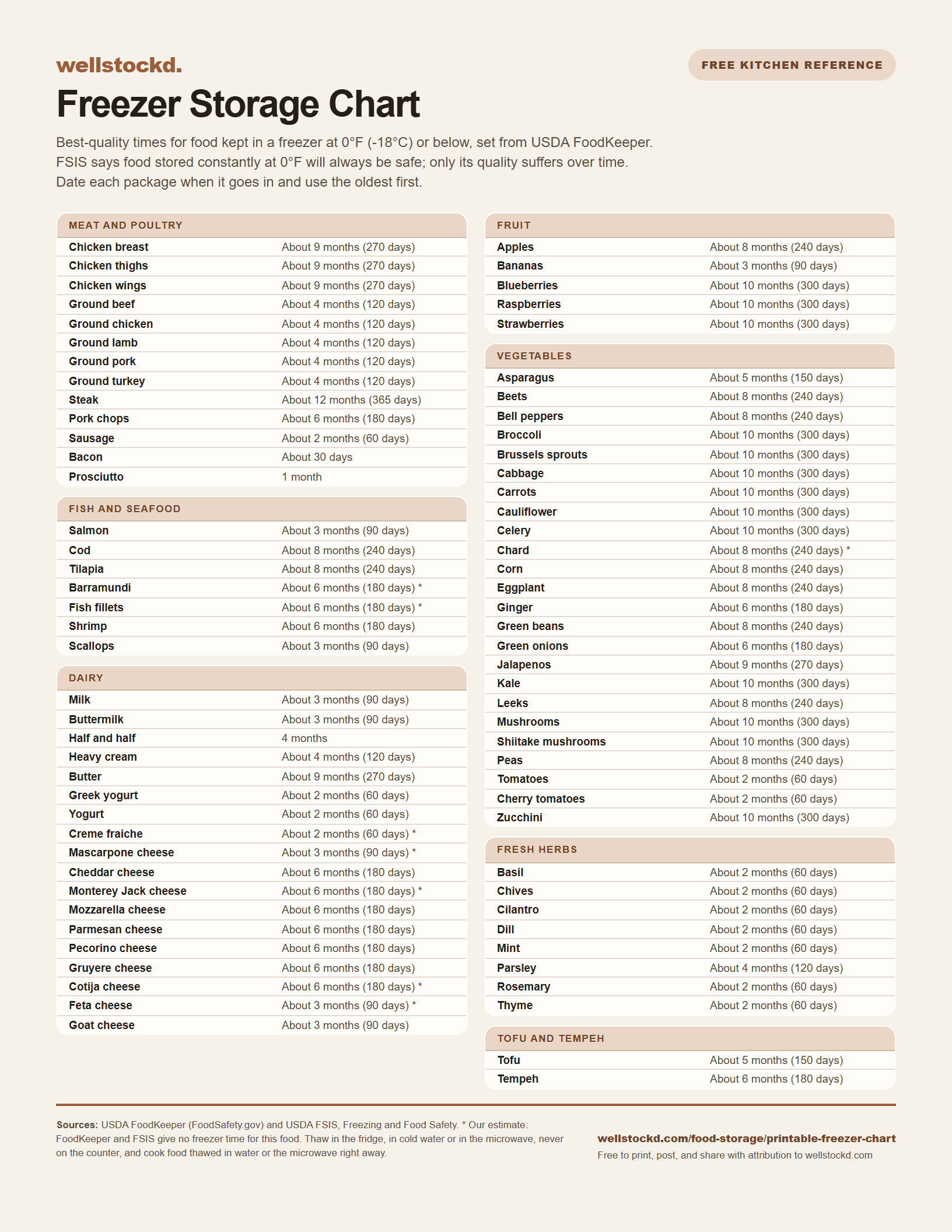
Free to print, post, and share with attribution to wellstockd.com.
Also free to print: Refrigerator shelf-life chart · Pantry shelf-life chart
| Food | Best quality at 0°F |
|---|---|
| Meat and poultry | |
| Chicken breast | About 9 months (270 days) |
| Chicken thighs | About 9 months (270 days) |
| Chicken wings | About 9 months (270 days) |
| Ground beef | About 4 months (120 days) |
| Ground chicken | About 4 months (120 days) |
| Ground lamb | About 4 months (120 days) |
| Ground pork | About 4 months (120 days) |
| Ground turkey | About 4 months (120 days) |
| Steak | About 12 months (365 days) |
| Pork chops | About 6 months (180 days) |
| Sausage | About 2 months (60 days) |
| Bacon | About 30 days |
| Prosciutto | 1 month |
| Fish and seafood | |
| Salmon | About 3 months (90 days) |
| Cod | About 8 months (240 days) |
| Tilapia | About 8 months (240 days) |
| Barramundi | About 6 months (180 days) * |
| Fish fillets | About 6 months (180 days) * |
| Shrimp | About 6 months (180 days) |
| Scallops | About 3 months (90 days) |
| Dairy | |
| Milk | About 3 months (90 days) |
| Buttermilk | About 3 months (90 days) |
| Half and half | 4 months |
| Heavy cream | About 4 months (120 days) |
| Butter | About 9 months (270 days) |
| Greek yogurt | About 2 months (60 days) |
| Yogurt | About 2 months (60 days) |
| Creme fraiche | About 2 months (60 days) * |
| Mascarpone cheese | About 3 months (90 days) * |
| Cheddar cheese | About 6 months (180 days) |
| Monterey Jack cheese | About 6 months (180 days) * |
| Mozzarella cheese | About 6 months (180 days) |
| Parmesan cheese | About 6 months (180 days) |
| Pecorino cheese | About 6 months (180 days) |
| Gruyere cheese | About 6 months (180 days) |
| Cotija cheese | About 6 months (180 days) * |
| Feta cheese | About 3 months (90 days) * |
| Goat cheese | About 3 months (90 days) |
| Food | Best quality at 0°F |
|---|---|
| Fruit | |
| Apples | About 8 months (240 days) |
| Bananas | About 3 months (90 days) |
| Blueberries | About 10 months (300 days) |
| Raspberries | About 10 months (300 days) |
| Strawberries | About 10 months (300 days) |
| Vegetables | |
| Asparagus | About 5 months (150 days) |
| Beets | About 8 months (240 days) |
| Bell peppers | About 8 months (240 days) |
| Broccoli | About 10 months (300 days) |
| Brussels sprouts | About 10 months (300 days) |
| Cabbage | About 10 months (300 days) |
| Carrots | About 10 months (300 days) |
| Cauliflower | About 10 months (300 days) |
| Celery | About 10 months (300 days) |
| Chard | About 8 months (240 days) * |
| Corn | About 8 months (240 days) |
| Eggplant | About 8 months (240 days) |
| Ginger | About 6 months (180 days) |
| Green beans | About 8 months (240 days) |
| Green onions | About 6 months (180 days) |
| Jalapenos | About 9 months (270 days) |
| Kale | About 10 months (300 days) |
| Leeks | About 8 months (240 days) |
| Mushrooms | About 10 months (300 days) |
| Shiitake mushrooms | About 10 months (300 days) |
| Peas | About 8 months (240 days) |
| Tomatoes | About 2 months (60 days) |
| Cherry tomatoes | About 2 months (60 days) |
| Zucchini | About 10 months (300 days) |
| Fresh herbs | |
| Basil | About 2 months (60 days) |
| Chives | About 2 months (60 days) |
| Cilantro | About 2 months (60 days) |
| Dill | About 2 months (60 days) |
| Mint | About 2 months (60 days) |
| Parsley | About 4 months (120 days) |
| Rosemary | About 2 months (60 days) |
| Thyme | About 2 months (60 days) |
| Tofu and tempeh | |
| Tofu | About 5 months (150 days) |
| Tempeh | About 6 months (180 days) |
* Our estimate: FoodKeeper and FSIS give no freezer time for this food.
How to use the chart
- Freeze food you won’t use soon while it’s still fresh, and write the date on the bag or box.
- Add the chart’s time to that date to get the month to use it by. Ground beef frozen in January is at its best until about May.
- Keep older packages at the front so they get used first.
- Thaw food in the fridge, in cold water or in the microwave, never on the counter. Cook food thawed in cold water or the microwave right away.
Sources and safe use
The times are Well Stockd’s planning figures, set from USDA FoodKeeper, and each food’s page names the FoodKeeper entry behind its time. They are for best quality. USDA FSIS says food stored constantly at 0°F will always be safe, and only the quality suffers with long freezer storage.
The times assume a freezer that holds 0°F (-18°C) or below. FSIS suggests keeping an appliance thermometer in the freezer. A freezer compartment that can’t hold 0°F, or one that’s opened often, is for short-term storage, so use food from it sooner.
Common questions
Is frozen food safe after the time on the chart?
Yes, as long as it stayed frozen at 0°F. USDA FSIS says food stored constantly at 0°F will always be safe, and only the quality suffers with long storage. To judge quality after thawing, FSIS suggests checking the smell first: throw out food with a rancid or off odor. Food that doesn’t look its best can go into soups or stews.
How long can you keep meat in the freezer?
For best quality, this chart gives chicken breasts, thighs and wings about 9 months; ground beef, chicken, lamb, pork and turkey about 4 months; steak about 12 months; pork chops about 6 months; raw sausage about 2 months; and bacon about 30 days. Meat kept at 0°F stays safe after that, though its quality slowly drops.
Can you refreeze food after it thaws?
Yes, if it thawed in the fridge. USDA FSIS says food thawed in the refrigerator can be refrozen without cooking, though it may lose some quality. Food thawed in cold water or in the microwave should be cooked right away, and once cooked it can be frozen. Don’t refreeze food that sat out of the fridge for more than 2 hours, or 1 hour above 90°F.
Is freezer-burned food safe to eat?
Yes. FSIS says freezer burn leaves food dry in spots and doesn’t make it unsafe. It shows up as grayish-brown, leathery patches where air reached the food. Cut those parts away before or after cooking. Food with heavy freezer burn may need to be thrown out for quality reasons. Wrapping food well, and overwrapping store packages for long storage, helps prevent it.
Which foods don’t freeze well?
USDA FSIS says you can freeze almost any food except canned food and eggs in the shell. Once food is out of the can, you can freeze it. FSIS names mayonnaise, cream sauce and lettuce as foods that don’t freeze well, and FoodKeeper doesn’t recommend freezing avocados, cream cheese, ricotta, leaf spinach or citrus fruit.