How to dice an onion without crying or a mess
A step-by-step guide to dicing an onion: the tools, each cut in order, small, medium and large dice sizes, why onions make you cry and how to cut down on tears, and common mistakes with their fixes.
To dice an onion, cut it in half through the root, peel it, make lengthwise cuts that stop before the root, then slice across those cuts so the onion drops away in small cubes of the same size. A sharp knife, a chilled onion and a cutting board that can't slide take care of most of the tears and most of the mess.
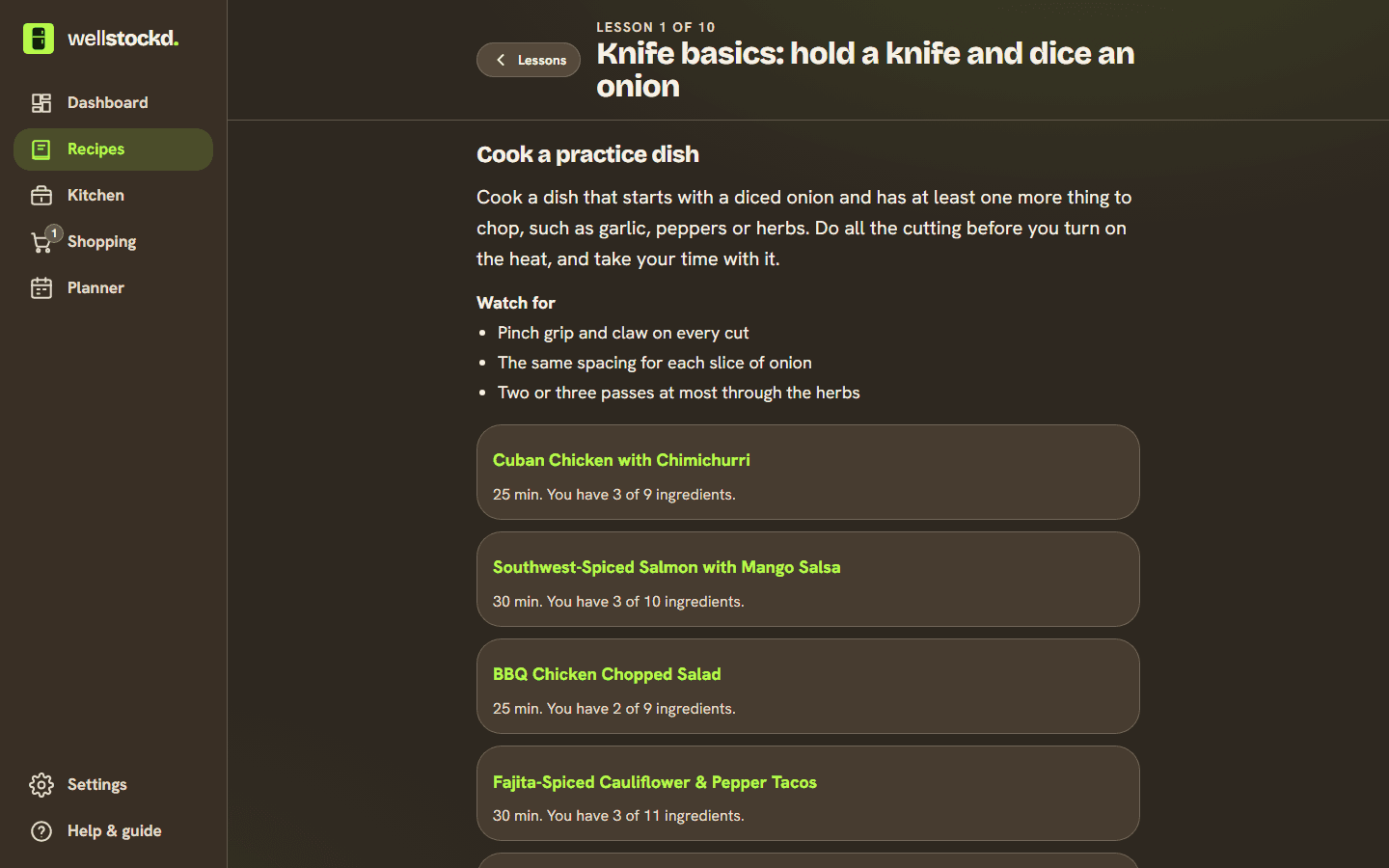
Below are the cuts in order, the dice sizes recipes mean, why onions sting and what helps, and the mistakes that leave you with a pile of uneven, watery pieces. If you'd like to practice on a real dinner, Well Stockd's Cooking School starts with exactly this skill, and its first lesson is free.
What you need to dice an onion
Very little:
- A chef's knife, about 8 inches long, as sharp as you can get it. A dull blade skids on the skin and crushes the onion.
- A large cutting board that stays put. If yours slides on the counter, spread a dampened paper towel or a piece of rubbery shelf liner under it.
- A small bowl for the skin and root ends. Onion trimmings make good broth, so they can go into a bag of vegetable scraps for stock.
How to dice an onion, step by step
- Trim the top. Cut a slice roughly 1/2 inch thick from the pointed stem end so the onion can stand on a flat surface. Leave the hairy root end alone. It's what keeps the layers joined while you cut.
- Halve it through the root. Stand the onion on the trimmed end and cut straight down through the middle of the root, so each half keeps a piece of it.
- Peel. Pull the dry skin off each half. If the layer underneath feels leathery or has brown patches, peel that away too.
- Lay one half flat on its cut face, with the root pointing away from you.
- Make lengthwise cuts. Starting near the root, draw the knife toward you through the onion, following the lines of its layers. Stop each cut a little before the root. Space them about 1/4 inch apart for a small dice or 1/2 inch apart for a medium one.
- Cut across. Curl the fingertips of your other hand under, the grip cooks call the claw, so your knuckles face the blade, and slice across the lengthwise cuts, starting at the trimmed end and moving toward the root. Square pieces drop away with every slice.
- Stop at the root. The last knob is too tangled to dice neatly. Chop it roughly for a soup or put it in the scrap bowl.
Some cooks add one or two horizontal cuts, parallel to the board, before the crosswise slices. They help with a very large onion when you want a fine dice. On an ordinary onion the layers already do that job, so you can skip them.
What size is a diced onion?
Recipes use a few words for onion size. These are the usual meanings:
| Recipe says | Piece size | Good for |
|---|---|---|
| Minced | about 1/8 inch or smaller | Dressings, salsa, meatballs, anything where the onion should almost disappear |
| Finely diced or small dice | about 1/4 inch | Sauces, fried rice, omelets, rice dishes |
| Diced or medium dice | about 1/2 inch | Soups, chili, sautés, most weeknight recipes |
| Chopped or large dice | about 3/4 inch | Stews, roasting pans, stock |
The spacing of your lengthwise cuts sets the size. Keep the crosswise cuts the same distance apart and the pieces come out square.
Why do onions make you cry?
Cutting an onion breaks open its cells. Enzymes that were held apart inside them mix with the onion's sulfur compounds and make a gas that irritates your eyes, and your eyes water to rinse it away. The more cells you crush, and the longer the cut onion sits under your face, the more of that gas reaches you.
How to dice an onion without crying
None of these stops the reaction completely, but together they make a big difference:
| What to do | Why it helps |
|---|---|
| Use a sharp knife | A clean slice breaks fewer cells than a dull blade that crushes them |
| Chill the onion first | A cold onion releases the gas more slowly than one from a warm counter |
| Work near moving air | A running range hood or a small fan carries the gas away from your face |
| Move cut pieces off the board | Every cut surface keeps releasing gas while it sits in front of you |
| Wear close-fitting goggles | Swim goggles keep the gas off your eyes, if you don't mind how they look |
How to keep onion mess down
Most onion mess is skin, juice and pieces that roll off the board. Peel over the scrap bowl, keep your diced onion in one tidy pile, and move it with the back of the knife or a bench scraper. Dragging the sharp edge across the board to scoop dulls it quickly.
If you only need half, wrap the other half and refrigerate it cut side down in a sealed container. Our guide to how long chopped onion lasts in the fridge has the times, and the onion storage page covers whole onions too. Afterward, hot, soapy water takes most of the smell off the board, the knife and your skin.
Common onion-dicing mistakes and how to fix them
| Mistake | What happens | Fix |
|---|---|---|
| Cutting off the root first | The layers fall apart into loose slices | Leave the root attached until you've made your final slice across |
| Lengthwise cuts go through the root | The slices separate before you cut across them | Stop each cut a little short of the root |
| Uneven spacing | Some pieces burn in the pan while others stay crunchy | Shift your guiding hand back by the same small step each time |
| A dull knife | The blade skids, the onion turns wet and your eyes sting more | Hone or sharpen it before you start |
| Chopping straight down hard | Bruised, watery onion and a tired arm | Slice forward and down in one smooth motion |
| A board that slides | The knife slips | Put a damp towel or mat under it |
Questions about dicing onions
How long does it take to dice an onion?
A beginner usually needs three to five minutes for one medium onion, including peeling. Speed comes with practice. Even pieces matter far more than fast ones, because even pieces cook at the same rate.
Can you dice onions ahead of time?
Yes. Dice them, seal them in an airtight container and refrigerate them until you cook. The smell is strong, so a container with a tight lid keeps it out of everything else in the fridge.
Practice dicing onions in the Cooking School
Knife work is the first lesson in Well Stockd's Cooking School. Lesson 1, Knife basics, is free and needs no account: you can read it, take its three-question quiz and use the checklist that asks how your cutting went. With a free account, Well Stockd suggests practice dishes that start with a diced onion, shows how many of each recipe's ingredients you already have, and walks you through the one you pick in cook mode.
If onions tend to sprout in your pantry before you get to them, it helps to keep track of what's in your pantry so they get used. When you're ready for the next skill, the Cooking School lists all ten lessons, from knife work to timing a whole dinner.