Refrigerator and freezer food storage chart: how long food actually lasts
Refrigerators need to hold 40°F or below and freezers 0°F or below. What matters day to day is how long specific foods last once they're in there. This chart covers eggs, meat, dairy, seafood, and leftovers, plus the two-hour rule that matters more than the chart itself.
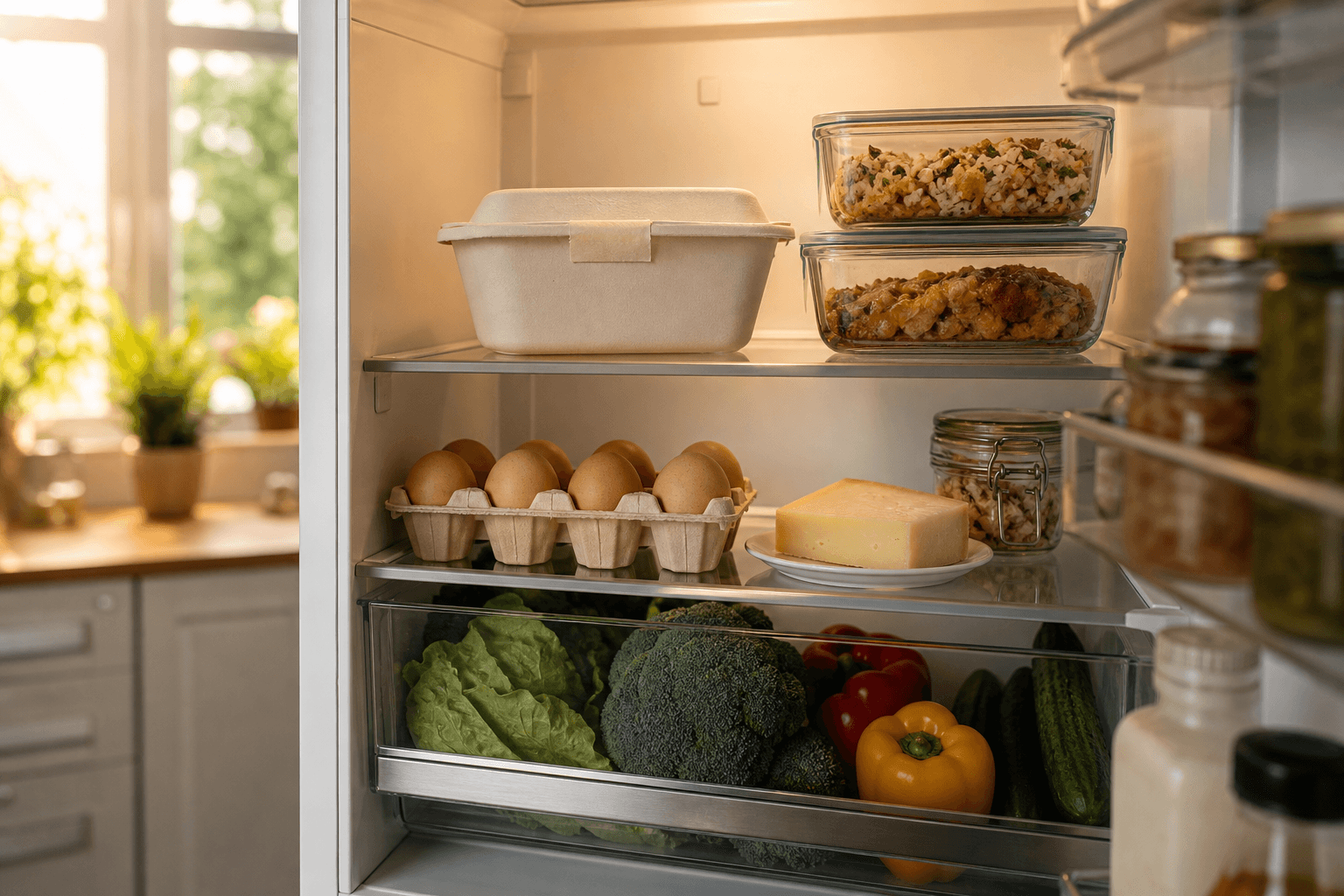
Keep your refrigerator at 40°F or below and your freezer at 0°F or below, then track two separate clocks: a safety clock for chilled food, where most raw meat and leftovers last 1 to 5 days, and a quality clock for frozen food, where most items stay good for 2 months to a year.
Everything else on a refrigerator and freezer storage chart is detail on top of that. Once you know the two temperatures and the two clocks, the rest is just looking up a number.
What temperature makes a storage chart accurate?
A chart is only as good as the appliance behind it. The USDA and FDA base every time limit below on a refrigerator holding at 40°F (4°C) or below and a freezer holding at 0°F (minus 18°C) or below. Above 40°F, bacteria that cause foodborne illness multiply fast enough that the safe windows below shrink, sometimes by half.
Most built-in dials read a few degrees off from reality. A cheap appliance thermometer, left in the fridge and freezer year round, is the only way to know your numbers are real rather than assumed. If you are setting up that kind of system for the first time, our guide to how to keep a kitchen inventory covers the basics of organizing a fridge, freezer, and pantry so you are not starting from scratch every week.
How long does food really last in the refrigerator?
Refrigeration slows bacterial growth. It doesn't stop it. That is why fridge times are measured in days, not weeks, for anything raw or already cooked. Fresh eggs in the shell are the big exception and can hold for a month; opened deli meat, ground meat, and most leftovers are on the short end, usually 1 to 5 days.
The number one way people blow past these windows is losing track of when something went in. If you want a day-to-day system for that, rather than just the outer time limits, see how to keep track of food in your fridge.
How long does food really last in the freezer?
Freezing is a different game. At 0°F or below, food stays safe to eat indefinitely, so every freezer number on the chart below is about quality, not safety. What goes wrong over time is freezer burn: the dry, grayish patches that form when air reaches the surface of frozen food and pulls moisture out of it. Freezer burn will not make you sick, but it does make food taste like the inside of the freezer.
Wrapping food tightly, pressing air out of bags before sealing, and using shallow airtight containers slows freezer burn considerably and is usually the difference between a cut of meat that tastes fine at nine months and one that tastes tired at three.
What does the full refrigerator and freezer storage chart include?
These ranges follow the USDA and FDA cold storage guidelines. Treat them as outer limits, not targets, and always let your eyes and nose override a chart if something looks or smells off before its time is up.
| Food | Refrigerator (40°F or below) | Freezer (0°F or below) |
|---|---|---|
| Eggs, fresh in shell | 3 to 5 weeks | Do not freeze in shell |
| Eggs, raw yolks or whites | 2 to 4 days | 12 months |
| Eggs, hard cooked | 1 week | Do not freeze |
| Milk, opened | 5 to 7 days | 3 months (texture changes) |
| Hard cheese, opened | 3 to 4 weeks | 6 months |
| Butter | 1 to 3 months | 6 to 9 months |
| Ground beef, turkey, or pork, raw | 1 to 2 days | 3 to 4 months |
| Beef, pork, or lamb steaks and roasts, raw | 3 to 5 days | 4 to 12 months |
| Chicken or turkey, raw, whole or pieces | 1 to 2 days | 9 months to 1 year |
| Bacon | 1 week | 1 month |
| Hot dogs, opened package | 1 week | 1 to 2 months |
| Deli meat, opened | 3 to 5 days | 1 to 2 months |
| Fresh shrimp, scallops, crawfish, or squid | 1 to 2 days | 3 to 6 months |
| Fatty fish, such as salmon or tuna | 1 to 2 days | 2 to 3 months |
| Lean fish, such as cod or flounder | 1 to 2 days | 6 to 8 months |
| Soups and stews, cooked | 3 to 4 days | 2 to 3 months |
| Cooked meat or poultry leftovers | 3 to 4 days | 2 to 6 months |
| Pizza, cooked | 3 to 4 days | 1 to 2 months |
Why does the two-hour rule matter more than any chart?
None of the times above apply if food sat out too long before it ever reached the fridge. Throw out perishable food that has sat at room temperature for more than 2 hours, or more than 1 hour above 90°F, no matter what the storage chart says: bacteria can grow to unsafe levels in that window alone. This is the rule that trips up potlucks, picnics, and forgotten grocery bags in a hot car, not the fridge itself.
How do you put this chart to work in a real kitchen?
- Verify your temperatures. A basic appliance thermometer costs a few dollars and confirms whether your fridge is really at 40°F or below and your freezer at 0°F or below, rather than trusting a dial that might run warm.
- Label what you freeze or open. Write the date on tape or directly on the container. Nothing on this chart is useful if you cannot remember when the clock started.
- Store first in, first out. Move newly bought or newly frozen items to the back and pull older ones forward so nothing gets buried and forgotten.
- Do a five-minute weekly scan. Before you shop, look through the fridge and freezer and use up or toss anything nearing the end of its window.
- Let the chart set a ceiling, not a goal. Eating something sooner is always fine. Eating it past its safe window because the chart said it was theoretically possible is not.
For pantry staples that follow a completely different, much longer shelf-stable clock than anything here, see our guide to how to keep track of pantry inventory.
What if you do not want to memorize a chart at all?
A printed chart works, but it only helps if you remember to check it and you remember what date you opened or froze something. That second part is where most people fall down, not the first. An app that logs the date automatically when you add food to your fridge, freezer, or pantry, then flags items as they approach the end of their window, removes the memory problem entirely. We compare Well Stockd against other options in our roundup of the best pantry inventory apps, if you would rather have the dates tracked for you than keep re-reading a table.
Frequently asked questions
Does the date printed on food packaging tell you when it goes bad?
Not usually. Outside of infant formula, phrases like "best by," "use by," and "sell by" are set by the manufacturer to indicate peak quality, not a federal safety cutoff. Use the storage chart's time limits instead, and let your senses have the final say if something looks or smells wrong before that window closes.
Can you refreeze food after it has thawed?
Yes, as long as it was thawed in the refrigerator and stayed at 40°F or below the whole time. Quality drops a little with each freeze and thaw cycle, so it helps to freeze food in meal-sized portions to begin with, rather than thawing a large batch and refreezing what you do not use.
Is frozen food unsafe to eat after the time listed on the chart?
No. Food held continuously at 0°F or below stays safe indefinitely; freezer times are entirely about taste and texture, not safety. A cut of meat frozen for fourteen months will not make you sick, it will just taste a bit more dried out than the same cut frozen for six.
Sources: FoodSafety.gov cold food storage charts, FDA refrigerator and freezer storage chart, USDA FSIS freezing and food safety, Minnesota Department of Health cold storage chart