A 7-Day Meal Plan for One Person That Doesn't Waste Food
A 7-day meal plan for one person, built around three anchor proteins and two starches so nothing goes bad before you eat it, with a full sample week and a leftover storage chart.
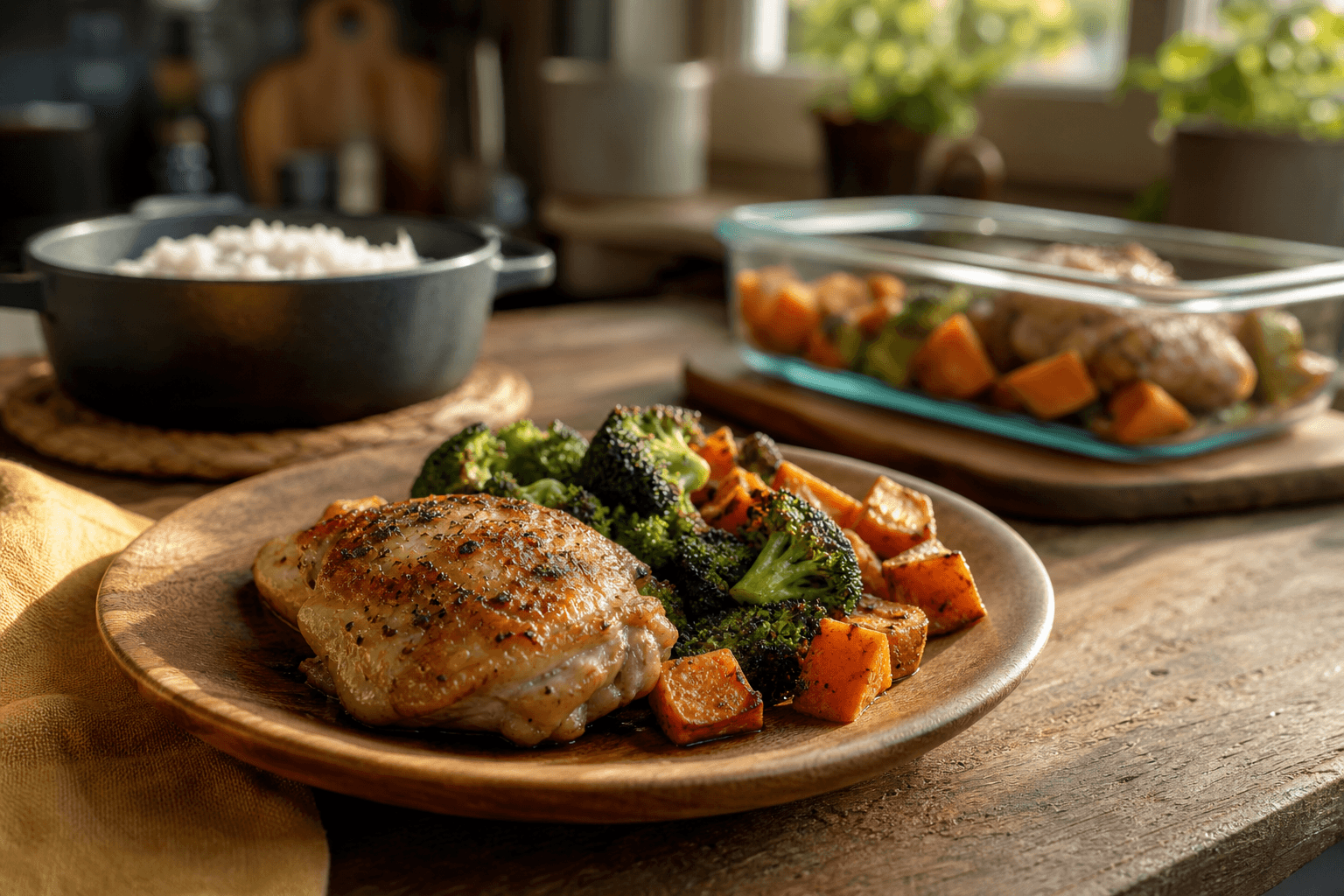
A 7-day meal plan for one person works best when you build it from three anchor proteins and two starches, cook once and eat the results two or three times, and freeze one extra portion on day one. That kind of repetition keeps a week of groceries in the roughly $50 to $75 range and leaves almost nothing rotting in the crisper drawer by Friday.
Why meal planning for one person is its own problem
Most meal plans are written for a family of four and then awkwardly cut in half, which is why they never quite work for one. Recipes call for a whole bunch of celery when you need two ribs. Chicken comes in a three-pound pack. A bag of spinach turns to sludge before you're through a quarter of it. And cooking a full, separate recipe every single night, just for yourself, gets old fast.
What works is a different structure, built around a handful of ingredients that stretch across the week in different forms, rather than a shrunk-down family plan. If you haven't planned a week of meals before, our guide to meal planning for the week walks through the basics that this article builds on for a household of one.
How to build a 7-day meal plan for one person, step by step
- Shop your kitchen first. Before you write a single meal, check what's already in the fridge, freezer, and pantry. Half a bag of rice or a lonely can of beans should shape the plan, not get ignored by it.
- Pick three anchor proteins. One from the freezer (chicken thighs, ground turkey, salmon), one canned or dried (black beans, lentils, chickpeas), and one that cooks fast (eggs, shrimp, tofu). Three is enough variety without three separate shopping trips.
- Choose two starches and let them repeat. Rice and pasta, or potatoes and rice, cooked once in a bigger batch and used across three or four meals in different forms.
- Buy vegetables that pull double duty. Broccoli that's roasted for Monday's dinner can go raw and chopped into Tuesday's lunch bowl. Buy produce that works both cooked and raw, and skip anything that only has one use in the week.
- Cook once, eat twice, sometimes three times. Roast a full tray of chicken thighs and you've got dinner tonight, a hash tomorrow, and shredded chicken for a salad the day after. This single habit does more to cut single-person food waste than any other step.
- Freeze one portion on day one. As soon as you cook the week's biggest batch, portion one serving straight into the freezer before you're tempted to eat it as a second helping. That's your built-in night off.
- Leave one night open. Plan six meals, not seven. The seventh night is for the soup that uses up whatever's wilting, the frozen portion from step six, or a genuinely unplanned takeout treat.
If you'd rather start from a ready-made framework and adjust it to your own tastes, our beginner meal planning template gives you a blank structure to drop these steps into.
A sample 7-day meal plan for one person
For a single week, that method centers on chicken thighs, rice, and broccoli as the repeating core, laid out below.
| Day | Dinner | Built from | What it sets up |
|---|---|---|---|
| Monday | Sheet-pan chicken thighs with roasted broccoli and sweet potato | Chicken thighs, broccoli, sweet potato | Cook two extra thighs and one extra sweet potato for Wednesday |
| Tuesday | Garlic butter pasta with a fried egg and any greens that need using | Pasta, egg, leftover greens | Clears produce before it turns |
| Wednesday | Chicken and sweet potato hash with a fried egg | Monday's leftover chicken and sweet potato | Ten minutes, no new cooking |
| Thursday | Black bean and rice bowl with avocado and salsa | Canned black beans, rice, avocado | Cook a full pot of rice, freeze two portions |
| Friday | Baked salmon or shrimp with roasted broccoli and rice | Salmon or shrimp, Thursday's rice | Reuses the rice and the broccoli habit |
| Saturday | Frozen portion from Thursday plus a quick side salad | Freezer meal | Zero cooking night |
| Sunday | One-pot vegetable soup with anything left in the crisper | Odds and ends, broth, leftover rice or pasta | Clears the fridge before the next shop |
Breakfast and lunch are deliberately left loose here. For one person, the thing that saves the most time is usually a repeatable breakfast (eggs, oats, or yogurt with whatever fruit is around) and lunches built from dinner leftovers, rather than seven separate recipes for three meals a day. If you want a fuller framework for slotting breakfast and lunch into a week like this, weekly meal planning for beginners covers that in more depth.
How long the leftovers in this plan will keep
A single-person meal plan only works if the food you cook on Monday is still safe to eat on Wednesday. According to USDA and FoodSafety.gov guidance, cooked leftovers hold up in the fridge for a shorter window than most people assume.
| Leftover type | Refrigerator (40°F or below) | Freezer (0°F) |
|---|---|---|
| Cooked meat or poultry | 3 to 4 days | 2 to 6 months |
| Soups and stews | 3 to 4 days | 2 to 3 months |
| Cooked rice, pasta, or grains | 3 to 4 days | 1 to 2 months |
| Cooked vegetables | 3 to 4 days | 1 to 2 months |
Get food into the fridge within two hours of cooking, and sooner if your kitchen is warm. If a "cook once, eat three times" plan is going to stretch past day four, freeze the extra portion on day one rather than hoping it lasts in the fridge until Thursday.
Do you need an app to pull this off?
You can run this whole method with a notebook and a grocery list, and plenty of people do. Where it tends to break down for a household of one is tracking what's left in the fridge by Wednesday night, so you don't buy a duplicate bag of rice or let the last two chicken thighs go quiet in the back of the freezer.
That's the specific gap Well Stockd is built for. It's a meal planning app with pantry inventory that tracks what you have on hand, flags what's about to expire, and matches your inventory against thousands of recipes so a half-used bag of rice or a lone sweet potato shows up as a real dinner option instead of getting forgotten. For a repeating, single-person week like the one above, that kind of visibility is what keeps the plan honest past Tuesday.
Frequently asked questions
How many meals should I actually plan for one person in a week?
Plan for about six cooked dinners rather than seven, and let one night run on a frozen portion or a fridge-clean-out meal. Trying to plan all 21 meals of the week in advance is usually where single-person meal plans fall apart.
Is a 7-day meal plan more expensive per meal when you're cooking for just one?
It can be, since package sizes are built for more than one serving. Reusing the same core ingredients across several meals, and freezing extra portions instead of letting them go bad, is the main way to keep the per-meal cost close to what a bigger household pays.
Can I meal plan for one person without eating the same thing every night?
Yes. The plan above uses the same core ingredients, chicken, rice, broccoli, but changes their form each time, roasted, then hashed, then folded into a bowl, so it doesn't feel like eating leftovers three nights running even though that's technically what's happening.
Sources: Cold Food Storage Chart, FoodSafety.gov; Leftovers and Food Safety, USDA FSIS; USDA Food Plans: Cost of Food Reports