How to meal plan for the week: the complete guide
A step-by-step hub for planning a week of meals around the food you already have, with links to guides for every budget, household size, and energy level.
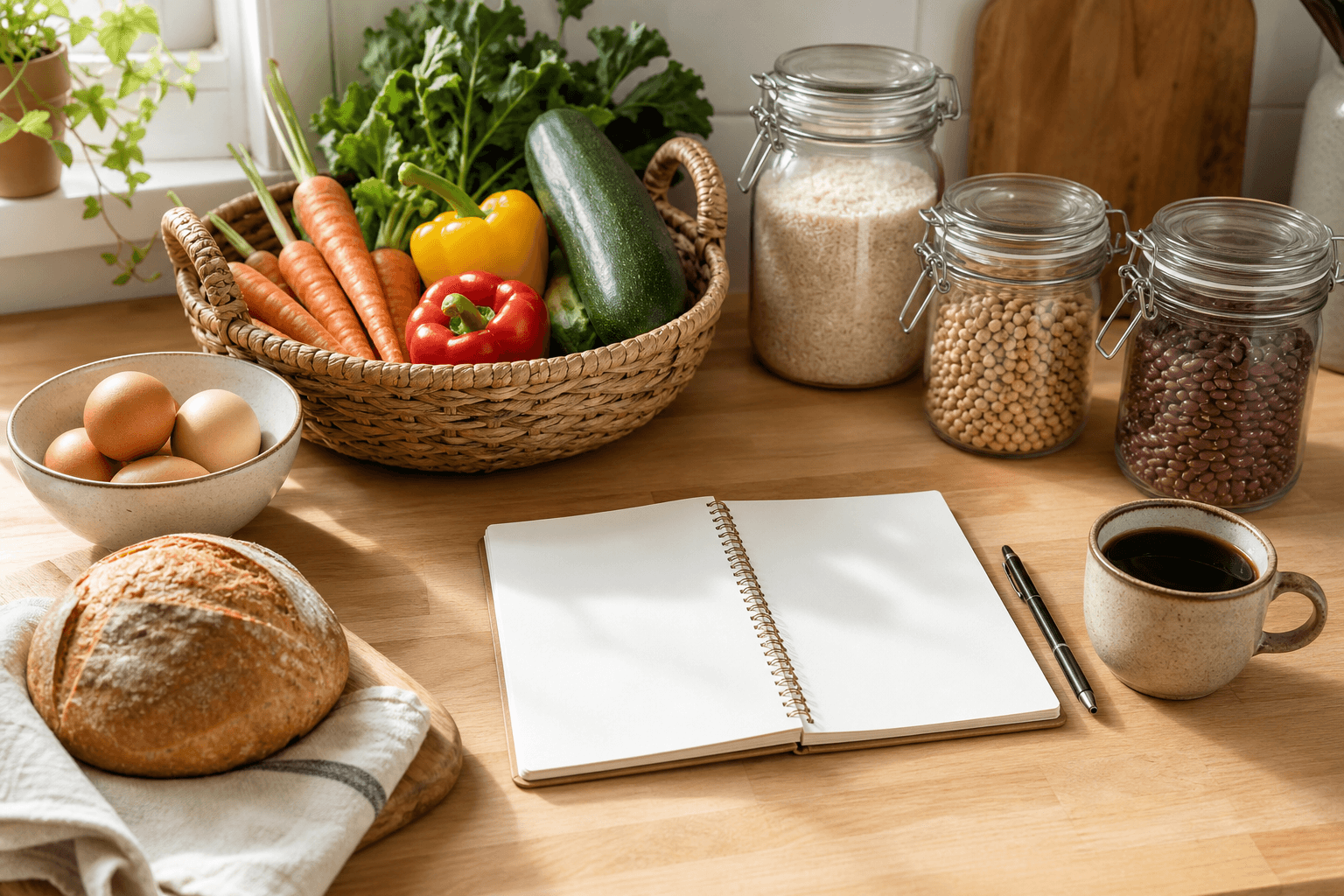
The fastest way to meal plan for a week is a five-step loop: check what food you already have, pick five to seven recipes built around it, write one grocery list for the gaps, prep two or three components ahead, then repeat next week starting with the leftovers.
The short version
- Plan around what is already in your fridge, freezer, and pantry before you shop, not after.
- Five to seven dinners covers most weeks. Let breakfasts and lunches repeat.
- One master grocery list, sorted by store section, beats a running note on your phone.
- Prep ingredients, like chopped vegetables, cooked grains, or marinated protein, instead of five finished meals.
- Build in one leftover night and one flex night so the plan survives a busy Tuesday.
- Look back at what worked before you plan next week. It gets easier every round.
Planning matters more than it sounds like it should. The USDA's food plan reports put a family of four's grocery spending anywhere from about 229 dollars a week on the thrifty plan to around 376 dollars a week on the liberal plan. The EPA estimates a family of four spends close to 3,000 dollars a year on food that never gets eaten, most of it food people buy with good intentions and never get around to using. A written plan closes most of that gap.
Which guide should you start with?
Every household's version of meal planning looks a little different. Use the table below to jump to the guide that matches your situation, then read the fuller breakdown underneath it.
| Your situation | Start with | Time to your first plan |
|---|---|---|
| Brand new to meal planning | Weekly meal planning for beginners | About 15 minutes |
| Cooking for one | 7-day meal plan for one person | About 15 minutes |
| Plans that fall apart by Wednesday | How to meal plan for the week and stick to it | About 20 minutes |
| Feeding a family on a set budget | Meal planning on a budget for a family of 4 | About 20 minutes |
| Trying to shop less often | How to meal plan for two weeks and grocery shop | About 25 minutes |
| Too tired to cook most nights | Meal planning for someone who hates cooking | About 10 minutes |
| Want to use what is already in the kitchen | Dinner ideas with pantry staples for a week | About 10 minutes |
How do you start meal planning as a beginner?
If a blank week of meal slots feels overwhelming, start smaller than you think you need to. Our weekly meal planning for beginners guide breaks the whole habit into five short steps you can repeat every Sunday. Once the routine clicks, the meal planning for beginners template gives you a fill-in-the-blank grid to work from, and the free printable weekly meal planner with grocery list turns that grid into something you can stick on the fridge.
How do you make a meal plan you will stick to?
Most meal plans fail for one of two reasons: they take too long to build, or they get boring by Wednesday night. How to make meal planning faster covers the shortcuts that get planning time under 20 minutes, and how to meal plan for the week and stick to it covers the habits that keep a plan from falling apart by Thursday. If your dinners have settled into the same five meals on repeat, meal planning without eating the same thing every day has a rotation system for that, and how to stop buying the same groceries every week tackles the cart that looks identical no matter what you meant to cook.
How do you meal plan on a budget for your household size?
Budget meal planning looks different depending on how many plates you are setting. How to meal plan for one person on a budget and how to meal plan for a couple on a budget size portions and grocery lists so less goes to waste. Feeding a bigger household costs more, but not dollar for dollar if you plan around it: meal planning on a budget for a family of 4 lays out the framework, and our 100 dollar a week meal plan for a family of 4 shows exactly what that number buys with real recipes and a sample list.
How do you plan two weeks of meals at once?
Planning further out means fewer grocery runs and fewer chances to grab something you did not need. Our 2-week meal plan on a budget with grocery list is a ready-made 14-day rotation, and how to meal plan for two weeks and grocery shop walks through building your own, including how to split one big shop into two smaller trips so produce stays fresh through the second week.
What if you do not like cooking or you are too tired most nights?
Not everyone wants to spend an hour at the stove, and that is fine. Meal planning for someone who hates cooking is built around low-effort dinners and one-pan meals, and lazy dinner ideas when too tired to cook is the list worth bookmarking for the nights when even that feels like too much.
How do you build a week of meals around food you already have?
This is the step most meal plans skip, and it is the one that saves the most money and the most food. Look at your fridge, freezer, and pantry before you write down a single recipe. Meal prep ingredients instead of full meals explains why prepping components beats cooking five identical lunches, dinner ideas with pantry staples for a week is your backup plan for the nights the fridge looks bare, and leftover-friendly meal ideas for the week turns Tuesday's extra rice into Thursday's lunch instead of Sunday's trash.
How do you stop ordering takeout, especially when you are cooking for one?
Cooking for one and breaking a takeout habit are related problems. Both come down to having an easy answer ready before hunger and decision fatigue team up. 7-day meal plan for one person gives you a full week sized for a single eater, and easy weekly meals to stop eating takeout focuses on dinners that come together faster than delivery does.
Where does an app help?
A paper plan works, but it cannot see inside your fridge. Well Stockd's meal planning app with pantry inventory tracks what you have on hand, flags what is about to expire, and matches it against thousands of recipes so your weekly plan is built around real food instead of a guess. You still choose the meals; the app just does the cross-checking so nothing at the back of the fridge gets forgotten.
Related guides
- Weekly meal planning for beginners
- Meal planning for beginners template
- Free printable weekly meal planner with grocery list
- How to make meal planning faster
- Meal planning for someone who hates cooking
- How to meal plan for one person on a budget
- How to meal plan for a couple on a budget
- Meal planning on a budget for a family of 4
- 100 dollar a week meal plan for a family of 4
- 2-week meal plan on a budget with grocery list
- How to meal plan for two weeks and grocery shop
- How to meal plan for the week and stick to it
- Meal planning without eating the same thing every day
- How to stop buying the same groceries every week
- 7-day meal plan for one person
- Lazy dinner ideas when too tired to cook
- Easy weekly meals to stop eating takeout
- Meal prep ingredients instead of full meals
- Dinner ideas with pantry staples for a week
- Leftover-friendly meal ideas for the week
Frequently asked questions
How far ahead should I meal plan? One week is the sweet spot for most households. It is far enough out to build one grocery list and save real time, but close enough that you can still adjust for a schedule change. If you want to cut your shopping trips in half, see how to meal plan for two weeks and grocery shop.
Do I need to plan every single meal? No. Most of the payoff comes from planning dinners. Breakfasts and lunches can repeat two or three times through the week without anyone minding, which is also where meal prep ingredients instead of full meals saves the most time.
What if my plan does not match what is in my kitchen by Wednesday? Rebuild around what is left, not around the original list. A pantry-first, leftover-first dinner covers most midweek gaps. See leftover-friendly meal ideas for the week and dinner ideas with pantry staples for a week for backups that use what is already open in the fridge.
Sources: USDA Food Plans: Cost of Food Reports, EPA: Preventing Wasted Food at Home