Can you cut mold off cheese and still eat it?
USDA guidance says you can save a hard cheese like cheddar or parmesan by cutting off at least 1 inch around and below a mold spot, but soft cheeses like Brie and cottage cheese have to be thrown out entirely. That's the exact rule, along with how long cheese actually lasts in the fridge and freezer
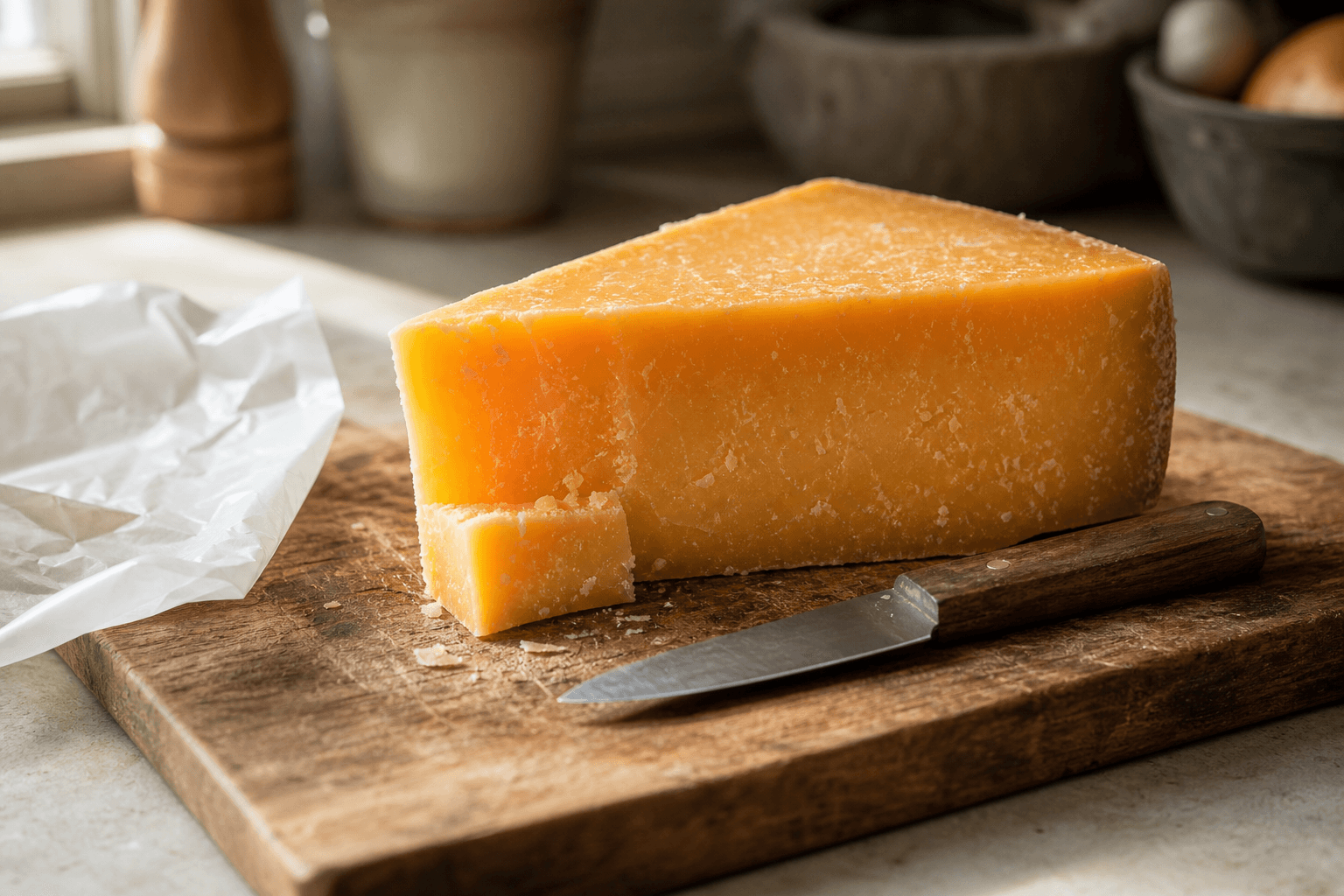
Yes, but only for hard cheese, and only if you cut it right. USDA guidance says to trim off at least 1 inch of cheese around and below a mold spot, and to keep the knife out of the mold itself. Throw out soft cheeses entirely if they have unwanted mold.
Can you cut mold off cheese and still eat it?
For hard, aged cheeses like cheddar, parmesan, swiss, and gouda, yes. The USDA's Food Safety and Inspection Service explains that mold generally cannot send its roots very deep into a dense, low moisture cheese, so cutting away a generous margin removes the part you cannot see along with the part you can.
Mold matters in the first place because a few types produce mycotoxins, poisonous substances that can make you sick, on top of the allergic reactions and respiratory irritation mold can cause on its own. That is why the USDA rule is specific rather than a rough guess.
Cut off at least 1 inch of cheese in every direction around the mold spot, including underneath it. Use a clean knife, and do not let the blade pass through the mold itself on its way in, or you will drag spores across the cut surface and recontaminate the good cheese. After trimming, wrap the remaining cheese in fresh wrap or paper rather than the wrapper the mold touched.
Soft cheeses do not get the same pass. Throw out cottage cheese, cream cheese, ricotta, and other moist, soft cheeses completely if any mold appears anywhere on them. Their higher moisture content lets mold roots spread invisibly through the whole product, and moldy soft cheese can be growing bacteria right alongside the mold you can see.
What about cheese that is already made with mold, like blue cheese or Brie?
Some cheeses are built around mold on purpose, and that mold is safe. Blue veined cheeses such as Roquefort, Gorgonzola, and Stilton get their color and flavor from Penicillium roqueforti. Brie and Camembert get their soft white rind from Penicillium camemberti, sprayed onto the surface during production. Both are intentional, and both are fine to eat as sold.
The rule changes the moment you see mold that does not belong there: a fuzzy patch in a different color or texture than the cheese's normal veining or rind. Because Brie, Camembert, and most blue cheeses are soft and moisture rich, treat any unexpected mold on them the same way you would treat mold on cottage cheese. Discard the whole piece rather than trying to cut around it.
What about shredded, sliced, or crumbled cheese?
Skip the inch rule here too. Once you shred, slice, or crumble cheese, mold and the tool used to cut it can spread contamination through the whole bag, even if only a corner looks affected. Throw out the entire package if you spot mold on shredded cheddar, sliced deli cheese, or crumbled feta, no matter how firm the original block would have been.
How long does cheese last in the fridge and freezer?
Storage time matters just as much as the mold rule, since cheese can spoil before mold ever shows up. These figures come from the USDA FoodKeeper app.
| Cheese type | Unopened (fridge) | After opening (fridge) | Freezer |
|---|---|---|---|
| Hard cheese (cheddar, parmesan, swiss, gouda) | Up to 6 months | 3 to 4 weeks | Up to 6 months, texture turns crumbly |
| Soft cheese (Brie, goat cheese, fresh mozzarella) | Use by the printed date | 1 to 2 weeks | Up to 6 months, texture turns watery or grainy |
| Cottage cheese | About 2 weeks | About 1 week | Not recommended |
| Cream cheese | Use by the printed date | About 2 weeks | Not recommended |
Since cheese rarely carries a use by date once it is opened, logging the day you opened it in a tool like Well Stockd's food expiration tracker is an easy way to know which side of these windows you are actually on.
For the same kind of fridge and freezer breakdown on other staples, see our full guide to how long food lasts, including how long cooked rice keeps in the fridge and how long raw chicken stays safe to store.
How to tell if cheese has gone bad
Trust your senses first, then trust the calendar. Signs a cheese is past its point of no return include:
- A strong ammonia smell that is sharper than the cheese's normal aroma, especially in soft, ripened cheeses like Brie
- Sliminess, excess wetness, or a sticky film on the surface
- Any fuzzy, colored patch that is not part of the cheese's normal rind or veining, in white, green, pink, black, or orange
- A sour, off smell that is different from the cheese's usual tang
- Dryness or cracking well beyond what is typical for that cheese
Spoilage is not always visible or smelly, which is the part that trips people up. Mold sends roots deeper than you can see, and Listeria monocytogenes, a bacteria linked to soft and unpasteurized cheeses, can grow at refrigerator temperatures without changing how cheese looks, smells, or tastes. That is why the storage window in the table above matters even when a cheese seems fine. Pregnant women, newborns, adults 65 and older, and anyone with a weakened immune system should be especially careful with soft and unpasteurized cheeses, since they are far more likely to get seriously ill from a Listeria infection.
How to store cheese so it lasts
- Wrap hard cheese loosely in wax paper, parchment, or cheese paper, then place it in a partly sealed bag or container so it can breathe without drying out.
- Keep soft cheeses in their original packaging until you use them, and reseal tightly after each use.
- Store cheese in the refrigerator's cheese or vegetable drawer, where the temperature stays closer to a steady 35 to 40 degrees Fahrenheit.
- Use a clean knife and clean hands every time you cut cheese, so you are not introducing new mold spores or bacteria to the surface.
- Re-wrap cheese in fresh material any time the old wrapper gets damp, torn, or has touched mold.
- Buy only what you can reasonably use inside the storage window in the table above, especially for soft cheeses.
Can you freeze cheese?
Yes, and it stays safe indefinitely as long as your freezer holds a steady 0 degrees Fahrenheit, but the texture pays a price. Hard and semi hard cheeses like cheddar, parmesan, and mozzarella freeze reasonably well for up to 6 months and mostly keep their flavor, though they turn more crumbly once thawed. Soft, fresh cheeses like cottage cheese, cream cheese, and ricotta do not freeze well and tend to separate into a watery, grainy mess. If you do freeze cheese, thaw it slowly in the refrigerator rather than on the counter, which gives it the best chance of reabsorbing moisture instead of weeping it out.
We walk through the exact steps, containers, and thaw times in our guide to freezing cheese.
When in doubt, throw it out
This is USDA's standard advice for any food you are unsure about, and it applies directly to cheese. If a soft cheese has mold you did not put there, if a hard cheese smells or tastes off even after trimming, or if you simply cannot remember how long something has been open, do not taste test it to find out. The inch of trimmed cheese you lose by playing it safe costs far less than a foodborne illness.
Mold isn't the only failure mode — how to tell if cheese is bad covers smell, texture, and taste too.
Frequently asked questions
Can you eat the rest of a block of cheddar if part of it is moldy?
Yes, if you cut at least 1 inch around and below the mold spot with a clean knife that never touches the mold, and the remaining cheese still looks, smells, and feels normal.
Is it safe to just scrape mold off soft cheese like Brie or cottage cheese?
No. Soft cheeses hold enough moisture that mold roots can spread through the whole piece invisibly, so scraping the surface does not remove the risk. Discard the entire cheese.
Does the mold in blue cheese mean any mold on cheese is safe to eat?
No. The mold in blue cheese, Roquefort, Gorgonzola, and Stilton is a specific, food safe strain added on purpose during manufacturing. A different colored or textured mold that shows up later is not the same thing, and the cheese should be thrown out.
Sources: USDA FSIS, Molds on Food: Are They Dangerous?, USDA, If food has mold, is it safe to eat?, USDA FSIS, Freezing and Food Safety, USDA FoodKeeper App, FoodSafety.gov, CDC, How Listeria Spreads: Soft Cheeses and Raw Milk, FDA, Listeria: Food Safety for Moms-to-Be.