What can I substitute for canned diced tomatoes?
A can-for-can guide to replacing canned diced tomatoes with whole peeled, crushed, fire-roasted, fresh or tomato sauce, with USDA cup volumes, the calcium chloride reason your substitute softens faster, and one home canning safety rule.
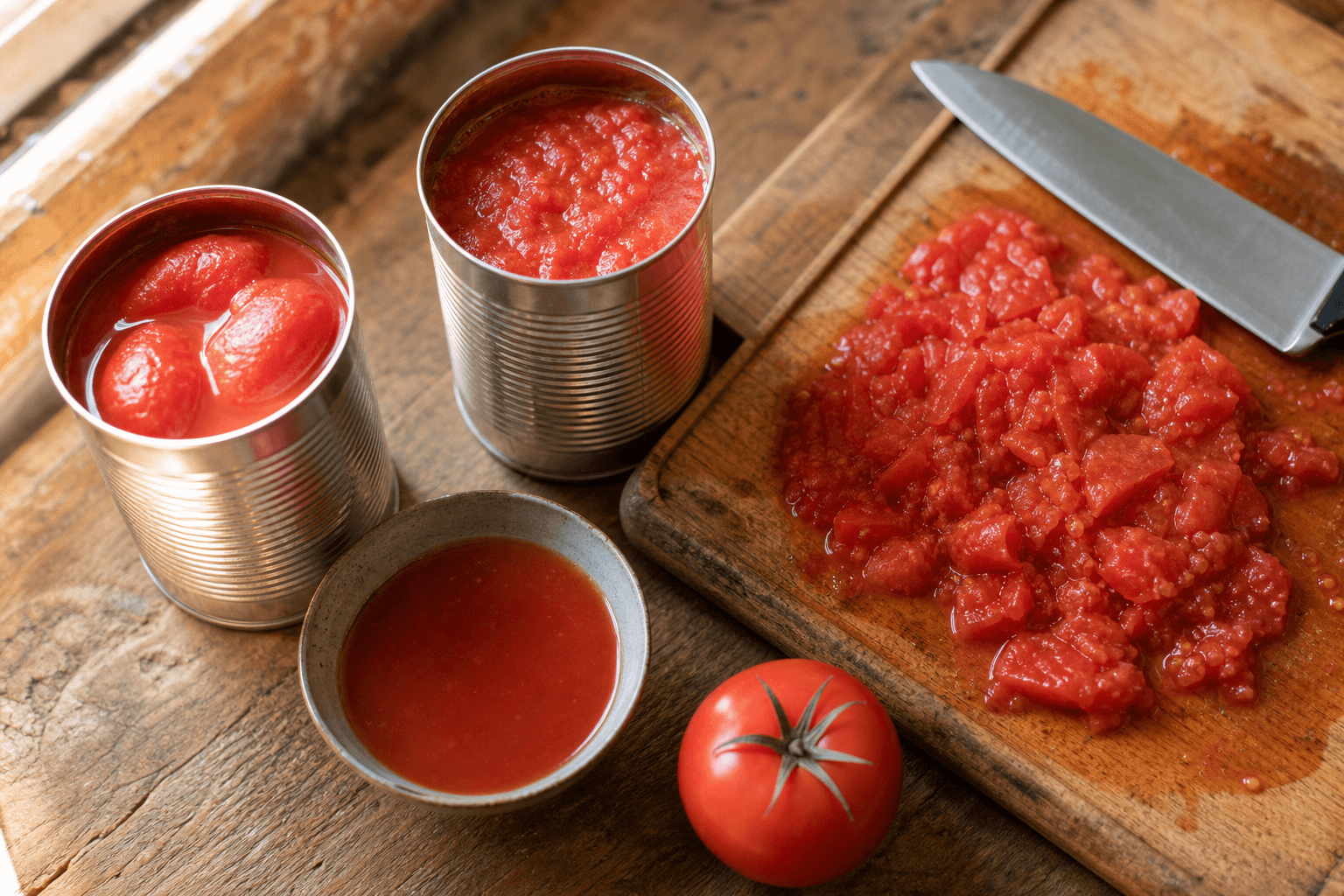
Substitute can for can. A 28 ounce can of whole peeled or crushed tomatoes replaces a 28 ounce can of diced with no measuring, because the USDA Food Buying Guide puts a 28 ounce can at 3-1/8 cups whole, 3-1/8 to 3-1/4 crushed and 3-3/8 diced, all with juice. That spread is under 10%. What does change is texture. Diced tomatoes are packed with calcium chloride so the cubes stay square through a long simmer, and every substitute below softens more than the original does.
Canned diced tomatoes substitutes at a glance
| Substitute | Ratio | Best for | Watch out |
|---|---|---|---|
| Canned whole peeled, chopped | 1:1, can for can (28 oz for 28 oz) | Anything that called for diced | Chop on a board or crush in the pot. The firming treatment barely reaches the middle, so they soften faster. |
| Canned crushed tomatoes | 1:1, can for can | Sauces, chili and soups where a little body helps | Thicker, with no distinct pieces. If the recipe wanted visible chunks, they are gone. |
| Fire-roasted diced tomatoes | 1:1, can for can | Chili, tacos, tortilla soup, salsa | Same texture, smoky flavor. Good in Southwestern dishes, wrong in Italian ones. |
| Imported San Marzano whole peeled | 1:1, can for can | Silky sauces | These skip calcium chloride by design, so they melt instead of holding shape. |
| Fresh tomatoes, peeled and diced | About 2 lb fresh per 28 oz can, 1 lb per 14.5 oz can | Summer cooking | Add about 1/2 cup water or stock per can's worth to replace the packing juice, and expect a longer cook. |
| Canned tomato sauce or puree | 1-3/4 cups sauce per 14.5 oz can of diced | Smooth results only: soups, braises | You lose all texture and gain concentration. Thin with water. |
How to swap whole peeled tomatoes for canned diced tomatoes
- Open the can size the recipe named. A 28 ounce can of whole peeled covers a 28 ounce can of diced.
- Tip the tomatoes into a bowl and chop them on a board, or squeeze them apart with your hands over the pot. Either way you get pieces close to a store dice.
- Pour the juice in as well, unless the recipe asked for drained tomatoes. Drained, the USDA puts a 28 ounce can of diced at about 2-1/4 cups and whole peeled at about 2 cups.
- If you do drain, keep the liquid. It is the easiest way to loosen a sauce that tightens later.
- Simmer as written, then look in the pot sooner than you normally would. Whole and crushed tomatoes collapse earlier.
What changes when you substitute canned diced tomatoes
Flavor barely moves. Rickman, Bruhn and Barrett measured soluble solids at 5.5% for canned whole tomatoes and 5.5% for canned diced, so the two are equally concentrated. Tomato sauce comes in at 9.0%, puree at 9.5% and paste at 24%, which is why those three need a real conversion and whole tomatoes do not.
Texture is the whole story. Calcium ions from the calcium chloride bond to pectin in the cell walls and cross-link it, stiffening the tissue against the heat and enzymes that would otherwise soften it. Cook's Illustrated found the firming works mostly near the surface of whole tomatoes and leaves the interior tender, while the juice that diced tomatoes are packed in is treated so the pieces hold up all the way through. America's Test Kitchen calls crushed tomatoes the middle ground between smooth puree and chunky diced, which is a fair way to picture what you give up.
When not to substitute canned diced tomatoes
Choose the direction of the swap on purpose. Diced belongs where you want distinct pieces, so chili, stew and shakshuka. Whole or crushed belongs where the tomatoes should melt, so sauces, soups and baked pastas.
The swap to avoid runs the other way. Do not use diced tomatoes when you want a smooth sauce and plan to let the blender fix it. The firmed pieces resist breaking down even after blending and can leave a slightly grainy texture.
Fire-roasted cans are a straight 1:1 for diced, but only where you want smoke. In marinara or lasagna it reads as out of place.
Canned diced tomatoes and one home canning safety rule
If you are canning rather than cooking, do not swap tomato products in a tested recipe. Different products have different density and heat penetration, and the process time was written for the product named. Home-canned tomatoes also need acid added. The National Center for Home Food Preservation calls for 2 tablespoons of bottled lemon juice or 1/2 teaspoon of citric acid per quart.
More swaps like canned diced tomatoes
Working the other direction, canned tomatoes instead of fresh has the ratios, and canned peeled tomatoes instead of tomato sauce covers turning whole cans into something smooth. For paste, see how much tomato sauce equals tomato paste. The fresh, frozen and canned substitution ratios chart goes past tomatoes, and the printable ingredient substitution chart is worth taping inside a cabinet door.
Canned diced tomatoes substitute questions
Can I use whole peeled tomatoes instead of diced tomatoes?
Yes, can for can. Chop or crush them first. They will break down more during cooking, because the calcium chloride that firms canned tomatoes works mostly at the surface of a whole tomato, while a can of diced is firmed all the way through the pieces.
How many cups is a 28 oz can of diced tomatoes?
3-3/8 cups with juice, or about 2-1/4 cups drained, per the USDA Food Buying Guide.
Why do canned diced tomatoes stay firm?
Calcium chloride. Calcium ions bond to pectin in the cell walls and cross-link it, which strengthens the tissue against the enzymes and heat that would otherwise soften it.
What if I only have tomato sauce instead of diced tomatoes?
Use about 1-3/4 cups per 14.5 ounce can of diced, and only in a dish that does not need visible pieces. Thin it with water, since sauce is more concentrated than diced tomatoes.
Find a canned diced tomatoes substitute in your own pantry
Well Stockd keeps a running list of what is in your pantry, and its substitution engine suggests swaps from that list when a recipe calls for something you are out of. Canned and frozen forms count as options, and you can reject any swap you do not want to see again. If cans pile up faster than you use them, tracking expiration dates and keeping a real pantry inventory tell you which to open first.
Sources: USDA Food Buying Guide, Section 2 Vegetables Yield Table; America's Test Kitchen, Cooking With Canned Tomatoes; Food52, reporting Cook's Illustrated on calcium chloride; Rickman, Bruhn and Barrett, J Sci Food Agric 2007, 87:1185-1196; National Center for Home Food Preservation, canning tomatoes.
Track it in Well Stockd
Add what you have, see what you can cook tonight, and get a reminder before anything goes off.
