How to keep a freezer inventory (a system that sticks)
A freezer inventory is a running list of what's frozen, when it went in, and how much there is, kept somewhere you'll check before you shop. This piece covers a simple system, a label format, and real USDA storage times so nothing goes to waste.
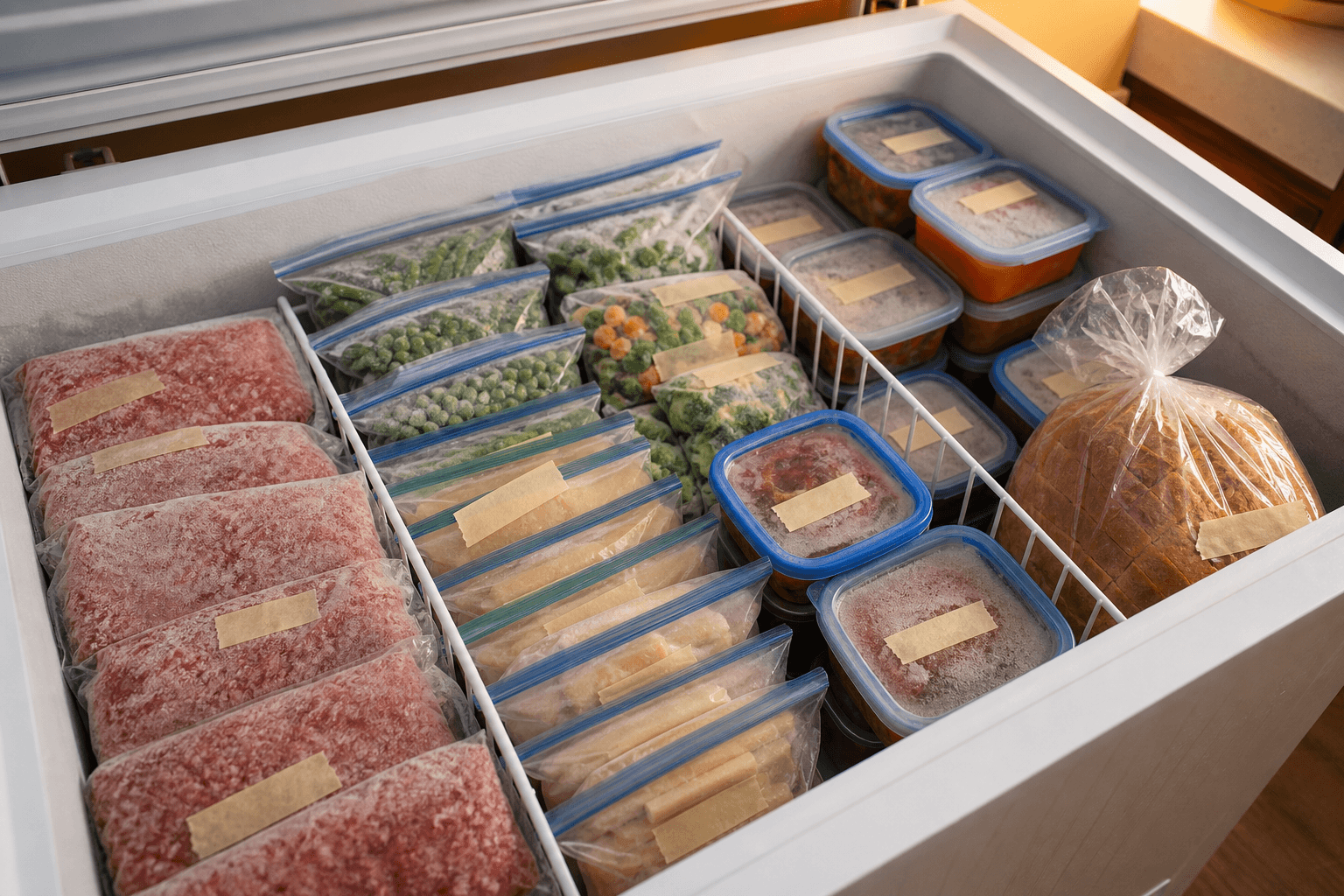
The fastest way to keep a freezer inventory is a single running list, on paper or in an app, that you update the moment food goes in or out. Note the item, the date frozen, and the quantity. Pair it with first-in-first-out shelving so nothing gets lost to freezer burn.
If your freezer is a mystery zone where foil-wrapped shapes go to disappear, you are not alone. A freezer without a list is a black hole: you buy ground beef because you "think" you're out, then find two packages under the ice cream a month later, freezer-burned and headed for the trash. A short list fixes that, and it takes less effort to maintain than most people expect.
What goes wrong without a freezer inventory
An unmanaged freezer breaks down the same way every time. Newer food gets stacked in front of older food, so the oldest items sink to the back and bottom and get forgotten. Packages lose their identity once frost builds up: a bag of chicken thighs starts looking a lot like a bag of chicken breasts, so you either guess wrong or thaw something you never meant to cook. And without dates, you lose track of quality windows. Food that is still safe to eat (frozen food held at 0°F stays safe indefinitely) ends up tasting like the inside of the freezer instead of the meal it was supposed to be.
An inventory solves all three at once. It is nothing more than a record of what is in the freezer, when it went in, and how much there is, kept somewhere you'll look before you shop or cook.
How do you set up a freezer inventory system
You do not need a spreadsheet with twelve columns. Start simple and add detail only if you find you need it.
- Pick one place to keep the list. A magnetic notepad on the freezer door, a note on your phone, or an inventory app all work. The only rule is that it has to live somewhere you'll see it the moment you open the freezer door, not in a drawer three rooms away.
- Do one full inventory pass. Take everything out, group it by type (meats, vegetables, prepared meals, baked goods), and write down what you have. This is the only time-consuming step, and it usually takes twenty to thirty minutes.
- Label every package as you put it back. Write the item name and the date frozen directly on the package, not just on your list. If the freezer door blows open or you drop a bag on the floor, the label is your backup record.
- Add items to your list the moment they go into the freezer, and cross them off (or delete them) the moment they come out. This is the habit that actually makes an inventory work. A list that only gets updated during the monthly "deep clean" isn't an inventory. It's a memory exercise.
- Review the list before you shop. Two minutes scanning what you already have prevents duplicate purchases and reminds you what needs to get used soon.
What should each freezer label include
A useful label answers three questions at a glance: what is it, when did it go in, and how much is there. Keep it to those three lines and you'll read the label instead of skipping it.
- Item name, specific enough to tell it apart from similar items (say "ground turkey" not just "meat," and "chicken thighs, boneless" not just "chicken").
- Date frozen, written large enough to read through frost. Month and day is usually enough; skip the year unless you tend to hold things longer than twelve months.
- Quantity or portion size, especially for anything you portion out, like soup in single-serve containers or shredded chicken in one-pound bags.
Freezer inventory list example
A simple running list looks like this. You can keep it on paper, in a notes app, or in a spreadsheet: the format matters far less than whether you keep updating it.
| Item | Date frozen | Quantity | Use by |
|---|---|---|---|
| Ground beef, 80/20 | July 2 | 2 lb, 2 packages | November 2 |
| Chicken thighs, boneless | July 5 | 3 lb | April 2027 |
| Vegetable soup | June 20 | 4 containers, 2 cups each | September 20 |
| Blueberries, home-frozen | June 15 | 1 gallon bag | June 2027 |
| Sliced bread | July 8 | 1 loaf | October 8 |
| Lasagna, unbaked | May 30 | 1 pan | August 30 |
How to organize a freezer for first-in-first-out
An inventory tells you what you have. Organizing the freezer itself is what makes first-in-first-out, or FIFO, happen without you having to dig.
In a chest freezer, use bins or baskets to create zones by category, meat in one bin, vegetables in another, and always load newest packages into the same side of the bin, oldest on the opposite side, so you naturally reach for the oldest item first. Hanging file folders work the same way for flat items like steaks or fish fillets.
In an upright freezer, think in shelves instead of bins. Keep this week's meals on the shelf that is easiest to reach, next week's on the shelf above or below it, and long-term stock (whole cuts of meat, extra bread, big batches of stock) on the bottom or in the door. As you use items, the newer ones migrate down into the "use soon" zone.
Either layout works with a written inventory sitting on top: the list tells you what exists, the zones tell you where to find it and which one to grab first.
How long can you keep food in the freezer
Frozen food held continuously at 0°F or below is safe to eat indefinitely, because freezing stops the bacterial growth that causes spoilage. The storage times below are about quality, not safety: past these windows food will not make you sick, but texture, flavor, and color start to slip, especially once freezer burn sets in.
| Food | Freezer time (quality) |
|---|---|
| Ground meat (beef, turkey, pork) | 3 to 4 months |
| Steaks, chops, and roasts | 4 to 12 months |
| Whole chicken or turkey | Up to 12 months |
| Chicken or turkey pieces | 9 months |
| Bacon and hot dogs | 1 to 2 months |
| Fatty fish (salmon, bluefish) | 2 to 3 months |
| Lean fish (cod, flounder) | 6 to 8 months |
| Soups and stews | 2 to 3 months |
| Casseroles and prepared meals | 2 to 3 months |
| Vegetables (blanched) | 8 to 12 months |
| Fruit | 8 to 12 months |
| Bread and baked goods | 2 to 3 months |
These numbers are exactly why the "date frozen" field on your label matters more than any other piece of information you write down. Without it, every one of these windows is a guess.
Can a freezer inventory app replace a paper list
A paper list works fine if you are consistent about it, but most people aren't. Life gets busy and the notepad falls behind. An app on your phone has one real advantage: you can check it from the grocery store aisle before you buy a second bag of chicken you already have three of at home.
This is one of the things Well Stockd was built for. You log what goes into the freezer once, and it tracks quantities, flags items nearing the end of their quality window, and cross-references what is on hand against recipes so you can see what you can cook tonight without opening the freezer door. If you're weighing options for running any part of your kitchen, freezer included, on a real system instead of sticky notes, our guide to the best pantry inventory app options walks through what to look for.
Whether you use an app or a notepad, the same discipline applies: update it the moment food moves, not later.
Frequently asked questions
Do I need a freezer inventory app, or does paper work fine?
Paper works fine as long as you update it every time food goes in or out. The advantage of an app is being able to check your list from the store, which is when duplicate purchases usually happen.
How often should I update my freezer inventory?
Update it the moment an item goes into or comes out of the freezer, not on a weekly or monthly schedule. Batched updates are where most freezer lists quietly fall apart, because it is easy to forget three transactions by the end of the week.
Is freezer-burned food safe to eat?
Yes. Freezer burn is a quality issue caused by moisture loss and air exposure, not a safety issue. You can trim the freezer-burned part and cook the rest, though the flavor and texture nearby may still be affected.
Once your freezer has a working list, the same habit tends to spread. A kitchen inventory system that covers the fridge, freezer, and pantry together catches gaps a single-appliance list misses, and it pairs naturally with a pantry inventory habit and a running fridge inventory so you always know what's in the house before you shop.
Sources: