Fresh to Dried Herb Conversion Chart (The 3:1 Rule)
A fresh to dried herb conversion chart built from extension service data and America's Test Kitchen testing. The base rule is 3:1 by volume, with per-herb rows for oregano, thyme, rosemary, sage, mint, basil, parsley, dill, chives and cilantro, plus ginger, garlic, onion, bay leaf and Italian seasoning, and the outliers where 3:1 does not apply.
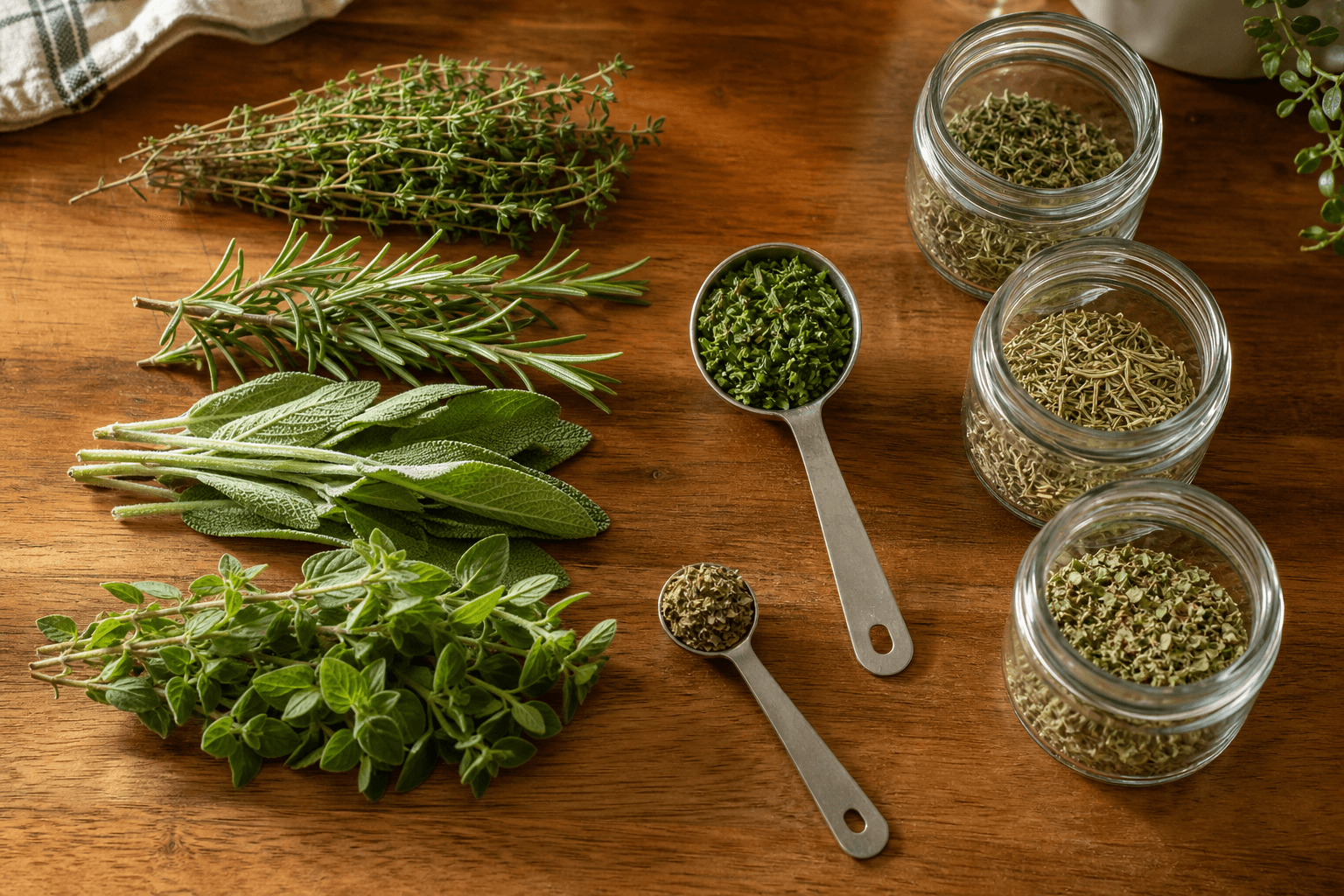
The standard conversion is 3:1 by volume. One tablespoon of finely cut fresh herbs equals 1 teaspoon of dried crumbled herbs, or about 1/4 teaspoon of ground. Penn State Extension, Purdue Extension and University of Illinois Extension all print that 3:1 ratio.
Most charts stop there. The 3:1 rule only holds up for hardy herbs in dishes with enough liquid that cook at least 20 minutes. America's Test Kitchen tested the swap and endorses it for four herbs: oregano, rosemary, sage and thyme. Basil, chives, dill, parsley and tarragon sit on its never-substitute list, since drying oxidizes them and dried herbs, in ATK's words, "will always have a slightly dusty, stale flavor."
Fresh to dried herb conversion chart
Fresh to dried herbs
| Herb | Fresh | Dried equivalent | Notes |
|---|---|---|---|
| Any leafy herb (base rule) | 1 Tbsp finely cut | 1 tsp crumbled, or 1/4 tsp ground | Soups, sauces, braises, rubs |
| Oregano | 1 Tbsp | 1 tsp | ATK-approved. Add with the liquid |
| Thyme | 1 Tbsp minced leaves | 1 tsp | ATK-approved. Needs 20+ minutes in liquid |
| Rosemary | 1 Tbsp minced | 1 tsp | ATK-approved. Crumble it first; dried rosemary stays needle-hard |
| Sage | 1 Tbsp minced | 1 tsp rubbed or crumbled, or 1/4 tsp ground | ATK-approved. Rubbed sage is fluffy; measure loosely |
| Marjoram | 1 Tbsp | 1 tsp | Extension rule only. Milder than oregano; add nearer the end |
| Mint | 1/4 cup chopped | 1 Tbsp | 4:1, not 3:1. Yogurt sauces, grain salads, lamb, tea |
| Basil | 1 Tbsp chopped | 1 tsp (one-third the fresh amount) | Simmered sauces only. Never pesto or caprese |
| Parsley | 1 Tbsp chopped | 1 tsp flakes | Hot liquid only, never a garnish. ATK never-substitute |
| Tarragon | 1 Tbsp | 1 tsp | Rule only, ATK never-substitute. Bloom in warm liquid or vinegar |
| Dill weed | 1 Tbsp | 1 tsp | Rule only, ATK never-substitute. Pickling: 1 fresh dill head = 1 tsp dill seed |
| Chives | 1 Tbsp | Do not use dried | Use 1 Tbsp finely chopped green onion tops |
| Cilantro | any amount | No reliable ratio | Almost no flavor dried. A background note at most |
Fresh to dried aromatics, bay and blends
| Ingredient | Fresh | Dried equivalent |
|---|---|---|
| Ginger | 1 Tbsp fresh grated | 1/8 tsp ground ginger |
| Garlic | 1 small clove | 1/8 tsp garlic powder, or 1/4 tsp instant minced garlic |
| Onion | 1 small onion, about 1/4 cup chopped | 1 to 2 Tbsp instant minced onion, or 1 tsp onion powder |
| Bay leaf | 1 whole leaf | 1/4 tsp cracked bay leaves |
| Bell pepper | 3 Tbsp chopped | 1 Tbsp dried chopped bell pepper |
| Italian seasoning | (blend) | 1 tsp = 1/4 tsp dried basil + 2/3 tsp dried parsley + a pinch of oregano |
How to use the fresh to dried herb chart
The chart reads in both directions. Going fresh to dried, divide by three. Going dried to fresh, multiply by three. A recipe wanting 2 tablespoons of fresh oregano takes 2 teaspoons dried; 1 teaspoon of dried thyme replaces 1 tablespoon fresh.
Timing matters more than the arithmetic. Dried herbs need heat, time and liquid to release their aroma, so they go in early with the broth or the tomatoes. Fresh herbs go in at the end. Dried oregano shaken over a finished salad tastes like dust.
For the ground or powdered form, start at 1/4 teaspoon per tablespoon of fresh and taste up. Penn State prints 1/4 teaspoon, Purdue prints 1/4 to 1/2 teaspoon, and The Kitchn prints 4:1 for ground herbs. The 1/4 teaspoon figure is the most conservative and the one two extensions share.
All of this assumes your dried herbs still smell like something. Illinois Extension tells you to smell each jar every six months. Once a jar has lost its aroma, 3:1 stops meaning anything.
Bunch math is where cooks get burned. A 3/4 oz clamshell of thyme, oregano or rosemary yields only about 3 tablespoons minced, so a whole package is roughly 1 tablespoon dried. A 3 oz bunch of parsley yields about 3/4 cup chopped, which converts to 1/4 cup dried. Both yields come from America's Test Kitchen. The printable ingredient substitution chart covers dairy, eggs, flours and leaveners.
Exceptions to the 3:1 fresh to dried herb rule
Ginger is the biggest outlier. NDSU Extension and Colorado State both put 1 tablespoon of fresh grated ginger at 1/8 teaspoon of ground, roughly 24:1. Apply 3:1 to ginger and your gingerbread is ruined.
Onion powder is the runner-up. One teaspoon replaces the 1/4 cup of chopped fresh onion you get from a small onion, about 12 times the strength by volume.
Bay leaf is contested. NDSU prints 1 whole leaf = 1/4 teaspoon cracked; Colorado State prints the reverse, 1 teaspoon crushed per whole leaf. Use the 1/4 teaspoon; over-bayed beans taste medicinal.
Mint runs 4:1, the only leafy herb where the standard ratio moves. Sage splits by form: 1 tablespoon fresh is 1 teaspoon rubbed but only 1/4 teaspoon ground, since ground sage is denser.
Chives and cilantro have no honest dried route. NDSU and Colorado State send chives to chopped green onion tops, and dried cilantro is bland enough that adding enough to taste it makes the dish taste dusty.
Basil, tarragon, lemon balm and the mints dry badly at home. Oregon State Extension notes they hold too much moisture and mold if they do not dry quickly, and NDSU says freezing basil gets you closer to fresh. If you grow these, freeze your fresh herbs instead.
Fresh to dried herb questions
What is the fresh to dried herb ratio?
Three to one by volume. One tablespoon of finely cut fresh herbs equals one teaspoon of dried crumbled herbs, or about 1/4 teaspoon of ground herbs.
Can you substitute dried basil for fresh basil?
Only in sauces that simmer. America's Test Kitchen puts basil on its never-substitute list because basil's flavor compounds are volatile and are largely lost in drying. Use one-third the fresh amount in a marinara or a minestrone, and never in pesto, caprese or a finishing sprinkle.
Do you add dried herbs at the start or the end of cooking?
At the start. Dried herbs need heat, time and liquid to release their aroma compounds, and ATK specifies recipes with ample liquid that cook at least 20 minutes. Fresh herbs go in at the end.
How long do dried herbs last?
About one year in an airtight container in a cool, dark, dry place away from the stove, sink and windows, per Penn State Extension. Smell them every six months. If there is no aroma left, the 3:1 ratio no longer applies.
How much dried herb replaces one bunch of fresh herbs?
It depends on the yield. A 3/4 oz package of thyme, oregano or rosemary gives about 3 tablespoons minced, so roughly 1 tablespoon dried. A 3 oz bunch of parsley gives about 3/4 cup chopped, so about 1/4 cup dried, which is why dried parsley rarely works.
When you have neither the fresh herb nor the dried
Well Stockd knows what is in your kitchen, and its substitution engine suggests swaps from what you already have. Frozen and canned forms count as matches, and you can reject any swap you never want offered again. If the gap is produce, the fresh vs frozen vs canned substitution ratios page has those numbers. To stop jars going flat, compare the best pantry inventory apps or our app to track food expiration dates.
Fresh to dried herb sources
- Penn State Extension, Drying Herbs
- Illinois Extension, Herbs and Salt
- Purdue Extension, Herbs and Spices
- America's Test Kitchen, Dried for Fresh
- America's Test Kitchen, Herb Yields
- NDSU Extension FN198, Ingredient Substitutions
- Colorado State Extension 9.329
- NDSU Extension, Field to Fork: Basil
- Oregon State Extension, Drying Herbs
- The Kitchn, Cilantro Substitutes