Is it safe to reheat leftovers twice?
Reheating leftovers twice is technically safe if the food hits 165 degrees Fahrenheit each time, but USDA guidance says to reheat only once and only what you plan to eat, since every reheat and cool cycle adds another trip through the danger zone.
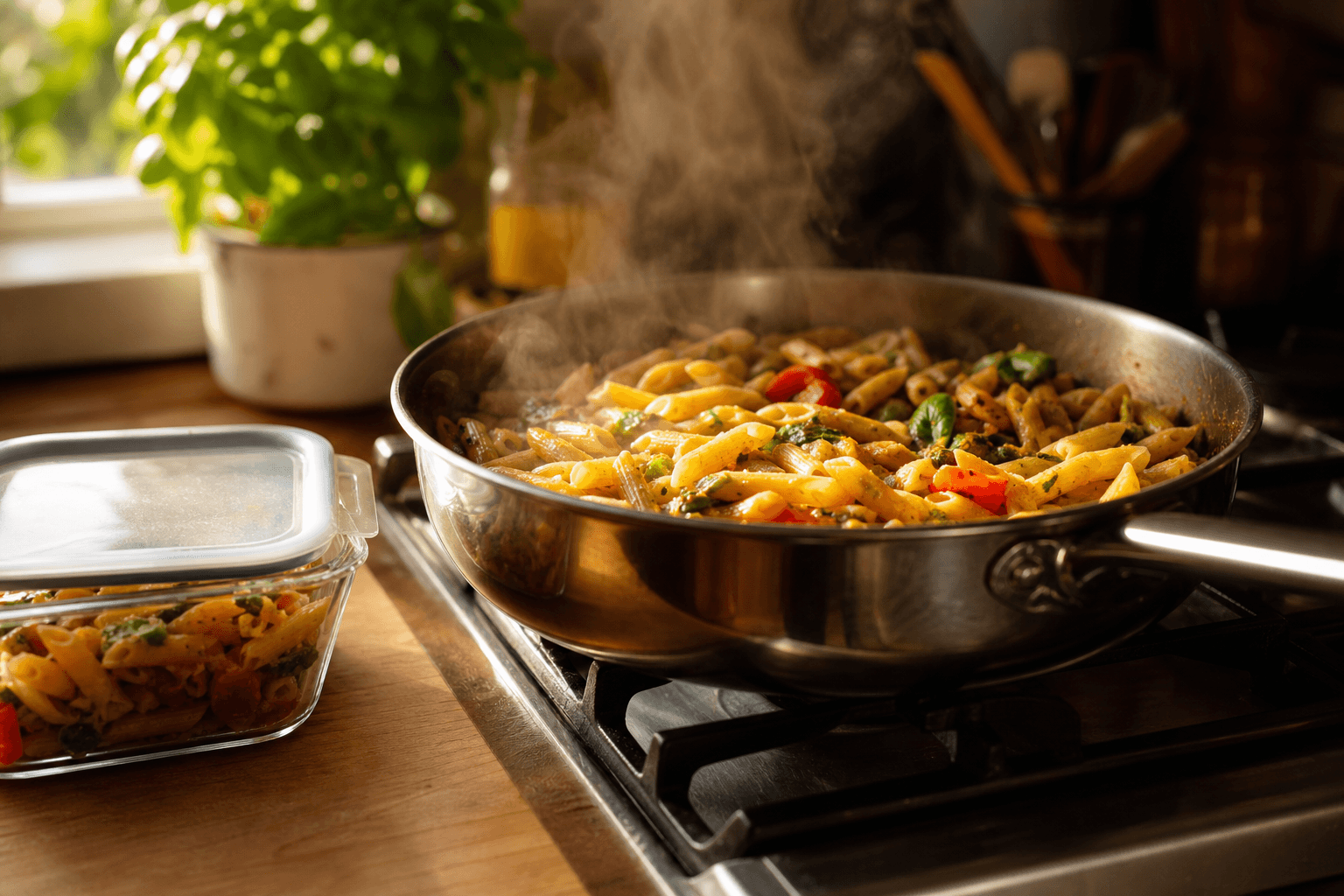
Yes, reheating leftovers twice is technically safe as long as the food hits 165 degrees Fahrenheit every time, but USDA guidance is to reheat leftovers only once. Each reheat and cool cycle sends food back through the 40 to 140 degree danger zone, which gives bacteria another chance to grow.
How many times can you reheat leftovers?
Neither the USDA nor the FDA sets a hard number on this. There's no rule that says reheat twice and stop, or three times and you're in trouble. What matters is whether the food reaches 165 degrees Fahrenheit, checked with a food thermometer, every time you reheat it, and whether it was cooled and refrigerated properly in between.
That said, the USDA's Food Safety and Inspection Service is direct about best practice: reheat leftovers only once. Every time you pull food out of the fridge, warm it up, let it cool back down, and put it away again, you send it through the danger zone once more, the range between 40 and 140 degrees Fahrenheit where bacteria multiply fast. FSIS puts a number on how fast: bacteria can double in as little as 20 minutes in that range. Two reheats means two passes through that zone instead of one.
The safer habit is to control portions instead of counting reheats. Take out only what you're going to eat and reheat that. Leave the rest in the fridge, undisturbed, at or below 40 degrees Fahrenheit. That way you're never reheating the same batch twice, because you never touched most of it in the first place. If you already reheated the full pot to serve it once and now you're eyeing the same pot again, you can still eat it safely as long as it reaches 165 degrees Fahrenheit again and hasn't sat out or in the fridge longer than the limits below. It just won't taste as good, and the safety margin gets thinner with each round.
How long do leftovers last in the fridge?
Storage time matters more than how many times you've reheated them. USDA guidance puts the general limit at 3 to 4 days in a refrigerator set to 40 degrees Fahrenheit or below.
| Leftover type | Refrigerator (40°F or below) | Freezer (0°F) |
|---|---|---|
| Cooked meat | 3 to 4 days | 2 to 3 months |
| Cooked poultry | 3 to 4 days | 4 to 6 months |
| Soups, stews, and gravies | 3 to 4 days | 2 to 3 months |
| Pizza | 3 to 4 days | 1 to 2 months |
| Cooked rice and pasta | 3 to 4 days | 1 to 2 months |
| Cooked vegetables | 3 to 4 days | 1 to 2 months |
| Casseroles and mixed dishes | 3 to 4 days | 2 to 3 months |
The freezer times above are about quality, not safety. Food kept frozen at 0 degrees Fahrenheit stays safe to eat indefinitely, but it loses texture and flavor the longer it sits. If you're storing raw chicken instead of cooked leftovers, the timeline is shorter. Our guide to how long raw chicken lasts in the fridge covers that separately, and if it's rice you're working through, see how long cooked rice lasts in the fridge for the specifics on that one.
How to tell if leftovers have gone bad
Trust your senses first, but don't trust them completely. Leftovers that have turned usually show it: a sour or off smell, a slimy or tacky film on the surface, visible mold, or a color that's dulled or shifted from what it looked like fresh.
The problem is that some of the bacteria that cause food poisoning, including Listeria and certain strains of Salmonella, don't change how food looks, smells, or tastes. Food can be dangerous and still seem completely normal. That's why the 3 to 4 day rule matters more than a sniff test. If leftovers have been in the fridge longer than that, the safe move is to throw them out even if nothing seems wrong.
How to store leftovers so they last
Get food into the fridge within 2 hours of cooking it, or within 1 hour if the room is warmer than 90 degrees Fahrenheit, which covers most backyard cookouts and potlucks. Waiting longer than that gives bacteria a real head start before the food ever gets cold.
Cool large batches faster by splitting them into shallow containers instead of putting one big pot straight into the fridge. A deep pot of soup can take hours to cool all the way through in the center, and it sits in the danger zone the whole time. Shallow containers, an inch or two deep, cool in a fraction of that.
Cover everything tightly or seal it in airtight containers, and keep your fridge at 40 degrees Fahrenheit or below. A fridge thermometer is worth the few dollars if you don't already have one, since the dial on the front of most refrigerators isn't a reliable gauge of the actual internal temperature.
Labeling helps more than people expect. Write the date you cooked or stored the food on a piece of tape, because "I think this was from Sunday" is exactly the kind of guess that leads to food sitting past 4 days. If keeping track of dates across a full fridge sounds tedious, an app that tracks food expiration dates can log when you stored something and remind you before it's past the safe window.
Can you freeze leftovers?
Yes, and freezing is the better option if you know you won't get to leftovers within 3 to 4 days. Move them to the freezer before that window closes rather than waiting to see if you'll eat them.
Thaw frozen leftovers in the refrigerator, not on the counter, since counter thawing lets the outer layer sit in the danger zone while the center is still frozen. Once thawed, reheat to 165 degrees Fahrenheit as usual, and follow the same one reheat rule. Freezing does not reset a food safety clock that's already run out. If leftovers sat in the fridge for 5 days before you thought to freeze them, freezing at that point doesn't make them safe again.
When in doubt
The USDA's food safety guidance is simple: when in doubt, throw it out. If you can't remember when leftovers went into the fridge, if they've been there longer than 3 to 4 days, or if anything about them seems off, it's not worth the risk of foodborne illness to eat them anyway. No amount of reheating to 165 degrees Fahrenheit fixes food that's already spent too long in storage. For a broader look at storage windows across your whole fridge and freezer, our hub guide on how long food lasts rounds up the numbers by category.
Frequently asked questions
Can you reheat leftovers a third time? There's no official cutoff at two or three reheats specifically. The same rule applies each time: the food must reach 165 degrees Fahrenheit, and it can't have been sitting out or stored past the 3 to 4 day window. Every extra reheat and cool cycle adds risk and hurts quality, so it's still best to portion out only what you'll eat rather than repeatedly reheating a full batch.
Is it safe to reheat leftovers in the microwave twice? Yes, as long as each reheat brings the food to 165 degrees Fahrenheit throughout, not just in one spot. Microwaves heat unevenly, so cover the dish, arrange food in an even layer, and stir or rotate partway through. Check the temperature in a few different places with a food thermometer before you call it done.
Do you need to reheat leftovers before refreezing them? No. If you took leftovers out of the fridge and decide you want to freeze them instead of eating them, you can move them straight to the freezer without reheating first, as long as they haven't been sitting out longer than 2 hours.
Sources: FSIS: Leftovers and food safety, Ask USDA: How many times can I reheat foods?, Ask USDA: How do I reheat leftovers safely?, FSIS: "Danger Zone" (40°F - 140°F)