Weekly fridge tracker printable: a simple system to use up food
A one-page weekly fridge tracker printable, with a simple fill-in method, a sample week already done for you, and where to keep it so food gets used before it goes bad.
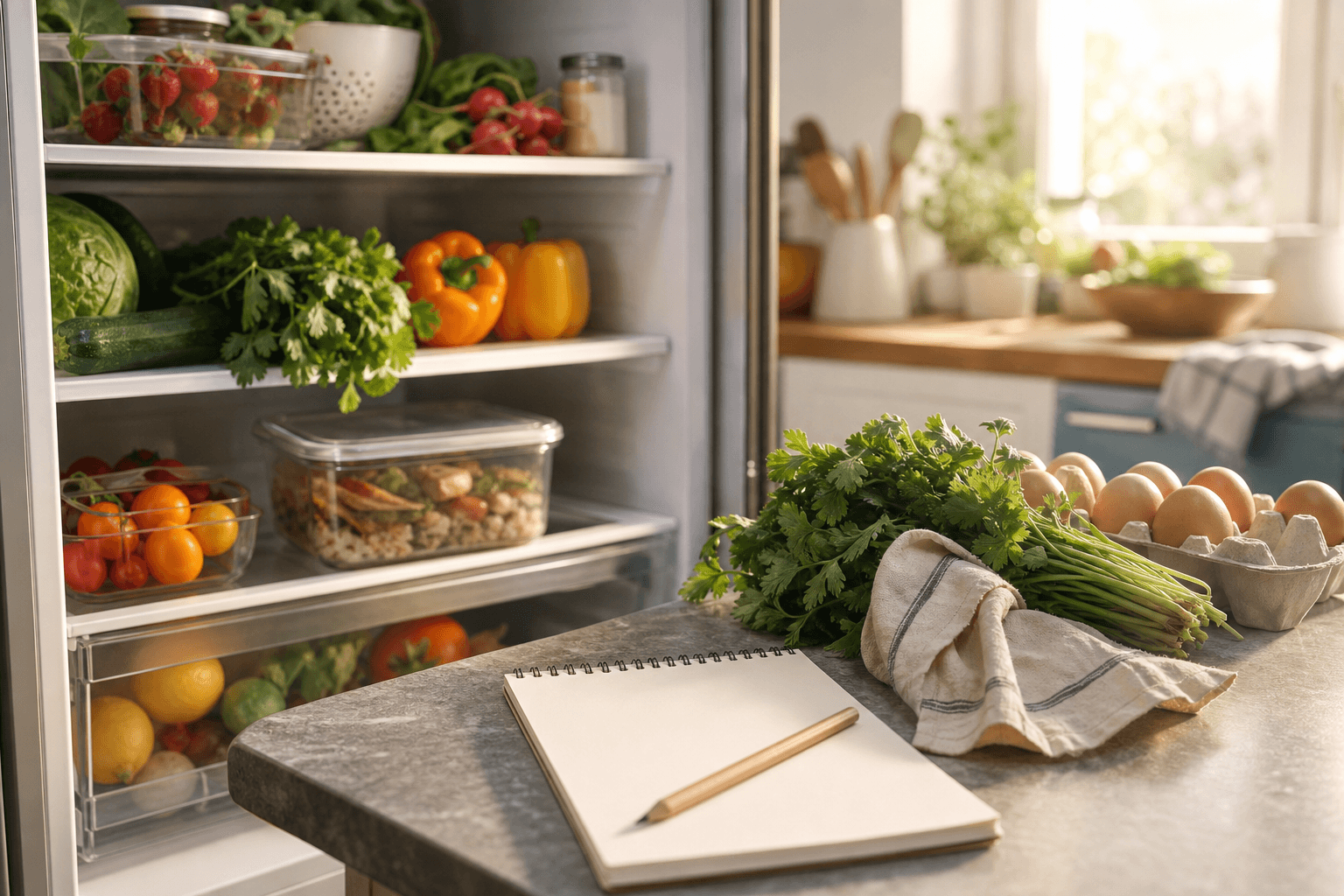
Print or download the weekly fridge tracker
Use the clean print layout below, or download the free letter-size PDF and high-resolution PNG. No email address is required.
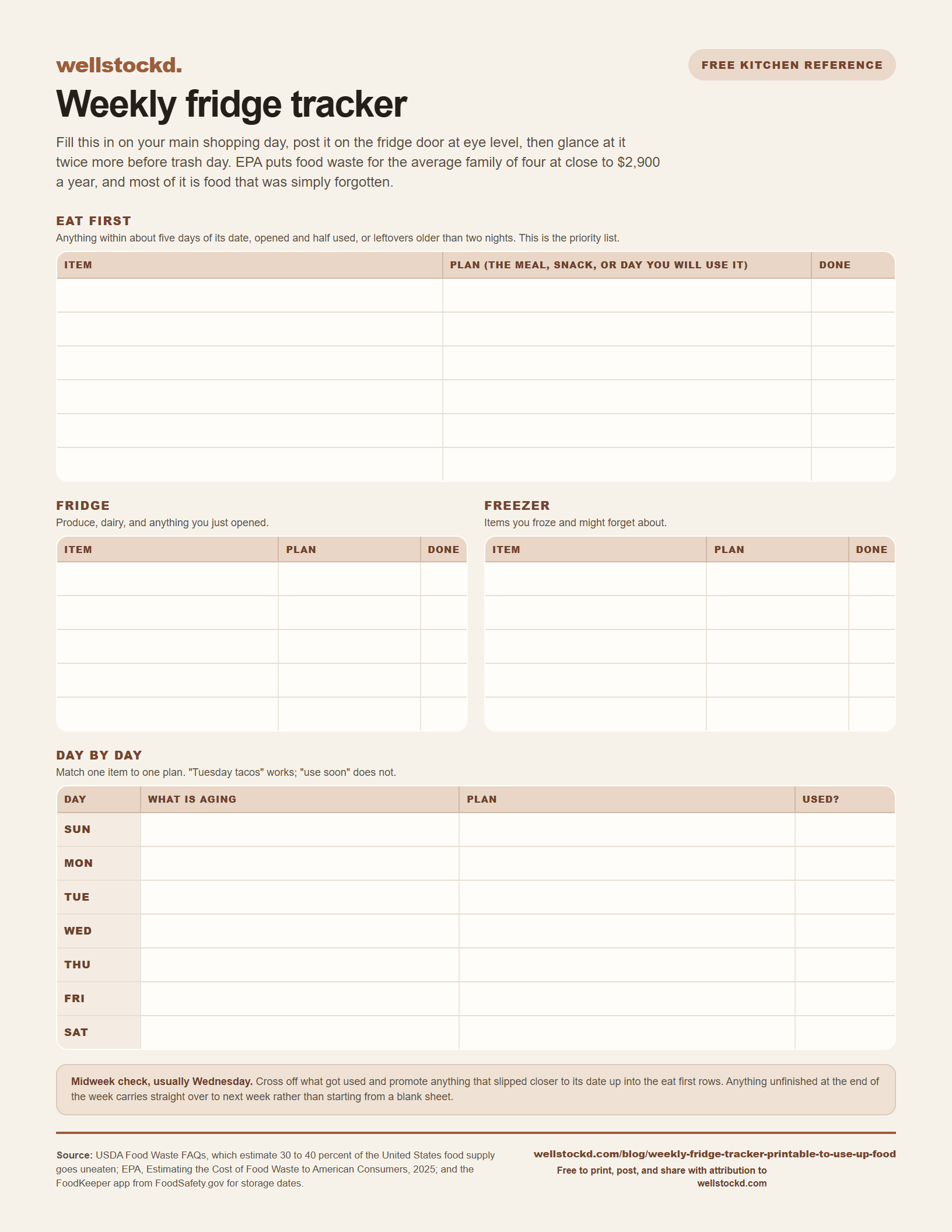
Free to print, post, and share with attribution to wellstockd.com.
A weekly fridge tracker printable is a one-page sheet with three sections, eat first, fridge, and freezer, that you fill in every Sunday and glance at twice more before trash day. Skipping it costs real money: a 2025 EPA analysis puts food waste for the average family of four at close to $2,900 a year.
What is a weekly fridge tracker printable?
It is a paper checklist, not an app, that lives on your fridge door and answers one question every day: what needs to get eaten before it goes bad? You write down what is aging, assign it to a meal, and cross it off when it is gone. That single habit closes the gap between "I have food" and "I cooked it," which is where most household food waste happens. The USDA estimates that 30 to 40 percent of the food supply in the United States goes uneaten, and most of that loss at home traces back to food simply being forgotten, not spoiled the moment it was bought.
The idea borrows from a trick professional organizers call the "eat me first" bin: a designated spot for anything close to its use-by date, kept front and center so nobody has to dig for it. A printable tracker does the same job on paper. It turns a vague sense of "something in there is probably going bad" into a specific, dated list you can act on.
What goes on the printable
Keep it to four columns and three rows so it takes seconds to fill in, not minutes. The free letter-size PDF and PNG in the download box at the top of this page are this exact layout, ready to print.
| Column | What goes there |
|---|---|
| Eat first | Anything within a few days of its date, opened and half used, or leftovers from the last two nights. This is the priority list. |
| Fridge | Everything else in the fridge worth noting: produce, dairy, condiments you just opened. It's on your radar before it becomes an eat-first item. |
| Freezer | Items you froze and might forget about. Freezer burn is its own kind of waste. |
| Plan | One line next to each item: the meal, snack, or day you intend to use it. |
A pantry column is a fine add-on if you want one sheet to cover everything, and it pairs naturally with a running list like the one in our guide to how to keep track of pantry inventory.
How to fill it out and use it each week
- Sunday reset: open the fridge and freezer and scan every shelf, not just eye level. Crisper drawers hide the worst offenders.
- Sort into eat first: anything within about five days of its date, or leftovers older than two nights, goes on the eat-first line.
- Match one item to one plan: write the meal or day next to each item. Vague entries like "use soon" do not work as well as "Tuesday tacos."
- List the rest: everything else in the fridge and freezer gets a line too, even if the plan is just "check again Wednesday."
- Post it at eye level on the fridge door, ideally near the handle so you see it every time you open the door.
- Do a two-minute midweek check, usually Wednesday. Cross off what got used and promote anything that slipped closer to its date into the eat-first row.
This is the same first-in, first-out rotation restaurants use to keep stock moving, just scaled down to one household fridge.
A sample week, filled in
| Day | What's aging | Plan | Used? |
|---|---|---|---|
| Sun | Half a rotisserie chicken | Shred for tacos Tuesday | Yes |
| Mon | Bag of spinach, starting to wilt | Sauté with eggs Tuesday morning | Yes |
| Tue | Sour cream, opened | Dollop on tacos, rest into a dip Wednesday | Not yet |
| Wed | Four hot dog buns, going stale | Garlic bread with Wednesday dinner | Yes |
| Thu | Leftover rice from Tuesday | Fried rice Thursday | Yes |
| Fri | Bell peppers, softening | Fajitas Friday night | Yes |
| Sat | Milk close to its date | Pancakes for Saturday breakfast | Yes |
Nothing here is fancy. That is the point: a tracker only works if the plans are things you would cook on a normal weeknight.
Where should you keep your printable tracker?
On the fridge door, held with a magnet, at a height where you see it without bending down. A magnetic clipboard works well if you want to swap the sheet out weekly without tape residue. Some households keep a second copy on the inside of a cabinet door near the pantry, which is handy if you are also working from a broader list like the one described in how to keep track of food in your fridge.
If the sheet keeps disappearing under grocery lists and school papers, give it its own laminated slot. A sheet you can wipe clean with a dry-erase marker lasts indefinitely and removes the printing step entirely.
When paper starts to slip
A printable tracker is a great habit builder, but it only works if someone remembers to fill it in. If your household tends to forget, or you would rather have expiration dates tracked automatically and get matched to recipes you can make with what's on hand, that is exactly the gap a dedicated app fills. We compared the options in the best pantry inventory apps, including Well Stockd, which logs what you have as you shop and flags anything nearing its date without you having to write it down. Paper and an app are not competitors here. Plenty of people use a printable tracker for the quick daily glance and let an app handle the dates in the background.
For the bigger habit this all sits inside, our guide to reducing food waste at home walks through building out fridge, freezer, and pantry tracking together.
Frequently asked questions
Do I need a special printer or app to make this work? No. A sheet of paper with four columns drawn in pen works exactly as well as a designed template. The system matters more than the format.
How often should I fill it in? Once a week in full, on whatever day you do your main grocery shop or meal plan, plus one quick midweek glance to cross things off and catch anything sliding toward its date.
What if I don't finish everything on the list by the end of the week? Carry it over. Move unfinished items straight into next week's eat-first row instead of starting from a blank sheet. The goal is a steady habit, not a perfect week.
Sources: USDA Food Waste FAQs, Estimating the Cost of Food Waste to American Consumers, EPA, The Kitchn: the eat-first bin fridge hack, FoodSafety.gov FoodKeeper app