Cornstarch substitute for thickening: use 2 Tbsp flour
The cornstarch substitute ratios that four university extension services agree on, plus tested gluten-free options, the arrowroot disagreement, and when a swap will ruin the dish.
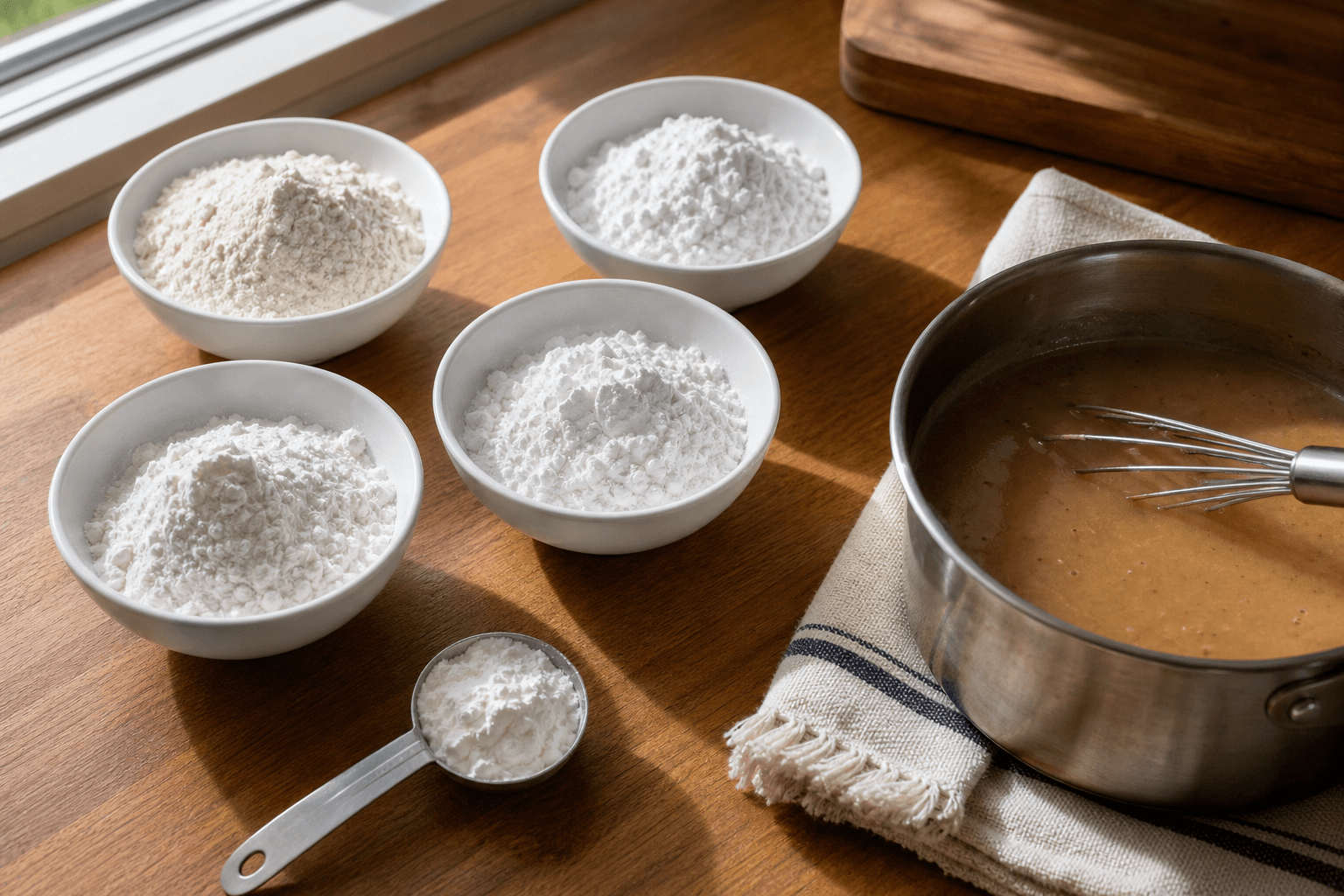
Use 2 tablespoons of all-purpose flour for every 1 tablespoon of cornstarch. Colorado State, NDSU, Mississippi State and Utah State Extension all print that conversion identically. If you need a gluten-free thickener instead, tapioca starch swaps 1:1, potato starch runs 1 to 1 1/2 tablespoons per tablespoon, and America's Test Kitchen puts arrowroot at 1 1/2 teaspoons per teaspoon of cornstarch.
Flour takes double because it is only about 75 percent starch, per America's Test Kitchen, while cornstarch is pure starch. That one fact explains the 2:1 ratio.
Cornstarch substitute ratios at a glance
| Substitute | Ratio | Best for | Watch out |
|---|---|---|---|
| All-purpose flour | 2 Tbsp per 1 Tbsp cornstarch | Gravy, pan sauces, stews, chowders | Clouds the sauce and has to boil to lose the raw taste |
| Tapioca starch (fine powder) | 1:1 by volume | Fruit pies, glossy sauces, slow-cooked fillings | Thickens fast, so add it near the end |
| Granular or quick-cooking tapioca | 2 Tbsp granular, or 4 to 6 tsp quick-cooking, per 1 Tbsp cornstarch | Fruit pies | Rest the filling 15 to 30 minutes before baking |
| Potato starch | 1 to 1 1/2 Tbsp per 1 Tbsp cornstarch | Asian-style sauces, gluten-free gravy | Thins back out with long cooking; big granules can read grainy |
| Arrowroot | 1 1/2 tsp per 1 tsp cornstarch (ATK's tested figure) | Clear glazes, fruit sauces | Goes slimy in dairy, so never in pudding or custard |
| Rice flour | Roughly 2 Tbsp per 1 Tbsp for thickening; equal volume for breading | Frying coatings, shortbread | Can leave a faint chalkiness |
| Wondra (instant flour) | Half as much Wondra by volume as the cornstarch (ATK's figure) | Last-minute gravy rescue | Has gluten, but resists burning better than all-purpose |
| Xanthan gum | Barely a pinch | Liquids you cannot cook a starch into | Far stronger than cornstarch and slimy if you overdo it |
| Instant ClearJel | Similar thickening power to cornstarch | Pies you plan to freeze | Toss it with the sugar first |
How to swap flour in for cornstarch
- Measure double. One tablespoon of cornstarch in the recipe becomes 2 tablespoons of flour.
- Pick a method. Whisk the flour into cold liquid until smooth, or cook it into a roux before the liquid goes in. Dry flour in a hot pan gives you lumps.
- Bring it to a boil. Flour tastes raw until it does, and that is the step people skip.
- Simmer until it coats the back of a spoon.
- If it is still loose, whisk another spoonful of flour into cold water and stir that in.
For the pure starches (tapioca, potato, arrowroot), slurry with cold liquid, stir it in near the end, and pull the pan off the heat as soon as it thickens.
What changes when you thicken without cornstarch
Flour makes a sauce cloudy. That is fine in gravy or chowder and wrong in a fruit glaze. King Arthur Baking notes that cornstarch itself can leave a starchy taste and a cloudy look in pie filling, while quick-cooking tapioca gives bright, clear fillings. Arrowroot and tapioca stay transparent.
Texture moves too. Potato starch thickens before the pot ever simmers, then thins back out if you keep cooking it. Tapioca holds through a long braise better than cornstarch does, because cornstarch breaks down under prolonged heat. Pull the pan off the burner once it sets.
When not to substitute for cornstarch
Skip flour in pudding, where it develops gluten and turns pasty. Skip arrowroot anywhere dairy is involved: America's Test Kitchen found it turns puddings and custards slimy. Cornstarch or flour is the right call there.
Pie has its own math, where the fruit matters more than the starch. King Arthur's thickener chart puts apples at about 1/2 teaspoon of cornstarch per cup of fruit and blueberries at about 2 1/2 teaspoons, a fivefold spread. Work out the cornstarch amount for your fruit first, then convert. Once it is baked, see do you have to refrigerate apple pie.
Where the charts disagree about cornstarch and arrowroot
You will find all three numbers online. Colorado State Extension calls 1 tablespoon of arrowroot equal to 1 tablespoon of cornstarch. NDSU has arrowroot as the stronger one, at 1 teaspoon of arrowroot for 1 1/2 teaspoons of cornstarch. America's Test Kitchen, in two separate articles, has it as the weaker one, at 1 1/2 teaspoons of arrowroot per teaspoon of cornstarch. Start at 1:1 and add more if the sauce stays loose.
The tapioca and rice numbers split for a naming reason. Tapioca starch, the fine white powder, goes in at 1:1. Granular tapioca, the pearls, takes 2 tablespoons per tablespoon of cornstarch, and quick-cooking tapioca 4 to 6 teaspoons. Colorado State lists rice starch at 1:1, while rice flour lands closer to 2:1. Read the bag before you measure.
Swaps that come up alongside cornstarch
If a recipe has more than one gap in it, our printable ingredient substitution chart collects the everyday conversions on one page. For produce, see fresh vs frozen vs canned substitution ratios. Tomato products run on their own numbers: how much tomato sauce equals tomato paste and tomato paste in chili.
Cornstarch substitute FAQ
How much flour equals a tablespoon of cornstarch?
Two tablespoons. Cornstarch has about twice the thickening power of flour because flour is only around 75 percent starch.
What is a gluten-free cornstarch substitute?
Tapioca starch at 1:1, potato starch at 1 to 1 1/2 tablespoons per tablespoon, or arrowroot at about 1 1/2 teaspoons per teaspoon of cornstarch. Keep arrowroot out of dairy-based sauces.
Why did my cornstarch-thickened sauce go thin again?
Cornstarch breaks down with prolonged heat. Pull the pan off the burner as soon as it thickens. For anything that simmers a long time, use tapioca, which holds up better.
Check for a cornstarch substitute before you start cooking
Well Stockd's substitution engine suggests swaps from what you already have when a recipe calls for something you are out of. Frozen and canned forms count as matches, and you can reject any swap you would rather it stopped offering. We also keep roundups of apps that track food expiration dates and pantry inventory apps.
Sources: NDSU Extension FN198, Colorado State University Extension Fact Sheet 9.329, Mississippi State University Extension, Utah State University Extension, America's Test Kitchen on cornstarch substitutes, America's Test Kitchen on thickeners, King Arthur Baking pie thickener guide.