How much minced garlic equals one clove?
One medium garlic clove equals about 1 teaspoon minced, based on USDA weights of 3 grams per clove and 2.8 grams per teaspoon. Full conversion table for jarred, powdered, dried and salted garlic, plus why the published charts disagree.
One medium garlic clove equals about 1 teaspoon minced. USDA FoodData Central puts a raw garlic clove at 3 grams and a teaspoon of garlic at 2.8 grams, so one clove is a slightly rounded teaspoon. Jarred minced garlic swaps one for one with fresh by volume. From the spice rack, 1/8 teaspoon of garlic powder or 1/4 teaspoon of dried minced garlic covers one small clove.
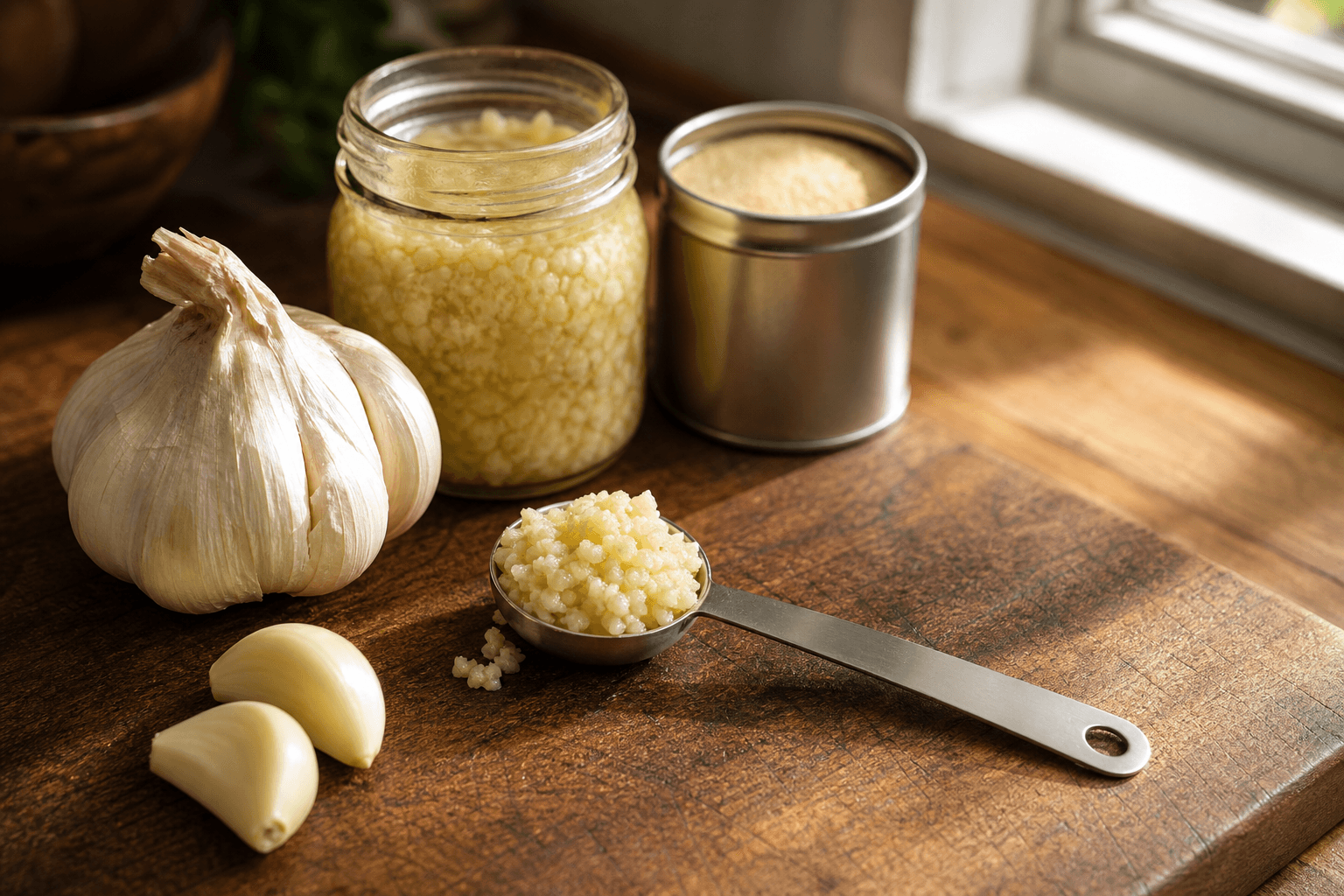
Garlic conversions at a glance
| Substitute | Ratio | Best for | Watch out |
|---|---|---|---|
| Fresh minced garlic | 1 medium clove = about 1 tsp minced | Everything | Clove size varies a lot. Weigh when a recipe is fussy. |
| Jarred minced garlic | 1:1 with fresh, about 1 tsp per medium clove | Sauces, marinades, weeknight cooking | Packed in acid, so it tastes duller. Many charts print 1/2 tsp per clove; use 1 tsp and taste. |
| Garlic powder | 1/8 tsp = 1 small clove | Dry rubs, dressings, high-heat searing | Roughly 8 times stronger than fresh minced by volume, and it scorches. |
| Dried/instant minced garlic | 1/4 tsp = 1 small clove | Soups, braises, dry mixes | Rehydrate it in a spoonful of the recipe's liquid first. |
| Garlic salt | 3/4 tsp = 1 medium clove | Seasoning blends and rubs | Cut the salt the recipe calls for. Colorado State prints 1/2 to 1 tsp per small clove. |
| Garlic by weight | 1 clove = 3 g, 3 cloves = 9 g, 1 tsp = 2.8 g, 1 cup = 136 g | Big batches, pickling, confit | USDA's weights describe an average clove. |
| Asafoetida (allium-free) | A pinch bloomed in hot oil | Low-FODMAP cooking | Much stronger than garlic. Start with less than you think. |
A head of garlic usually holds somewhere around 10 to 12 cloves, a rough working figure rather than a measured one.
How to swap minced garlic for whole cloves
- Count the cloves and multiply by 1 teaspoon. Four cloves comes to about 4 teaspoons.
- Pick the form you actually have. Fresh and jarred both go in at 1 teaspoon per medium clove. Garlic powder goes in at 1/8 teaspoon per small clove, dried minced garlic at 1/4 teaspoon.
- Adjust the timing. Jarred garlic is milder than fresh, so drain the liquid off the spoonful and add it earlier than you would add fresh.
- Bloom the dry forms. Stir garlic powder into fat or liquid before the pan gets hot, and give dried minced garlic a few minutes in a spoonful of the recipe's liquid.
- Taste before you add more. Clove size is the biggest variable, and you can always stir in another quarter teaspoon.
- If you reach for garlic salt, pull back the salt elsewhere. NDSU Extension puts 3/4 teaspoon of garlic salt at one medium clove, and Colorado State's chart adds the instruction to cut the salt the recipe calls for.
What changes when you swap the garlic
Fresh minced garlic is the sharpest of the group, and the only one that keeps its bite when added at the end. Jarred minced garlic is acidified for shelf stability, which is why it tastes flatter. That acid is easy to notice in a dish with a short ingredient list and easy to miss in a long-simmered sauce.
Texture moves too. Fresh and jarred garlic leave small pieces that soften and brown in fat, while powder and dried granules dissolve. When you want to bite into the garlic, as in a garlic butter, the dry forms won't get you there.
When not to substitute for fresh garlic
Where garlic is the headline flavor, use fresh. Aioli, garlic bread and a plain aglio e olio put garlic in front of everything else, and jarred garlic's acid packing shows up immediately.
Heat is the other limit. Garlic powder burns fast and so does fresh garlic. Add either after the other aromatics have softened, or bloom it in fat off the heat.
Why garlic conversion charts disagree
The published numbers conflict because of the clove each chart has in mind. USDA's 3-gram figure describes an averaged clove, which works out to about a teaspoon minced. NDSU Extension's chart is written around a small clove, and its garlic salt row implies half a teaspoon of fresh minced per clove. The USDA weight is the harder number, so 1 teaspoon is the figure to use.
One figure floating around online is simply wrong. Charts that tell you 1 teaspoon of garlic powder replaces one clove are off by roughly eight times. NDSU, Colorado State and Mississippi State Extension all print 1/8 teaspoon per small clove.
Related swaps for garlic and other aromatics
Keep the printable ingredient substitution chart near the stove, check the fresh to dried herb conversion chart when the question is a herb rather than an allium, and read the onion substitutes if the whole aromatic base is gone. For pesto with no pine nuts, walnuts do the job.
Garlic conversion questions people ask
How much minced garlic equals one clove?
About 1 teaspoon. USDA FoodData Central puts a raw garlic clove at 3 grams and a teaspoon of garlic at 2.8 grams, so one medium clove is a slightly rounded teaspoon minced.
How much jarred minced garlic equals a clove of garlic?
That same teaspoon, swapped one for one with fresh minced. Jarred garlic is milder because it is packed in acid, so add it earlier and taste before you add more.
How much garlic powder equals one clove of garlic?
One-eighth of a teaspoon replaces one small clove, per NDSU, Colorado State and Mississippi State Extension. Use about 1/4 teaspoon for a large clove.
How many cloves are in a tablespoon of minced garlic?
About three. A tablespoon is 3 teaspoons, and one medium clove yields about a teaspoon minced.
Know how much garlic you already have
Most garlic swaps start with finding the head sprouted. Well Stockd's substitution engine suggests swaps from what is already in your kitchen when a recipe calls for something you are out of, frozen and canned forms included, and you can reject any swap you never want offered again. It also does expiration tracking and pantry inventory, so the garlic gets used while it is firm.
Sources: USDA FoodData Central, NDSU Extension FN198, Colorado State Extension 9.329, Mississippi State Extension, Tasting Table.
Need a different swap? See the full list of Garlic substitutes.
Quick planning number: see the Garlic fridge shelf-life reference.