Can I use milk instead of heavy cream?
Whether milk works in place of heavy cream, with exact ratios for the straight swap, milk plus melted butter, evaporated milk and starch-thickened milk, plus the dishes where the swap fails.
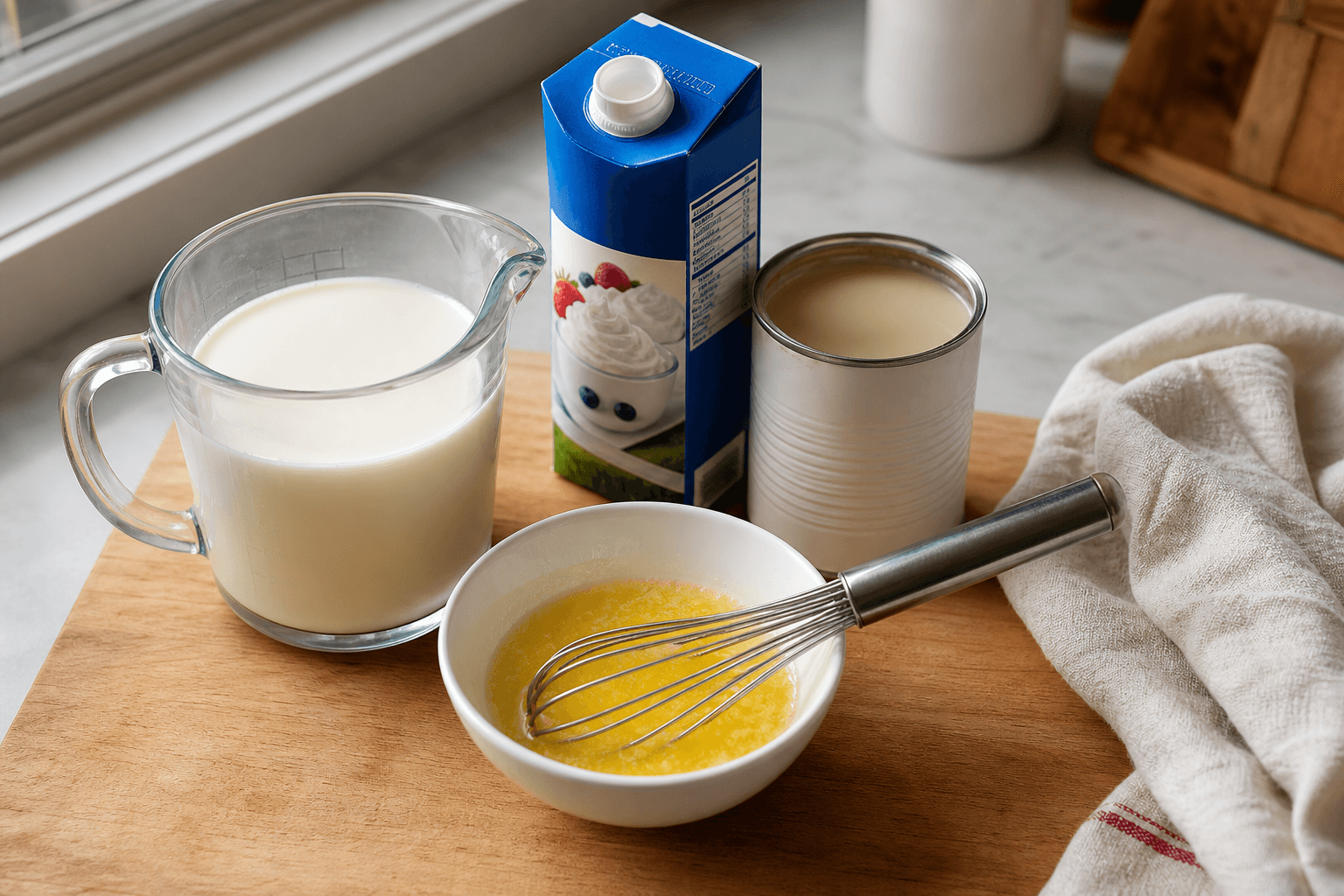
Yes for baking and thin sauces, no for whipping or reducing. Heavy cream is at least 36% milkfat under the FDA standard of identity, and whole milk runs about 3%, so what you are short on is fat. In most cooked and baked dishes you can put the fat back: 3/4 cup milk plus 1/3 cup melted butter makes 1 cup of heavy cream substitute. Plain milk will never whip, however cold your bowl is.
Milk substitutes for heavy cream at a glance
| Substitute | Ratio | Best for | Watch out |
|---|---|---|---|
| Whole milk, straight swap | 1 cup milk for 1 cup heavy cream | Quick breads, muffins, pancakes, custard bases, scrambled eggs, mashed potatoes, coffee | Only works where the cream was acting as a liquid. Anything leaning on cream for body or reduction comes out thin |
| Milk plus melted butter | 3/4 cup milk + 1/3 cup melted butter = 1 cup heavy cream | Sauces, soups, casseroles, richer bakes | Will not whip. The butterfat is not dispersed as the microscopic globules whipping requires |
| Evaporated milk | 1 cup evaporated milk = 1 cup heavy cream | Soups, sauces, baked pasta, pumpkin pie | Purdue Extension files undiluted evaporated milk under light cream at 18 to 20% fat, so the result is lighter than true heavy cream |
| Milk plus cornstarch or flour | 1 Tbsp cornstarch, or 2 Tbsp all-purpose flour, per cup of milk | Gravies, chowders, creamed vegetables, pan sauces | Gives thickness, not richness. A starch-thickened milk sauce reads a little chalky next to cream |
| Milk for whipped cream | Not applicable | Nothing | Cream needs at least 30% milkfat to hold a foam. Milk is nowhere near it |
How to swap milk for heavy cream
- Measure 3/4 cup whole milk for every 1 cup of heavy cream the recipe calls for.
- Melt 1/3 cup butter and let it stand a minute so it is warm rather than hot. That dose is from the Purdue and NDSU Extension substitution table (FN198). Many recipe sites call for 1/4 cup instead, a lighter version that still works in baking.
- Take the chill off the milk before you combine them. Warm butter hitting cold milk seizes into little flecks.
- Pour the butter into the milk in a thin stream while you whisk, then use it right away, 1 cup for 1 cup.
For the starch route, whisk 1 Tbsp cornstarch into a few tablespoons of cold milk until it is smooth, then stir that slurry into the rest of the milk and heat it. Purdue's table also gives 2 Tbsp all-purpose flour as the equal of 1 Tbsp cornstarch, if flour is what you have.
What changes when you use milk instead of heavy cream
Fat carries flavor and coats your tongue, so a milk version of a cream dish tastes cleaner and thinner. In baking, that is usually fine. The flour, eggs and sugar are doing the structural work, and a milk swap in muffins or a quick bread mostly shows up as a slightly less tender crumb. On the stovetop the gap is obvious within minutes: cream clings to the back of a spoon, milk stays loose in the pan.
Evaporated milk is the closest drop-in for cooked dishes, because the water is already out of it. Use it 1 cup for 1 cup in soups, sauces, baked pasta and pumpkin pie. Just know what you are getting. Purdue lists 1 cup of undiluted evaporated milk as the stand-in for light cream at 18 to 20% fat, well under heavy cream's 36%, so the finished dish lands lighter. Going the other way, 1/2 cup evaporated milk plus 1/2 cup water gives you 1 cup of whole milk.
When not to use milk instead of heavy cream
Whipped cream is out. America's Test Kitchen whipped light cream and half-and-half and found both "remained liquid no matter how long we whipped them," and Iowa State Extension's AnswerLine puts the floor at 30% milkfat for a foam that holds. Whole milk is around 3%. Stirring melted butter into it does not fix the problem either, because whipping needs fat suspended as tiny globules, which melted butter does not provide.
Reduced sauces are out too. Milk breaks or goes watery long before it thickens into something that coats pasta or chicken. If reduction is the point of the recipe, use the butter version or evaporated milk.
Then there is curdling, the one that ruins dinner. Fat protects milk proteins from acid and heat, and milk has much less of it than cream, so milk splits in tomato sauces, wine pan sauces and anything with lemon far more readily. Temper it first by stirring a ladle of the hot liquid into the milk, then add that mixture back to the pot. Once the milk is in, keep the pot below a boil.
Related heavy cream and milk swaps
A soup and a pasta sauce fail differently, so the fixes differ: see substitute for heavy cream in soup and substitute for heavy cream in pasta sauce. If the recipe wants buttermilk and you have plain milk on the door, the buttermilk substitute is a two-ingredient fix. For everything else, keep the printable ingredient substitution chart on the fridge.
Let your kitchen list find the milk swap for heavy cream
Well Stockd's substitution engine reads what is already in your kitchen and suggests swaps when a recipe calls for something you are out of. Frozen and canned forms count as matches, and you can reject any suggestion you would rather not see again. It runs off the same list that tracks what is about to expire, so the milk gets used before it turns. If you would rather start from the shelves, the pantry inventory app guide covers the setup.
Milk instead of heavy cream: common questions
Can I use milk instead of heavy cream?
In baking and thin sauces, yes. For whipping, reducing, or a rich cream sauce, no. Add melted butter or use evaporated milk instead.
How much butter do you add to milk to make heavy cream?
1/3 cup melted butter to 3/4 cup milk makes 1 cup. It cooks and bakes like cream, and it will not whip.
How much fat is in heavy cream versus milk?
Heavy cream is at least 36% milkfat by the FDA standard. Whole milk is roughly 3%.
Can you whip milk with butter in it?
No. Whipping needs at least 30% milkfat present as suspended fat globules, and melted butter stirred into milk does not create them.
Sources: FDA 21 CFR 131.150, heavy cream standard, Purdue Extension and NDSU Extension FN198 substitution table, America's Test Kitchen, whipping light cream vs heavy cream, Iowa State University Extension AnswerLine, whipped cream tips.