How long can leftovers sit out before refrigerating?
USDA rules say perishable leftovers need to go into the fridge within 2 hours, or 1 hour if it's above 90°F. This covers the timing breakdown, spoilage signs, and how to store leftovers so they last.
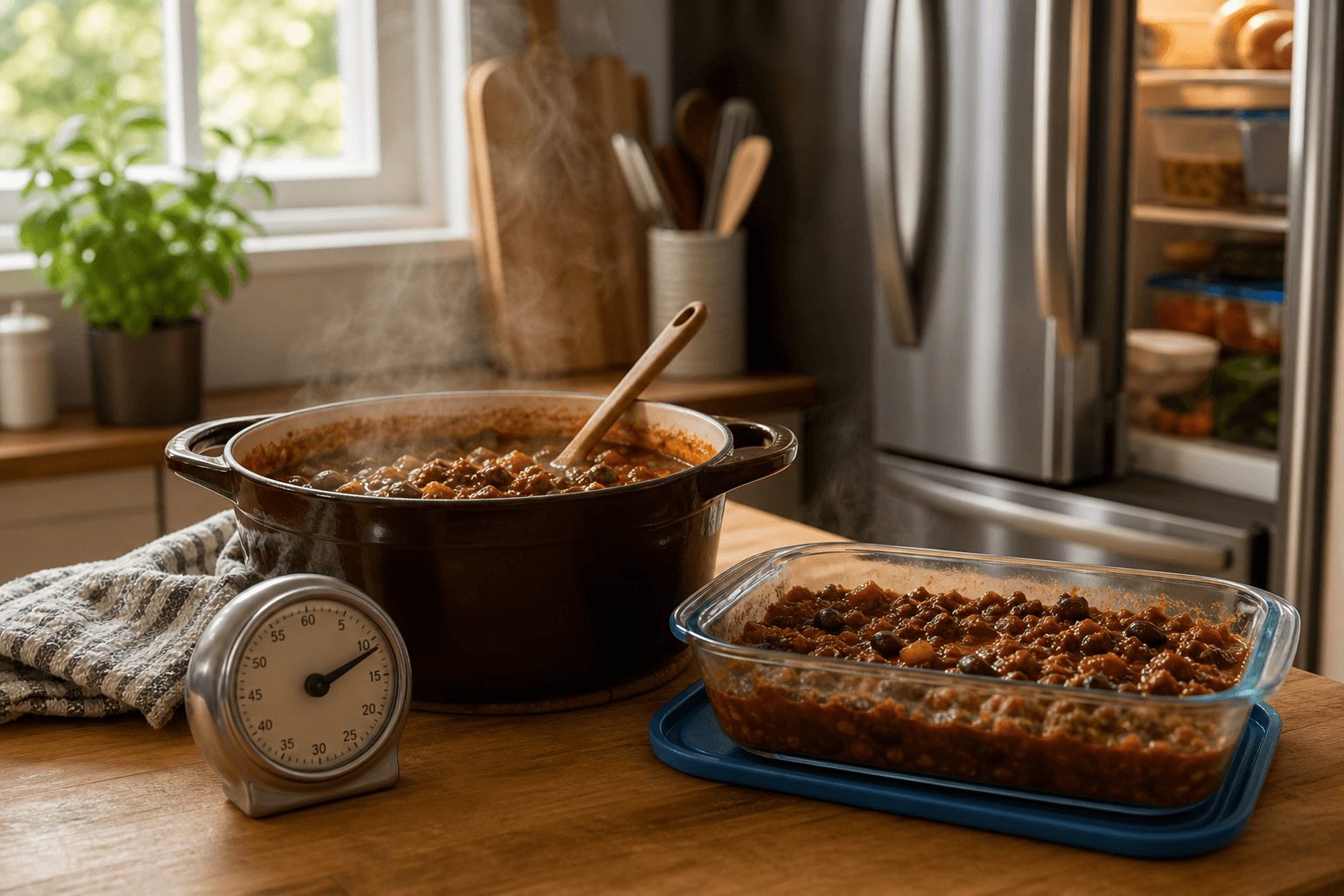
Two hours is the cutoff. USDA guidance says cooked leftovers and other perishable food need to go into the refrigerator within 2 hours of cooking, or within 1 hour if it is 90 degrees Fahrenheit or hotter outside. Past that window, throw the food out rather than risk it.
That window exists because of what USDA calls the "danger zone," the range between 40°F and 140°F where bacteria multiply fastest. Left in that range, bacteria that cause foodborne illness can double in number in as little as 20 minutes. A pot of chili cooling on the stove or a tray of pasta salad on a picnic table sits squarely in that zone the whole time it is out, which is why the clock starts the moment the food stops being actively cooked or actively chilled.
How long can food sit out before it needs to go in the fridge?
The base rule is easy enough. It's the exceptions (hot cars, warming trays, an overnight mishap) that catch people off guard.
| Situation | Maximum time at room temperature |
|---|---|
| Normal indoor temperature, 90°F or below | 2 hours |
| Hot weather or a hot space, 90°F or above (cars, patios, tailgates, outdoor buffets) | 1 hour |
| Food actively held hot on a warming tray, chafing dish, or slow cooker set to warm, above 140°F | No time limit, as long as it stays above 140°F |
| Any perishable food already past the 2 hour or 1 hour mark | Discard it, do not taste it to check |
The clock covers the whole stretch food is out, not just the time on the counter after a meal ends. If a roast came out of the oven at 6 p.m. and sat there while everyone ate and talked, it needs to be in the fridge by 8 p.m. at the latest. If you're not sure how long something sat out, whether it was left overnight by accident or forgotten in a hot car, treat it as expired rather than guess.
For a broader look at how long other foods keep once they are properly stored, the how long does food last guide covers fridge and freezer timelines across categories.
How to tell if it has gone bad
Once leftovers are safely refrigerated, the usual signs of spoilage still apply: a sour or off smell, a slimy or tacky texture, visible mold, or a change in color. Trust your nose and your eyes before you trust the calendar.
The bacteria that cause food poisoning, such as Salmonella, Listeria, and Staphylococcus aureus, usually don't change how food smells, tastes, or looks. Food that sat out too long can seem completely normal and still make you sick, which is why the time rule matters more than a sniff test. If leftovers sat out past 2 hours (or 1 hour in the heat), toss them even if nothing about them seems wrong.
Rice is a special case. A common spoilage bacteria in cooked rice, Bacillus cereus, forms heat-resistant spores that survive cooking and then multiply at room temperature without any obvious warning signs. If rice is part of what you're dealing with, see how long does cooked rice last in the fridge for the specifics.
How to store it so it lasts
Getting leftovers into the fridge within the time window is only half the job. A few habits help them stay safe and taste better for longer:
- Split large batches of soup, stew, or casserole into smaller, shallow containers so the middle cools quickly instead of staying warm for hours inside a deep pot.
- Don't pack the fridge so tightly that cold air can't circulate around new containers.
- Keep your refrigerator at 40°F or below, and check it with a fridge thermometer if you're not sure it's running cold enough.
- Label containers with the date you cooked or stored the food, since "3 to 4 days" is easy to lose track of once a few things are stacked in there.
- Reheat leftovers to an internal temperature of 165°F, checked with a food thermometer, or until soups and sauces are at a rolling boil.
Raw meat and poultry follow a stricter set of rules even before they are cooked, since they carry a higher risk of contamination going in. If chicken is part of this week's meal prep, how long does raw chicken last in the fridge breaks down those timelines separately.
Can you freeze it?
Yes, and freezing is a good option if you know you won't get to something within 3 to 4 days. Cooked leftovers frozen at 0°F or below stay safe to eat indefinitely, though quality starts to slip after 3 to 4 months. That shows up as freezer burn or a change in texture, not a safety risk.
Freeze leftovers in airtight, portion-sized containers or freezer bags as soon as you know you won't eat them in time, ideally while they are still fresh rather than waiting until day three or four. Thaw them in the refrigerator, in cold water, or in the microwave, never on the counter, since thawing at room temperature puts the food right back in the danger zone.
When in doubt
USDA's food safety guidance comes back to one simple line again and again: when in doubt, throw it out. You can't see, smell, or taste dangerous bacteria, so if you're unsure how long something sat out, or it has been in the fridge past the 3 to 4 day mark, the safest choice is to skip it rather than gamble on it.
Keeping track of when leftovers went into the fridge is often the harder part, not the rule itself. A tool like the food expiration tracker app from Well Stockd lets you log the time food went in and get a reminder before the 3 to 4 day window closes, so you're working from a date instead of a guess.
Frequently asked questions
Does it still count if the food was covered or in the fridge, just not cold yet? Yes. The clock is about time in the danger zone, not whether a lid was on. A covered dish left on the counter still sits in the danger zone, so bacteria grow the same way they would in an uncovered one.
What if leftovers were left in a hot car or on a counter overnight? Throw them out. Both situations mean the food sat well past the 1 or 2 hour limit, and no amount of reheating makes food safe again once bacteria have had time to grow.
Is food safe if it still smells and looks fine after sitting out too long? Not necessarily. Many of the bacteria responsible for foodborne illness don't change a food's smell, taste, or appearance, so normal-looking leftovers can still be unsafe if they exceeded the time limit.
Updated July 2026.
Sources: USDA Food Safety and Inspection Service, "Leftovers and Food Safety"; USDA FSIS, "Danger Zone (40°F - 140°F)"; USDA Ask USDA, "What is the 2-Hour Rule with leaving food out"; USDA FSIS, "Safe Handling of Take-Out Foods."