Is it safe to eat leftovers after 7 days?
USDA caps cooked leftovers at 3 to 4 days, so day 7 is three days past the line. Here is what changes in the fridge over that week, the answer for the foods people ask about most, and the two leftovers that genuinely keep seven days.
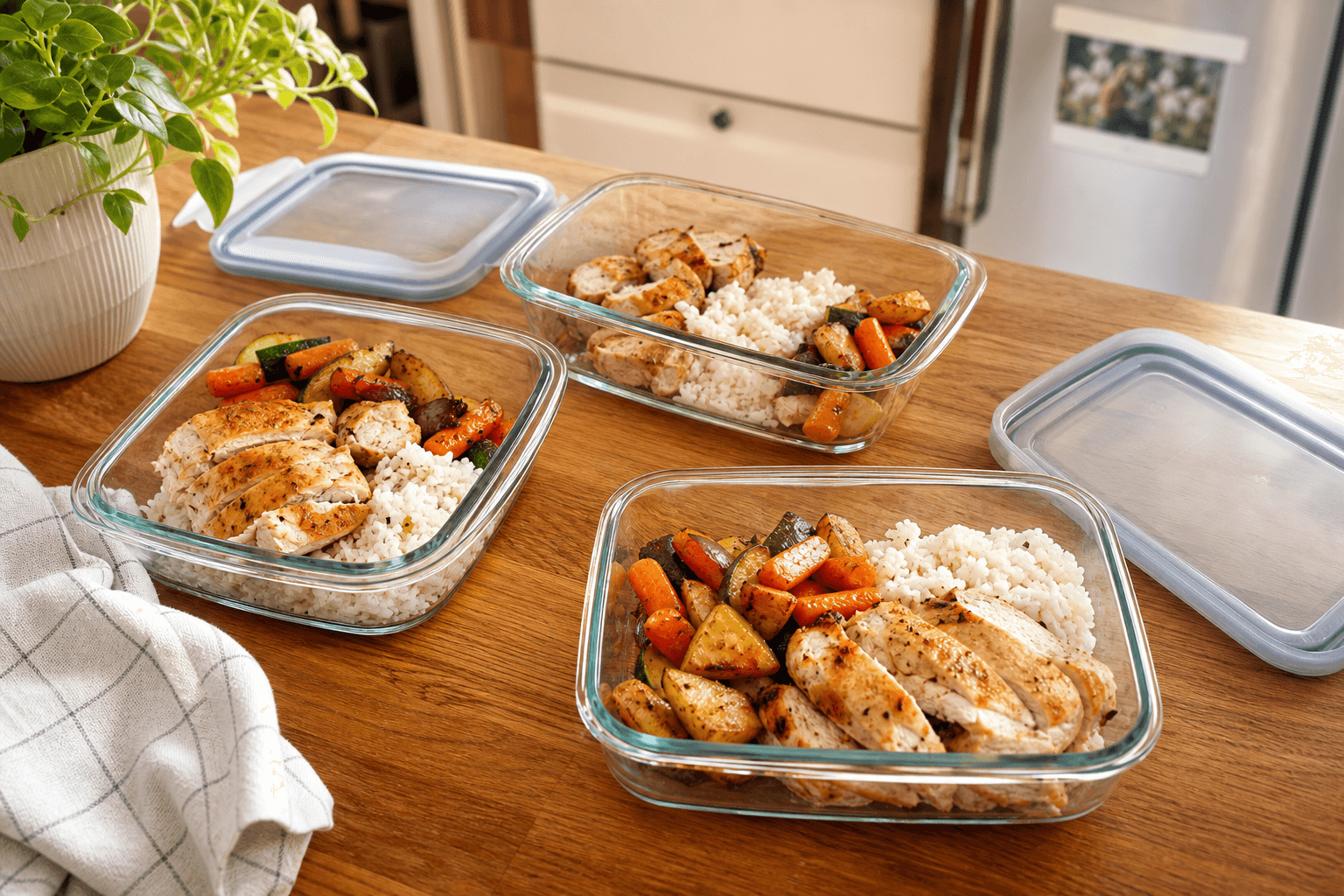
No. The USDA says cooked leftovers are safe in the refrigerator for only 3 to 4 days, so day 7 is past the safety window. Throw leftovers out after day 4, even if they still look and smell fine. Harmful bacteria don't always change how food looks or smells.
For other foods in your fridge, our general guide to how long food lasts covers produce, dairy, and pantry staples too.
For the full food-by-food table, poultry, rice, soups, pizza and more, fridge and freezer, see the complete leftovers storage chart. This article is about the specific question of day 5, day 6 and day 7.
Why the USDA rule stops at day 4
FSIS publishes one window for cooked leftovers: 3 to 4 days in the refrigerator, or 3 to 4 months frozen. Its refrigeration fact sheet says the same thing in fewer words: "a general rule of thumb for refrigerator storage for cooked leftovers is 4 days".
That is not a measurement of when a dish turns. It is where USDA stops being able to call a container safe without knowing how fast it cooled, how cold your fridge runs, and how often the door has opened since. Some of the margin was gone before the lid went on: bacteria multiply fastest between 40°F and 140°F, some doubling in as little as 20 minutes, so a deep pot that cooled slowly on the counter starts day 1 behind.
What changes in a fridge between day 4 and day 7
A refrigerator slows bacterial growth rather than stopping it, and it does not slow every kind equally. FSIS divides the bacteria in a fridge into two completely different families: pathogenic bacteria, which cause foodborne illness, and spoilage bacteria, which make food deteriorate and develop off odors, tastes and textures. Its wording on the first group decides this question. Pathogens "do not generally affect the taste, smell, or appearance of a food. In other words, one cannot tell that a pathogen is present."
Spoilage bacteria are the ones that grow well in the cold, and they are why leftovers turn sour or slimy: a quality problem. The trap on day 7 is that the two families run on separate clocks, so a container can carry enough of a pathogen to make you ill and still smell like the dinner it was.
Listeria monocytogenes is the clearest case. Unlike most foodborne bacteria it thrives at cold temperatures and will multiply in the refrigerator over time, with a growth range as low as 31°F. Day 7 hands it three more days at a temperature it is comfortable in. Listeriosis is uncommon, and FSIS notes it is most likely to seriously sicken pregnant women, adults 65 or older, and people with weakened immune systems.
Day 7, food by food
- Cooked rice. The 3-to-4-day rule applies, and USDA FoodKeeper lists plain cooked rice at 4 to 6 days when it was cooled fast, sealed, and held at 40°F or below. Day 7 is past both. Rice also carries Bacillus cereus, which survives cooking and can leave a toxin that reheating does not destroy. More in how long cooked rice lasts in the fridge.
- Cooked chicken. 3 to 4 days, like any cooked poultry dish, whether it started as a roast or a rotisserie bird. Cooked chicken after 5 days covers the earlier call.
- Pizza. The cold food storage chart gives pizza 3 to 4 days, the same as everything else cooked.
- Soup and stew. 3 to 4 days. A big pot is the riskiest version, because a deep container cools slowly through the middle and starts with less margin.
- Pasta. Plain or sauced, it is a cooked leftover on the 3-to-4-day clock. A meat or dairy sauce does not extend that.
- Cooked ground beef. 3 to 4 days. Grinding mixes surface bacteria through the batch, which is why raw ground beef gets only 1 to 2 days, and cooking it does not buy the leftovers extra time. Cooked ground beef after 7 days walks through it.
The two leftovers that really do keep a week
Hard-cooked eggs keep 1 week in the refrigerator, shell on or peeled. That is USDA's own entry for the food, not a rounding of the leftovers rule, so a batch boiled last Sunday is still fine the following Saturday. The same chart says not to freeze them.
A whole fully cooked ham, store-wrapped, is the other one: 1 week refrigerated, and 7 days on FDA's chart. Halves and spiral-cut ham drop to 3 to 5 days and slices to 3 to 4, so the exception is the intact ham, not the plate you carved off it. For ways to use up a ham, see what to do with leftover ham.
Opened deli meat sits just outside at 3 to 5 days. Everything else that came off a stove is on the 3-to-4-day clock.
Freeze it on day 3 and the question never comes up
FSIS's freezing guidance carries the line that settles this: freeze leftovers within 3 to 4 days. Food held constantly at 0°F will always be safe, so the 3-to-4-month freezer figures are about flavor and texture, not safety. For leftover prime rib specifically, see what to do with leftover prime rib.
The habit that works is day 2 or day 3, not day 4. On day 4 you are deciding under pressure with no margin left if the fridge ran warm. On day 3 the food is still at its best and comes back out as a meal instead of a judgment call. How long leftovers last in the freezer has the quality windows by dish.
All of that depends on remembering which day the container went in, so label with the date you cooked the food, not the date you plan to eat it. If you tend to lose track, our guide to using an app to track food expiration dates walks through how to automate that reminder so day 4 doesn't sneak up on you. The printable refrigerator shelf-life chart is the low-tech version, for the fridge door.
Frequently asked questions
What happens if you eat leftovers after 7 days?
You are not guaranteed to get sick. It depends on which bacteria are present and how the food was handled, but the risk climbs past the 3-to-4-day mark and you cannot read it off the container. That is why USDA's standing advice is when in doubt, throw it out.
Does reheating to 165°F make week-old leftovers safe?
No. Reheating to 165°F is what FSIS asks for on every reheat and it kills the bacteria present, but it does not undo the week. Some bacteria leave heat-stable toxins behind, and Bacillus cereus in leftover rice is the everyday example: the toxin outlasts the reheat that kills the bacterium. Reheating is a step you take inside the window, not a way to extend it.
Why do leftovers still look and smell fine on day 7?
Because the bacteria that spoil food and the bacteria that make you ill are different families. Spoilage bacteria grow in the cold and eventually announce themselves; pathogens, in FSIS's words, "do not generally affect the taste, smell, or appearance of a food." A sniff test on day 7 tells you about quality, not safety, which is why you cannot always tell if leftovers are bad by smell.
Sources: USDA FSIS, Leftovers and Food Safety; USDA FSIS, Refrigeration and Food Safety; USDA FSIS, Listeria Questions and Answers; USDA FSIS, Freezing and Food Safety; FoodSafety.gov, Cold Food Storage Chart.
Track it in Well Stockd
Add what you have, see what you can cook tonight, and get a reminder before anything goes off.
