Casserole Left Out Overnight: Is It Safe to Eat?
A casserole left out overnight is not safe to eat. The USDA two-hour rule, the oven-turned-off case, and how to cool and store a casserole properly.
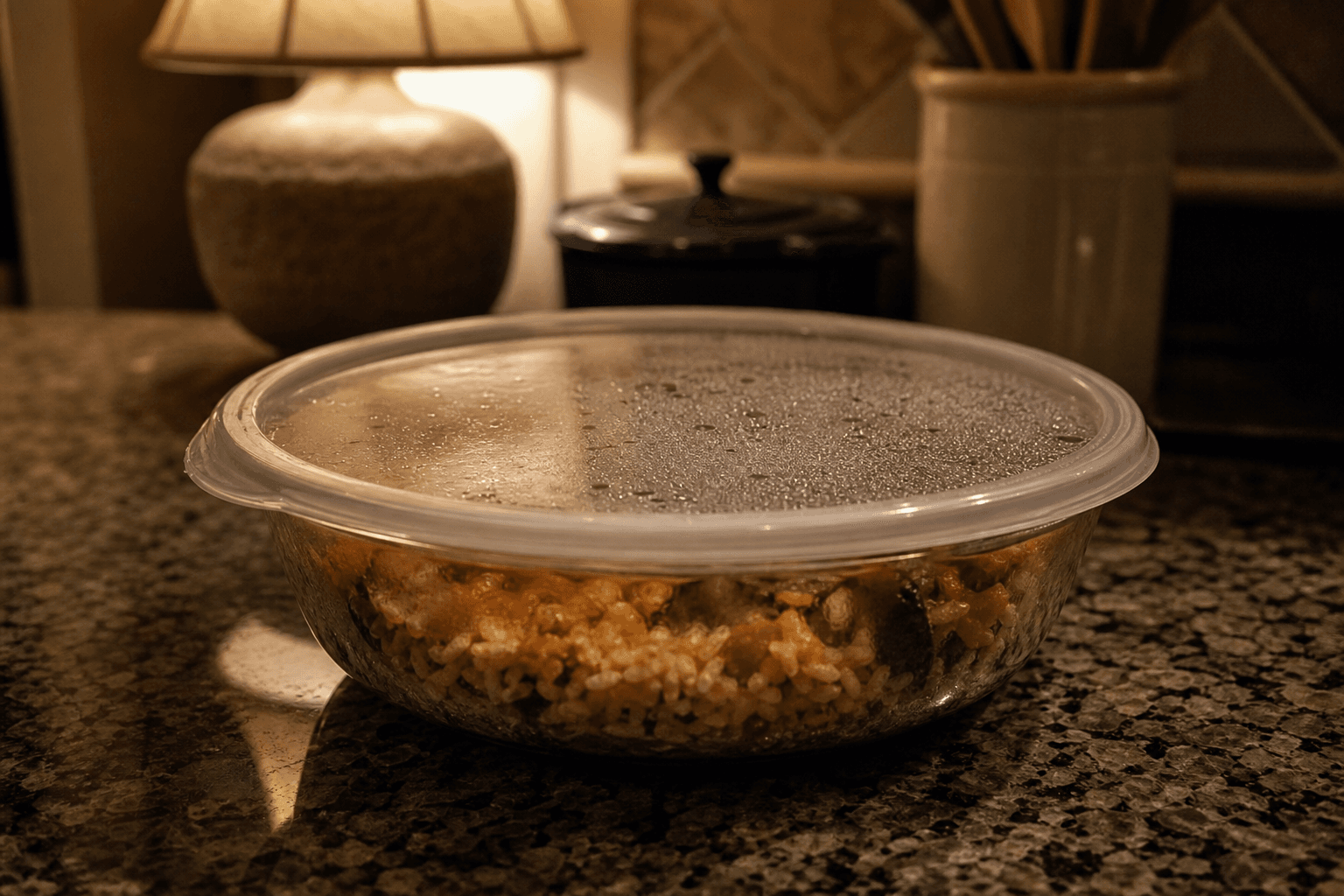
A casserole left out overnight is not safe to eat, according to USDA guidelines. Perishable food can sit at room temperature for two hours at most, and a full night is far past that. Throw it out, and do not try to bake it back.
Casserole is a category rather than one dish. A chicken and rice bake, a green bean casserole and a lasagna all land on the same question and get the same answer, because each of them holds dairy, cooked starch or cooked meat. The rule covers every perishable leftover, and the general guide to food left out overnight has the long version.
How long can a casserole sit out?
Perishable food can sit at room temperature for a maximum of two hours before it has to go back in the fridge, and above 90 F that window is one hour (FSIS, Leftovers and Food Safety). USDA calls 40 F to 140 F the danger zone, because bacteria can double in number in as little as 20 minutes in that range (FSIS, Danger Zone).
A casserole is deep and dense, which is the worst shape for cooling. The edges reach room temperature while the middle stays warm for hours. The sibling page on chicken broth left out overnight follows the same clock, and how long leftovers can sit out before refrigerating has the timing detail.
| Storage method | Safe storage time |
|---|---|
| Room temperature (40 F to 140 F) | Up to 2 hours, or 1 hour above 90 F |
| Refrigerator (40 F or below) | 3 to 4 days (FoodSafety.gov cold food storage chart) |
| Freezer (0 F) | Safe indefinitely, best quality within 3 to 4 months |
Does it matter what is in it?
It does not. Every row below ends in the same place.
| What is in it | Why people think it is safer | What actually happens |
|---|---|---|
| Cheese or cream sauce | It was baked hot and sealed under a crust | Dairy follows the two-hour rule like everything else |
| Cooked pasta or rice | Dry grains keep for months in the cupboard | Once cooked, starch is perishable and carries its own hazard |
| Cooked chicken or beef | The middle stayed hot the longest | The middle also spent the longest in the danger zone |
| Eggs | A set custard looks preserved | Egg dishes are perishable, on the same clock |
| Canned soup base | Cans keep for years | Opened, heated and mixed in, it is an ordinary perishable food |
| Vegetables | Vegetables feel low risk | Mixed into a moist dish, they fail the same test at the same time |
A casserole left in the oven overnight
A switched-off oven does not protect the dish. It is an insulated box, so it holds warmth in and the casserole falls through the danger zone more slowly than it would on the counter. Throw it out.
An oven left on a warming setting does not rescue it either. Food held above 140 F stays out of the danger zone, but you cannot verify in the morning that your oven held that temperature for eight hours, and we will not give you a number for an appliance we cannot check.
Does baking it again make it safe?
No. Some bacteria produce heat-stable toxins while the food sits out, and those toxins survive cooking (FSIS, Leftovers and Food Safety). Putting the dish back in a hot oven kills active bacteria and leaves the toxins where they are.
If the casserole contains rice or pasta, there is a second reason. Bacillus cereus spores survive cooking, and at room temperature they can grow and produce cereulide, a heat-stable toxin that reheating does not reliably destroy (FDA Bad Bug Book, UF IFAS Extension).
The 165 F reheating figure applies to leftovers you refrigerated promptly. For the repeat-reheating question, see is it safe to reheat leftovers twice.
What if it was covered with foil, or the kitchen was cold?
Neither is an exception. Foil keeps dust off and holds warmth in, which is the opposite of what you need. A cool kitchen is not a refrigerator either: the line that matters is 40 F, and a room that feels chilly to you is usually well above it.
How to tell if a casserole has gone bad
A sour or yeasty smell, a slimy surface or any visible mold means the dish is finished. Those signs are worth knowing for a casserole that has been in the fridge for a few days.
They cannot clear a dish that stood out overnight. A baked top hides a great deal, so the crust can look perfect while the layers underneath spent eight hours in the danger zone, and bacteria that cause illness do not reliably change smell, color or texture. The smell test tells you about spoilage, not about safety.
Keep or toss
| Situation | How long it was out | Verdict | Why |
|---|---|---|---|
| Refrigerated soon after the meal | Under 2 hours | Keep | Inside the two-hour window |
| Covered with foil on the counter | Overnight | Toss | Foil blocks dust, not bacterial growth |
| Uncovered on the counter | Overnight | Toss | Hours in the danger zone |
| Left in the oven, switched off | Overnight | Toss | An off oven slows cooling rather than helping it |
| Left in the oven on a warming setting | Overnight | Toss | You cannot verify it held above 140 F all night |
| Brought home from a potluck, then left out | Overnight, plus the journey | Toss | The time out of the fridge started before you got home |
| Kitchen above 90 F | Overnight | Toss | The window there is one hour |
| Still warm when you found it | Overnight | Toss | Warmth means it was in the danger zone, not that it is safe |
How to cool and store a casserole properly
Do not put the whole hot pan in the fridge and hope. A deep dish cools slowly even in the cold. Portion the casserole into shallow containers instead, so it loses heat from a wide surface, and refrigerate it within two hours. Hot food can go straight in, and whether to put hot food in the fridge right away covers the detail.
A casserole then keeps 3 to 4 days in the fridge. Date every container, and if containers go missing at the back of the shelf, keeping track of leftovers in the fridge fixes that.
A dish cooked for a table is the one that gets left out, because nobody owns the clearing up. A shared kitchen shows everyone what went into the fridge and what still needs eating. Start the free trial
Can you freeze a casserole?
Yes, as long as it went into the fridge on time. Cool it fast in shallow containers, freeze it in labeled portions, thaw it overnight in the fridge and reheat it to 165 F. Creamy and potato-topped casseroles change texture more than tomato-based ones, and what you can and cannot freeze covers which is which.
When in doubt, throw it out
When in doubt, throw it out. That is the USDA fallback, and it is the whole answer here. A casserole is hours of work, often cooked for people you love, and none of that changes what happened to it overnight. If you have already eaten some and you feel unwell, contact a doctor.
FAQ
Is a casserole left out overnight safe to eat?
No. Perishable food can sit out for two hours at most, or one hour above 90 F. After a full night, throw it out.
Is a casserole left out overnight still good?
No. A baked top hides a great deal, and bacteria that cause illness do not reliably change the way food looks or smells. Overnight means throw it out.
Is a casserole left in the oven overnight safe?
No. An oven that has been switched off is an insulated box, so it slows cooling instead of helping it. The dish still spends the night in the danger zone.
Does baking a casserole again make it safe?
No. Some bacteria produce heat-stable toxins while food sits out, and those toxins survive cooking. Reheat only leftovers you refrigerated in time, to 165 F.
How long can a casserole sit out at room temperature?
Two hours at most, and one hour if the kitchen is above 90 F. Refrigerate it in shallow containers before that window closes.
Start free, then try the shared kitchen for 7 days once your first three fresh foods are in, with no card. One household, one plan, and no more dishes lost to the counter. Start the free trial